
Foreword
Alexander G. Tvalchrelidze, Academician of the Georgian Academy of Natural Sciences, Doctor of Sciences, Chairman of the Georgian State Department
Our short and, frankly speaking, mostly tragic experience of independent statehood cropped out an essential paradox – within the framework of free market relations functions and systems of governmental management of both mineral resource base (and fund) and geological survey should be significantly updated. In the Soviet Union the resource base have been considered as a political & economic category allowing the enormous country to survive in economic isolation from the democratic world. Basic attention was mostly paid to military security of the “labor State” and not to pragmatic imperatives of economic efficiency
That
is why everybody agreed with a model, when, for instance, the Tadjik uranium
ores were processed at the Urals secret plants. Exploitation of mineral
resources in the USSR was free. The added value originated at the first stage of
their processing only. Geological mapping, prospecting, exploration of mineral
resources including feasibility studies was a basic function of the USSR
Ministry of Geology whereas responsibility for excavation of ores and their
processing bear other sectoral ministries.
On the other hand, in countries developing according to the Anglo-Saxon macroeconomic model, the resource base is considered as a specific form of tangible property, which participates in international cash flows and creates economically rigidly determined added value via capitalization processes. From the macroeconomic point of view the resources base entirely or any its part may be sold, alienated, leased, landed, mortgaged, taken as warranty, given for exploitation, according to existing legislation, to any physical or legal person, etc.
As
far as the Georgian people expressed a hard desire to construct a democratic
state, which in near future would be integrated with the European Union and the
North Atlantic Treaty Organization, the Geological survey of the country should
be updated in a manner, which corresponds to the mentioned strategic goal. 
According to the Georgian organic and antimonopoly legislation in force, the highest governmental agencies implement the function of state governance determining the state policy of the sector, are entirely financed from the State Budget and have no right of routine economic activity. Therefore, the whole system of the Georgian geological survey has a three-stage structure as it is shown on the Figure below.
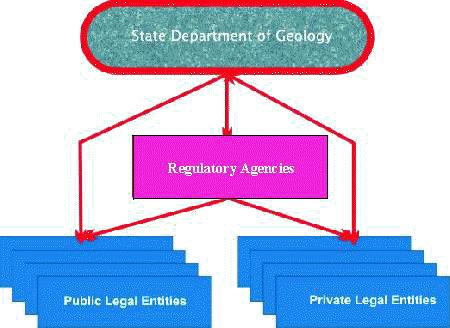
The figure clearly demonstrates that the basic state managerial body is presented by the State Department of Geology, which determines the state policy of the survey and mining in close and strategic perspectives via launching and managing sate programs.
Regulatory
agencies belong to structures of the intermediate stage of governance. Among
them the following ones should be mentioned:
Agency on State Reserves of Mineral Resources supporting activities of the State Commission on reserves;
Licensing bodies of geological and mining activities;
Supervision and control bodies.
 Routine
economic activities in fields of geological mapping, prospecting, exploration,
geological, hydrogeological, seismic, geodynamic, geoecological etc. monitoring
are executed by public and private legal entities as follows:
Routine
economic activities in fields of geological mapping, prospecting, exploration,
geological, hydrogeological, seismic, geodynamic, geoecological etc. monitoring
are executed by public and private legal entities as follows:
Central Geological Fund;
A. Tvalchrelidze Caucasus Institute of Mineral Resources;
JSC “National Geological and Mining Company”;
Engineering geological enterprise “Stikhia”;
Georgian Geological Expertise Agency;
National Center for Seismogeodeformation Studies;
State Agency for Protection of the Black Sea, Study and Exploitation of its Resources;
Survey of Engineering Regulation of Geological Hazards.
Thus, the geological survey of Georgia is able to solve complex state problems of the sector.
 At
present the essential work is being executed in order that with the help
of this web-site all necessary information can be got by all taking an interest
organizations and a private person about the Geological Survey of Georgia.
At
present the essential work is being executed in order that with the help
of this web-site all necessary information can be got by all taking an interest
organizations and a private person about the Geological Survey of Georgia.