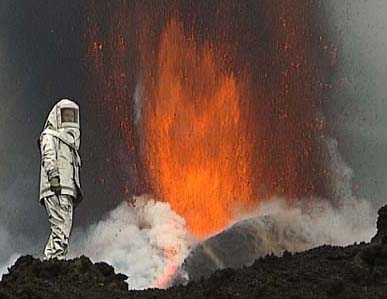
John Seach at Mt Etna on June 8th 2000.
The lava fountain is 800 m high.
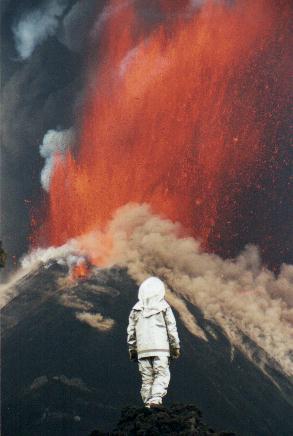
June 8th Paroxysm at SE crater at Mt Etna. This was one of the most beautiful eruptions
in years at Mt Etna. Lava fountain is 1 km away. Etna at it's best.
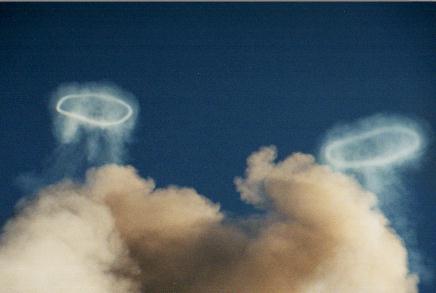
Gas Rings (smoke rings) from Bocca Nuova Crater, Mt Etna. These rings were produced at a rate of 100
per day over the months April to July 2000. They were up to 200 m in diameter, lasted up
to 17 minutes and rose to an atlitude of 5500 m. Gas rings have been seen at Etna as far back as 1910.
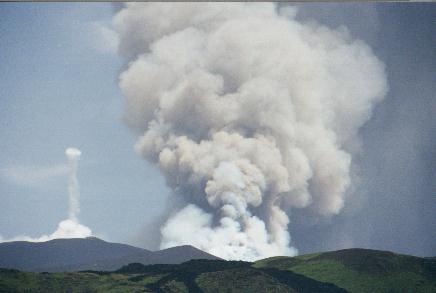
The paroxysm from SE crater,
Mt Etna, on June 14th 2000 from a distance of 10 km from the south of Mt
Etna.
A gas ring (smoke
ring) is forming above Bocca Nuova crater. Black lava flows from 1983 can
be seen in the foreground. Etna can produce lava flows which threaten villages.
Eruptions of Mount Etna Volcano
The first recorded eruption
of Mt Etna was in 1500 BC. Major eruptions have occurred in 122 BC, 1669,
and 1787.
The1669 eruption almost completely
destroyed the city of Catania. Mt Etna volcano is one of the world's
most active volcanoes. Dormant
periods are extremely rare. During 2000 there was a series of over 60 paroxysms
from
the SE crater. The paroxysms
have commenced again in June 2001 from a slightly different location. These
eruptions
were some of the most beautiful
ever seen on the volcano. Mt Etna is also a profilic producer of
gas rings (smoke rings).
Gas rings are an unusual
volcanic phenomenon.