|
Volcanic Eruption Events in New Zealand |
||||||||||||||||||||||||||||||||||||||||||||||||||||
New Zealand VolcanismThe New Zealand region is characterised by having
Although the probability of an eruption affecting a significant portion of the North Island is relatively low in any one year, the probability of one occurring in the future is high. The potential impacts of a large eruption event are great and the risk cannot be ignored. The timing of the next eruption of a volcano cannot yet be determined but its probable effects can reasonably be assessed. We can subdivide New Zealand's volcanoes either by type or by status. Status of New Zealand's VolcanoesThe National Civil Defence plan subdivides New Zealand's potentially active volcanoes into two classes: frequently active and re-awakening volcanoes. Frequently active volcanoes are characterised by numerous often prolonged eruption episodes over the last 150 years. Frequently active volcanoes include White Island, Tongariro-Ngauruhoe, and Ruapehu. Re-awaking volcanoes have been less active in historical times but have had numerous eruptions in the last 15,000 years. Re-awaking volcanoes include the Auckland Volcanic field, Mayor Island, Mt Edgecumbe, Okataina, Rotorua, Maroa and Taupo volcanic centres, and Taranaki (Mt Egmont). see New Zealand Volcanic Database Types of VolcanoNew Zealand's young volcanoes represent a cross-section of most of the types of volcanoes documented elsewhere in the world, the only type missing being an example of a modern basaltic shield volcano such as Kilauea or Mauna Loa in Hawai'i. In two respects, New Zealand's volcanoes are world-beaters: our cone volcanoes at Ruapehu, Ngauruhoe and White Island are among the most frequently active examples known; and Taupo and Okataina are the largest and frequently active rhyolite caldera volcanoes.
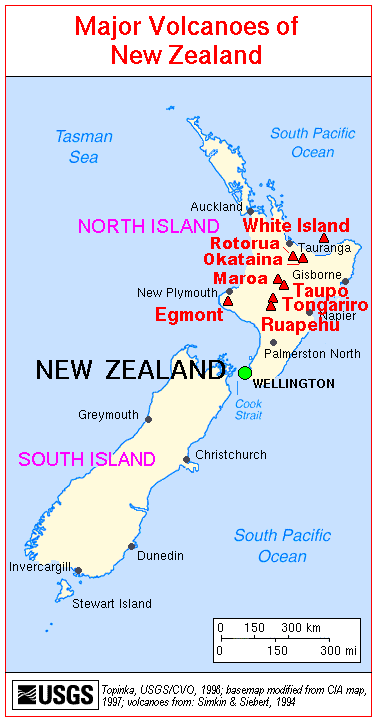
Map 1 New Zealand's VolcanoesVolcanic fields: Volcanic fields such as Auckland, are where small eruptions occur over a wide geographic area, and are spaced over long time intervals (thousands of years). Each eruption builds a single small volcano (e.g. Mount Eden, Rangitoto), which does not erupt again. The next eruption in the field occurs at a different location, and this site cannot be predicted until the eruption is imminent.
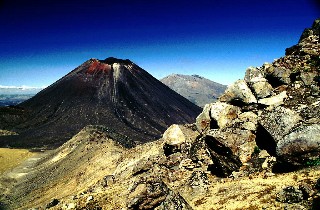
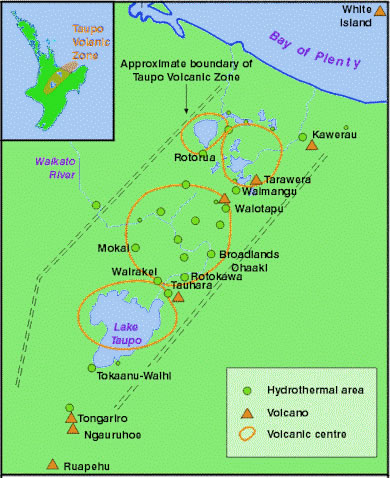
Caldera volcanoes: Caldera volcanoes such as Taupo and Okataina (which includes Tarawera) exhibit a history of moderate to large eruptions. Eruptions at these volcanoes are occasionally so large that the ground surface collapses into the "hole" (caldera) left behind by the emptying of the underground magma chamber. The pyroclastic products are usually spread so widely that no large cone forms, except where lava flows may pile up on top of each other to form a volcanic edifice (for example, Mt Tarawera). In the large caldera-forming eruptions, a lot of the erupted material accumulates within the caldera itself as it collapses, and the old land surface may be buried to several kilometres depth. Distribution of New Zealand's VolcanoesVolcanoes in New Zealand are not randomly scattered, but are grouped into areas of more intensive and long-lived activity, whose position (and the compositions of the magmas erupted) can be related to the large-scale movement of plates in the New Zealand region. Volcanic activity in New Zealand occurs in six areas (Map 1), five in the North Island and one offshore to the northeast in the Kermadec Islands. Most New Zealand volcanism in the past 1.6 million years has occurred in the Taupo Volcanic Zone, an elongate area from White Island to Ruapehu, which has been by far the most frequently active area, both in historic times and over the last 1.6 million years. Taupo Volcanic Zone (TVZ) is extremely active on a world scale; it includes three frequently active cone volcanoes (Ruapehu, Tongariro/Ngauruhoe, White Island) and the two most productive caldera volcanoes in the world (Taupo, Okataina). Volcanic FieldsNorthland and Auckland: Three volcanic fields occur in Northland and Auckland, where small individual eruptions occur at intervals of hundreds to thousands of years. The best known of these is the Auckland field, where around 50 small volcanoes have formed, Rangitoto being the youngest at about 600 years old. The magma is basaltic in composition, and eruptions tend to be small, and the areas affected are also small. The hazards are very localised (Johnston et al. 1997). However, the growth of New Zealand's biggest commercial centre almost exactly on top of one of these fields has led to much greater awareness of the risks posed by a potential renewal of activity in this area. Visit the Auckland Regional Council's volcanic site Cone VolcanoesEgmont: The modern cone of Egmont is only the latest in a series of cone volcanoes that stretches back in time for 1.7 million years. The older cones have now been eroded down to relics which form the Pouakai and Kaitake Ranges, and the Sugarloaf Rocks at New Plymouth. The main Egmont cone is about 130,000 years old, and has a complex history of multiple cone building episodes followed by cone collapse episodes when much of the cone was destroyed by huge debris avalanches. Most of the actual mountain that we see today is only about 10,000 years old and has rapidly built up since the last major collapse. The latest eruption where magma reached the surface is thought to have occurred in 1755 AD, so the volcano is considered to be dormant. Eruptive products of Egmont are andesitic to dacitic in composition. They form domes and lava flows that, together with some pyroclastic material, have built up the modern cone itself. Comparable volumes of pumice, scoria and ash have spread as thin pyroclastic fall and flow deposits beyond the cone. Tongariro/Ngauruhoe: Tongariro is a large (100 km3) cone volcano of which the youngest cone, Ngauruhoe, is the main active centre (Topping 1973). Tongariro, like Egmont, has been both built up by eruptions producing lava flows and pyroclastic material and has been partially destroyed on occasions in the past. However, the main destructive force at Tongariro does not appear to have been cone collapse, so much as erosion by ice during glacial periods. The oldest lavas from Tongariro are at least 340,000 years old, and occur in places that imply there was a substantial "Mt Tongariro" at that time. New work is showing that the modern cone has grown since 275,000 years ago, with intervals of cone building occupying a few thousand to tens of thousands of years (Ngauruhoe is only 2,500 years old) (Hobden et al. 1996). These cone-building periods are separated by times when either most activity was expressed as widespread pyroclastic deposits (which did not contribute much to cone building) or the volcano was much less active. In most eruptions the magma was andesite, but minor amount of dacite and basalt are also known here. The most prominent vent, Ngauruhoe, has been frequently active in recorded times, but has not erupted since 1975 and is now undergoing its longest break from activity in recorded history. Ruapehu: Ruapehu is New Zealand's largest cone volcano and, like Tongariro and Egmont, has been built up and partially destroyed on several occasions during its history (Hackett and Houghton 1989). The oldest dated lavas are 230,000 years old, but there has probably been a "Ruapehu volcano" for at least 0.5 million years. Destructive influences at Ruapehu include both cone collapse and glacial erosion, the latter continuing to the present day. Like Tongariro, Ruapehu has erupted mostly andesite, and only minor amounts of basalt and dacite have been found. Ruapehu is unusual among the cone volcanoes in having a crater lake which, in historic times, has greatly modified eruptive behaviour such that even small eruptions are accompanied by potentially dangerous mudflows or lahars. With the exception of the 1945 eruption, the lake has acted as a trap for magmatic heat and volatiles, so making it warm and highly acidic. Ejection of lake water leads to the formation of lahars, one of which in 1953 led to New Zealand's worst volcanic disaster, at Tangiwai. Only in 1945 was the lake displaced, and lava extruded at the surface during the largest volcanic eruption in New Zealand this century (Johnston and Neall 1995). White Island: White Island is the 320 m high emergent tip of a 17 km wide, 750 m high cone volcano largely submerged beneath the Bay of Plenty (Nairn et al. 1991). It is unusual in being one of the very few privately owned volcanoes in the world. White Island is currently New Zealand's most active volcano with three long cycles of eruption recorded between 1976 and 1994. Our knowledge of the earlier history of the volcano is severely limited by a lack of data on the age of prehistoric eruptions. This early history includes two major episodes of cone growth with both extrusion of lava flows and explosive eruptions. There are no recognisable products of primeval or historic activity preserved on the mainland. Historic activity included a small collapse of the west wall of the main crater in 1914, forming a debris avalanche which killed 11 sulphur miners. All subsequent events have been small explosive eruptions, linked to the formation of collapse craters through the 1914 deposits. Since 1976, White Island has erupted low-silica andesitic magma, whereas most early activity involved higher-silica andesite or dacite. Caldera VolcanoesThe youngest, and therefore potentially active, calderas within New Zealand are: Taupo: Taupo is a large caldera volcano, whose shape reflects collapse following two large eruptions about 26 500 and 1 800 years ago (Wilson 1993), although the volcano itself first began erupting about 300,000 years ago. The modern Lake Taupo partly infills this caldera structure. Taupo has erupted mostly rhyolite, with only minor amounts of basalt, andesite and dacite, and is the most frequently active and productive rhyolite caldera in the world. The eruptions are notable for varying enormously in size, up to the largest (26 500 years ago) which ejected about 800 km3 of pumice and ash. There have been 28 eruptions at Taupo since 26 500 years ago, of very different sizes and spaced at different intervals. The variability in the sizes and repose periods makes it impossible to predict when the next eruption will occur and how big it will be. The latest major eruption from Taupo caldera volcano about 1,800 years ago was the most violent volcanic eruption in the world for the past 5000 years and has left marks on the landscape and vegetation patterns which are still visible today. Okataina: Okataina is a large caldera volcano which has been erupting over a similar time span to Taupo, at similar rates of production, and involving the same types and proportions of magma (that is, almost entirely rhyolite). However, the superficial appearance of the volcano and the styles of recent eruptions at Okataina are different. The last caldera collapse occurred about 64,000 years ago, and the many eruptions since then have largely infilled the hole left behind by the collapse. These young eruptions at Okataina have been fewer in number than at Taupo, but more uniform in size, so that the smallest rhyolite eruptions at Okataina were bigger than all but the four or five largest eruptions at Taupo in the same time period. Many eruptions at Okataina have produced large volumes of rhyolite lava; this lava has piled up over the vent areas to produce two large massifs, Haroharo and Tarawera. However, Okataina has also produced some unusual eruptions such as the basaltic eruption of Tarawera in 1886 AD which is not only New Zealand's largest historic eruption, but also the largest basaltic eruption known in the entire 1.6 million year history of the Taupo Volcanic Zone. Mayor Island: Mayor Island (Tuhua) is the emergent summit, 4 km in diameter and 350 m high, of a caldera volcano which is roughly 15 km across and 750 m high (Houghton et al. 1992; Houghton et al. 1994). Our present understanding of the history of the volcano is therefore limited to what we can see on the island, the oldest portion of which is about 130,000 years old. Although Mayor Island erupts almost entirely rhyolite magma, this rhyolite is unusual in containing higher amounts of sodium and potassium than the more "normal" rhyolites at Okataina or Taupo, reducing the magma viscosity and therefore the degree of explosivity of many eruptions. The volcano has produced many explosive and effusive eruptions during its history above the water surface, punctuated by at least 3 occasions when caldera collapse occurred. The latest of these occurred about 6,300 years ago, following the largest eruption known in the history of the volcano, and later lavas have only partly filled in this caldera. The eruption 6,300 years ago was so large that substantial amounts of fall material fell on the North Island, and large pyroclastic flows entered the sea, building up fans that (temporarily) roughly doubled the area of the island. TABLE 3.1: Summary of volcanoes, eruption sizes and frequency of occurrence
3.1.4 Possible Future Eruption ScenariosAn understanding of past eruptive activity is a key to assessing the location, size and nature of future eruptions. The following section illustrates the range of possible future volcanic hazards by presenting examples of past eruptions and scenarios. However, a future eruption at any volcano will not necessarily be the same as events described here.
White Island Figures 3.5 and 3.6 show the distribution of ash from scenarios developed by Nairn et al. The entire island is subject to debris avalanche, pyroclastic flow and surge and ballistic block hazards. A major eruption (or a very large debris avalanche entering the sea) could generate a tsunami affecting the Bay of Plenty coast, although the risk is thought to be extremely low.
FIGURE 3.5 Bay of Plenty map showing possible ash dispersal ellipses from White Island for a 100 year return period. The dispersal ellipses can be pivoted around White Island depending on the wind direction at the time of the eruption. The rose (compass) diagram shows the approximate percentage of time that wind blows in various directions.
FIGURE 3.6 Possible ash dispersal map for a one per 1000 year return period eruption. See above caption.Okata |
|||||||||||||||||||||||||||||||||||||||||||||||||||||