 |
|
|
|
|
|
|
|
|
|
|
|
|
|
|
|
|
|
|
|
|
|
|
|
|
|
|
|
|
|
|
|
|
|
|
|
| THREE GORGES DAM |
|
|
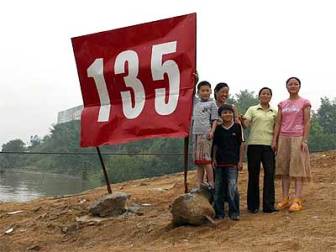
| YICHANG (Hubei) - The crowd arrived as early as 6am, some with babes in their arms, others with walking sticks, and gazed over the Three Gorges Dam in stony silence as the water level at the reservoir crept up to the 135m mark. There was no celebration for what a state official proclaimed as 'overcoming the first challenge of nature', only a deep sense of anxiety among the ordinary Chinese as their lives looked set to be altered again by the 'Da Ba' -literally the Big Dam - as the world's biggest hydroelectric project is known here. |
|
|
| In 1993, China went ahead with the construction of the Three Gorges Dam in central Hubei province despite warnings of catastrophic environmental and social damage. Officials said the project was essential to meet the country's power needs and would improve navigation and flood control on the Yangtze River. In the decade since, almost 720,000 people have been uprooted as farms, ancient cities and cultural sites are inundated for the country's most ambitious engineering project since the Great Wall. |
|
|
| But in the Yilin district of Yichang, where many residents live within a 2km radius of the dam, there is little sentimentality about the historical and cultural loss, and even less display of anger or bitterness about being forced to relocate from their by-now submerged villages. 'The country has to progress, so we support the project,' said farmer Xu Tianzhen, who had to move out of her farm in 2000 with her family to Yilin. |
|
|
| Ms Wang Guizhen, a grocery store owner who saw her business rise and fall in tandem with the arrival and departure of various construction teams at the dam in the 1990s, added: 'Most people here don't say much about the dam because their feelings are too complex to be expressed in a few words. 'We are proud that the country is making progress but so many people have lost their homes, farms and jobs because of the dam. Most of us just hope the new shipping facilities at the dam will bring more business and investments here.' |
|
|
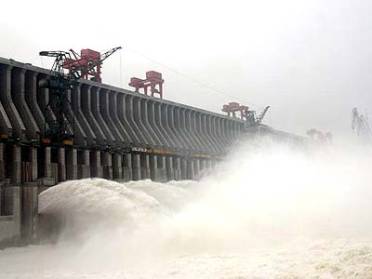
| Ordinary Chinese have been keeping their fingers crossed since June 1, when China shut 19 of the 22 sluice gates at the dam, creating a 1,084 sq km reservoir on the Yangtze River. On Tuesday, the 203.9 billion yuan (S$43 billion) project reached another major milestone when the reservoir filled to the 135m mark - the necessary depth for conducting trials on the dam's powerful generators and permanent ship lock that would eventually allow commercial vessels to sail upstream to Chongqing in central China. Chinese engineers began testing two power-generating units this week, which are expected to be fully operational in August, according to the official Xinhua news agency. Two more units are slated to be operational in October, and by year-end, the power station would be able to supply 5.5 billion kilowatt-hours of electricity. |
|
|
| When completed in 2009, the dam's 26 power-generating units are supposed to provide clean energy for a large part of the country, cut shipping costs by about a third, and create new tourism and investment opportunities. But the 185m-high dam, which stretches 2km across the Yangtze, is also a huge gamble on all fronts. Critics have pointed out that the electricity generated by the dam would be too expensive, and that China was better off building several smaller dams. |
|
|
| The dam could also trap pollution from thousands of factories and villages, which dump large amounts of industrial waste and sewage into the Yangtze yearly, turning the reservoir into a cesspool. China is not unaware of the problems, committing 39.3 billion yuan to pollution control and ecological protection, and plans to build more than 200 sewage and waste treatment plants at the Three Gorges reservoir and the upper reaches of the Yangtze River by 2010, state media said. But some problems have already surfaced, with officials admitting on Thursday that they have found 80 cracks on the dam's surface that could cause leaks if not fixed, and that there is not enough fertile farmland for those relocated. The full extent of the dam's impact will not be known for years, but many people who live in cities along the Yangtze River have already experienced huge changes to their lives. |
|
|
| Mr Tang Liming, a taxi-driver in Chongqing's Wushan county, said that before the flooding of the reservoir, he could charge 20 yuan for each trip from the harbour to the city. Now, he gets only 10 yuan because the distance has been shortened after the water reached the 135m mark. |
|
|
 |
|
|
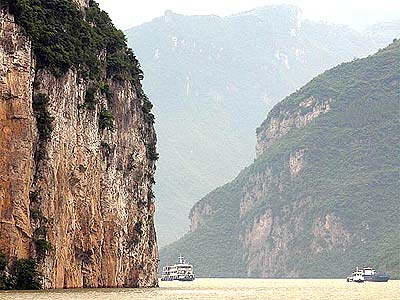
LESS MAJESTIC?: The Three Gorges Dam reservoir is said to improve navigation along the Yangtze River, but many tourists are bemoaning the fact that the scenery is no longer as majestic as before. |
|
|
|
 |
|
|
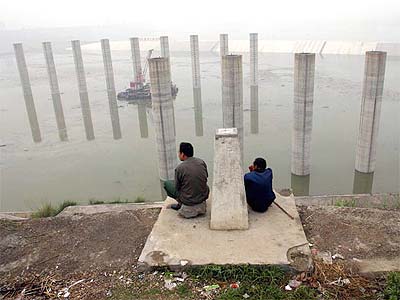
RISING WATERS, RISING ANXIETY: The dam has caused water levels to rise. These residents who live on the banks in the Yilin district of Yichang, central Hubei, are worried about the threat to their homes and their livelihoods. |
|
|
|
|
 |
|
|
|
THE DAM: This is the world's biggest hydroelectric power project. It reached a construction milestone in June, when the sluice gates were shut, creating a 600km-long reservoir on the Yangtze. |
|
|
|
|
|
 |
|
|
|
THE DEPTH IN JUNE: A family poses next to the signboard marking the 135m depth of the Three Gorges Dam reservoir. In six years, the water level will hit 175m, drowning many more scenic spots and old towns. |
|
|
|
|
|
 |
|
|
|
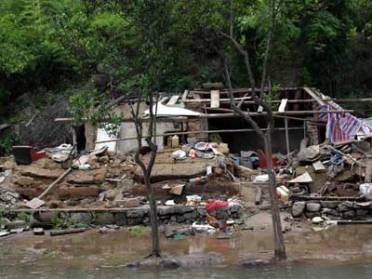
HOMES GO UNDER: The rising waters have already submerged some homes. Residents such as Madam Xiang Jigui and her son, Cao Xianjun, stayed in their hut till it was unsafe for them. The Chinese government has relocated thousands of residents. |
|
|
|
|
|
 |
|
|
|
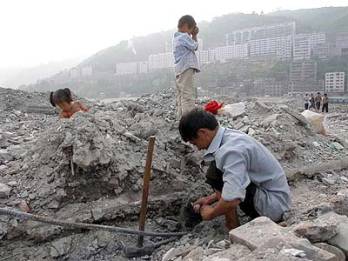
TOUGH LIVELIHOOD: This used to be Fengjie town. The riverbank town has been demolished under the project, leaving residents like Mr Chen Shengui, 30, to scavenge for a living. He has two children aged six and 10 to support |
|
|
|
|
|
Rising tide ? Photo and story by Chua Chin Honhttp://straitstimes.asia1.com.sg/mnt/html/webspecial/gallery/gorges/gorges10.html |
|
|
|
 |
|
|
|
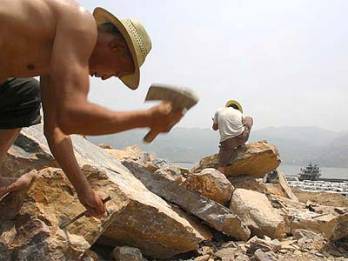
BUILDING WALLS: Aside from building new towns away from the rising waters, the other urgent task is to fortify the towns' edges against the rising waters. Here, labourers in Wushan break down boulders for a new embankment. |
|
|
|
|
|
 |
|
|
|
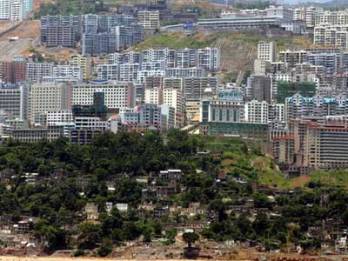
NEW TOWNS: The difference between old and new towns is most apparent at Wushan, central China. Rows upon rows of freshly painted new buildings are built above crumbling old houses near the water mark. Wushan residents began moving into homes in the new city in 2002, even as it was still being built. The new city is thrice the size of the old one and will house 100,000 people, or twice the population of the old Wushan. |
|
|
|
|
|
 |
|
|
|
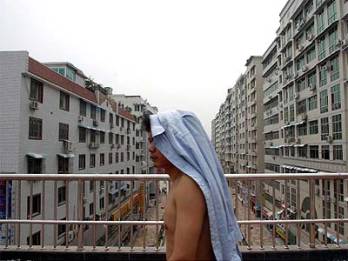
NEW WORLD: This is the new Fengjie town, with its freshly painted walls and linear layout. It is a stark contrast from the chaotic mess of the crumbling old town. |
|
|
|