
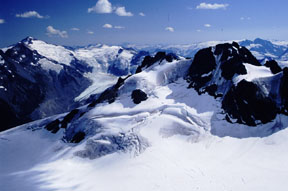
Glaciers
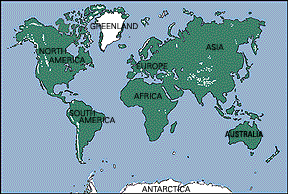 From the frigid lands of Greenland and Antarctica to rising mountain
ranges such as the Andes and the Alps, glaciers lie within many of these
frozen landscapes. Approximately 10% of the earth's land surface
is currently covered by glaciers, however, during the past ice ages they
covered about three times as much (1). The map on the left shows the areas
of glaciers in the world. It is interesting to see that even in warm
climates such as South America and Africa, alpine glaciers can exist in
the high mountainous regions.
From the frigid lands of Greenland and Antarctica to rising mountain
ranges such as the Andes and the Alps, glaciers lie within many of these
frozen landscapes. Approximately 10% of the earth's land surface
is currently covered by glaciers, however, during the past ice ages they
covered about three times as much (1). The map on the left shows the areas
of glaciers in the world. It is interesting to see that even in warm
climates such as South America and Africa, alpine glaciers can exist in
the high mountainous regions.
Glacial Anatomy
Glaciers are formed in areas where low temperatures and high amounts of
snowfall are consistent (2). This snow accumulates and packs together, creating
a solid body of firn. Eventually, as more snow falls and condenses, the
weight created causes the firn to become more dense and impermeable, and
over a few years this process creates glacial ice (
3
). However, because of the fairly constant accumulation of snow, firn
continues to develop on top of the glacial ice. This firn keeps changing
form into glacial ice and that is why glaciers can become over several kilometres
thick (4). 
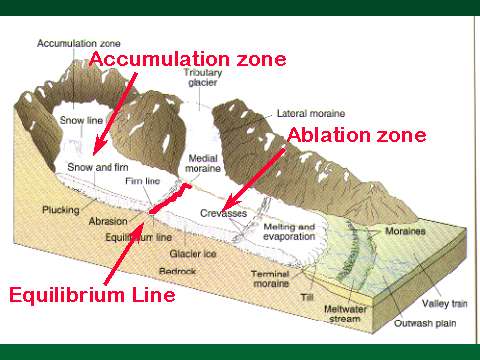
As seen in the alpine glacier diagram to the right, a firn limit exists
between the zone of accumulation and ablation. The accumulation zone
is where the majority of snow accumulates and therefore firn develops.
This is represented in the diagram by the white layer in the zone
of accumulation. However, past the firn limit is the zone of ablation.
In the ablation zone, snow and firn is lost through melting and therefore
the surface consists of exposed glacial ice. The process of accumulation
and ablation maintains mass balance creating a state of equilibrium for
the glacier. If more snow accumulates one year, then an increase of
ablation will follow, but might not occur for a few years depending on the
rate of which the glacier is moving.
For Glossary.
Diagram Source
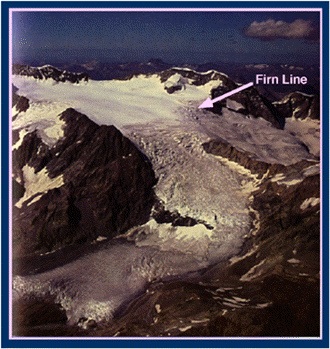
On the left below is a photograph of a glacier. This photograph is
labelled with the firn line which is quite visible at the end of the ablation
season (
5
). Below on the right is a diagram of a glacier which shows the firn
line and the equilibrium line. Above
the equilibrium line is the zone of accumulation, and below is the zone of
ablation (same as firn line) however the equilibrium line refers to the process
of mass balance rather than the presence of firn.(6).
Source: left diagram
Source: right diagram
 The diagram on the left (
10
), shows the flow pattern of the glacier, and the point at which
the ice flows faster. The ice on the outside edges of the glaciers
moves slower because of the resistance
The diagram on the left (
10
), shows the flow pattern of the glacier, and the point at which
the ice flows faster. The ice on the outside edges of the glaciers
moves slower because of the resistance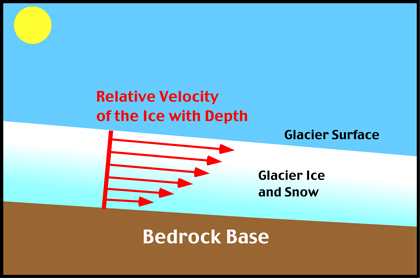 caused by the land material (
11
). For example, if the glacier were to flow through a valley, the
resistance caused by the sides of the valley walls would slow down the
outside of the glacier. Therefore the center moves faster. In the
diagram, this is shown by the fact that the rocks in the center have moved
farther ahead than the others. However, the speed of glacial movement
also changes within the horizontal layers of the glacier. The diagram
on the right (
12
), shows a vertical cross-section of a glacier. The bedrock
base causes resistance for the flowing ice, therefore, the flow of ice
is slower near the bottom of the glacier. The red arrows depict various
layers of ice that move at different rates of speed. The bottom layer
is the slowest and the layers increase in speed towards the top. Each
layer is carried along by the one below and since the upper layers are moving
away from the resistance of the bottom, they move faster than the layer below
(13). Also, in the area between the head and the toe, basically at the equilibrium
line, the glacial ice moves faster. This occurs because the pressure created
from the amount of snow, firn and glacial ice in the accumulation zone, creates
more stress and therefore causes the ice to move faster (14). However,
the ice slows down after reaching the ablation zone because melting occurs
and therefore less pressure is created (15). Therefore, the ice of
a glacier moves the fastest at the surface, in the center (between the left
and right sides), at the equilibrium line.
caused by the land material (
11
). For example, if the glacier were to flow through a valley, the
resistance caused by the sides of the valley walls would slow down the
outside of the glacier. Therefore the center moves faster. In the
diagram, this is shown by the fact that the rocks in the center have moved
farther ahead than the others. However, the speed of glacial movement
also changes within the horizontal layers of the glacier. The diagram
on the right (
12
), shows a vertical cross-section of a glacier. The bedrock
base causes resistance for the flowing ice, therefore, the flow of ice
is slower near the bottom of the glacier. The red arrows depict various
layers of ice that move at different rates of speed. The bottom layer
is the slowest and the layers increase in speed towards the top. Each
layer is carried along by the one below and since the upper layers are moving
away from the resistance of the bottom, they move faster than the layer below
(13). Also, in the area between the head and the toe, basically at the equilibrium
line, the glacial ice moves faster. This occurs because the pressure created
from the amount of snow, firn and glacial ice in the accumulation zone, creates
more stress and therefore causes the ice to move faster (14). However,
the ice slows down after reaching the ablation zone because melting occurs
and therefore less pressure is created (15). Therefore, the ice of
a glacier moves the fastest at the surface, in the center (between the left
and right sides), at the equilibrium line.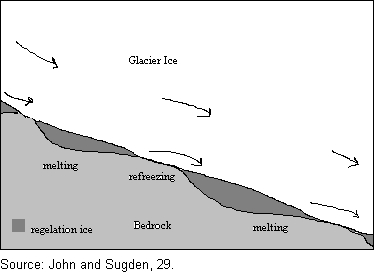 This
process occurs in warm glaciers and involves pressure build up, which results
in melting (23). As shown in the diagram on the right, this occurs
when the ice moves over small bumps in the bedrock below. As the glacier
ice moves up the side of the bump, melting occurs because of the pressure
forced upon it (24). The water that is produced from the melting, then flows
over the downward side of the bump where the pressure is lower and the water
refreezes (25). This refrozen ice is called regelation ice (26). The
obstacle size has a crucial role in how effective this type of movement can
be. If the size of the obstacle is less than one metre, than the ice
can move around it more quickly, but a bigger obstacle will slow down the
process (27).
This
process occurs in warm glaciers and involves pressure build up, which results
in melting (23). As shown in the diagram on the right, this occurs
when the ice moves over small bumps in the bedrock below. As the glacier
ice moves up the side of the bump, melting occurs because of the pressure
forced upon it (24). The water that is produced from the melting, then flows
over the downward side of the bump where the pressure is lower and the water
refreezes (25). This refrozen ice is called regelation ice (26). The
obstacle size has a crucial role in how effective this type of movement can
be. If the size of the obstacle is less than one metre, than the ice
can move around it more quickly, but a bigger obstacle will slow down the
process (27). 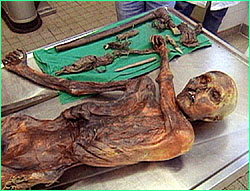 The frozen bodies found due to glacial movement and ablation, are known as ice mummies. Some of these findings can date back to the periods of early man. These findings range in location from all over the world, and because of the amazing preservation from the ice,they present fascinating information from earlier periods in time. (For information about how the ice preserves the bodies go to: http://www.howstuffworks.com/question712.htm. ) The photograph on the left is a clear example of how well the ice preserves these bodies (
36
). In August of
1999, sheep hunters in British Columbia discovered a body on the slopes
of a melting glacier in Tatshenshini-Alsek Provincial Wilderness Park
(
37
). Kwaday
The frozen bodies found due to glacial movement and ablation, are known as ice mummies. Some of these findings can date back to the periods of early man. These findings range in location from all over the world, and because of the amazing preservation from the ice,they present fascinating information from earlier periods in time. (For information about how the ice preserves the bodies go to: http://www.howstuffworks.com/question712.htm. ) The photograph on the left is a clear example of how well the ice preserves these bodies (
36
). In August of
1999, sheep hunters in British Columbia discovered a body on the slopes
of a melting glacier in Tatshenshini-Alsek Provincial Wilderness Park
(
37
). Kwaday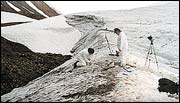 Dan Sinchi, as the body was named, was in fact from the fifteenth century
(
38
). The photograph
on the right is men working to extract Kwaday Dan Sinchi's body from the
ice (39
). Similarly, “Ötzi the Iceman” was
Dan Sinchi, as the body was named, was in fact from the fifteenth century
(
38
). The photograph
on the right is men working to extract Kwaday Dan Sinchi's body from the
ice (39
). Similarly, “Ötzi the Iceman” was 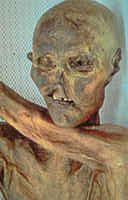 also discovered in a melting glacier in September of 1991 (
40
). Otzi (photograph on the left) was found near Hauslabjoch in the Ötzal
Alps, however, unlike the more recent Kwaday Dan Sinchi, Ötzi died
approximately 5200 years ago (
41
). The photograph to the lower right shows the medical experts observing
this amazing find (42
). The hunt to find out who Otzi was has led to many
also discovered in a melting glacier in September of 1991 (
40
). Otzi (photograph on the left) was found near Hauslabjoch in the Ötzal
Alps, however, unlike the more recent Kwaday Dan Sinchi, Ötzi died
approximately 5200 years ago (
41
). The photograph to the lower right shows the medical experts observing
this amazing find (42
). The hunt to find out who Otzi was has led to many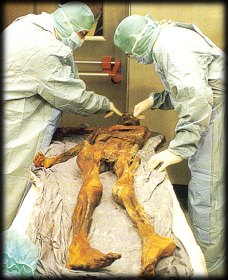 theories about how he died which can be found on this site:
http://www.d.umn.edu/cla/faculty/troufs/anth1602/pcice_man.html
or
http://www.pbs.org/wgbh/nova/icemummies/
. Therefore, it appears
that glacial movement and melting can be the cause for amazing discoveries
such as these ice mummies. Glaciers are now more than a signature of mystery
and beauty, but they are now also known to hold many secrets within.
theories about how he died which can be found on this site:
http://www.d.umn.edu/cla/faculty/troufs/anth1602/pcice_man.html
or
http://www.pbs.org/wgbh/nova/icemummies/
. Therefore, it appears
that glacial movement and melting can be the cause for amazing discoveries
such as these ice mummies. Glaciers are now more than a signature of mystery
and beauty, but they are now also known to hold many secrets within.
|

|

|