
CLASSE 45/A LINGUA INGLESE


LESSON PLAN

Cosenza
16.12.2003
Prof.
P. Gentile
specializzanda
Mariagiovanna Chirillo

A LEVEL (BASIC USERS) OF THE COMMON EUROPEAN FRAMEWORK:
A2 (WAYSTAGE)
Third year of ‘Scuola Media’.

·
Can use basic patterns with
memorised phrases, groups of a few words and formulae in order to communicate
limited information in simple everyday situations.
·
Can use some simple
structures correctly, but still systematically make basic mistakes
·
Can make him/herself
understood in very short utterances, even though pauses, false starts and
reformulation are very evident
·
Can answer questions and
respond to simple statements. Can indicate when he/she is following but is
rarely able to understand enough to keep conversation going of his/her own
accord
·
Can link groups of words with
simple connectors like “and”, “but”, and “because”.

- Past tense of regular and some irregular verbs.
- Knowledge of the period: The Middle Age.

- Receptive (listening, reading)
- Productive (writing, speaking)

- to develop reading skills
(skimming, scanning)
- to revise and to improve vocabulary.
- to listen to and read about past events
- to answer, by writing and by speaking, questions of a short text.
- to write
a short text using the past tense.

-
Vocabulary
-
Past tense of some irregular verbs

Linguistic competence
- Broadening active reading
vocabulary
-
Using the Past Simple in past events narration
Communicative competence (also includes pragmatic)
- Grasping global and detailed
information from an audio or written text
-
Simple oral reporting of a written text within the given field
-
Writing short text on subjects within a given field structuring them as linear
sequences of points
- Identifying the main features
of the text

It
will be preferred an integrated approach.
Students
must be guided to develop strategies of reading-comprehension, oral and written summary of texts (speaking, writing), listening.
The
material selected will be at the basis of tasks, visual and listening
activities, written, guided exercises (matching, filling in the blanks,
completing grids) and freer ones (make your own summary), pair work
and group work (discussions and exchanging opinions).
Students’
attention will be caught using pictures, schemes and grids with different
colours (stimulating visual intelligences).
It
will be also important to start from what students already know.

-
Photocopies
-
Blackboard
-
Tape recorder


Lexical and structural aspects are suitable for the
third year of “Scuola Media”

The text is related to the Middle Age, a topic that
students, presumably, already know from an historical even a literary point of
view. It should be interesting to revise it from another point of view (that
the foreign language).

The text let’s:
-
to revise grammatical
structures (simple past of regular and irregular verbs, interrogative
adjectives and pronouns, linkers)
-
to ask and give information
-
to express relations of time,
cause/effect using connective devices

·
Warm up
AIM The teacher tries to motivate his/her
students before reading the text in order to understand what they already know
(and remember) about Middle Age and life at that period.
PRODUCTION/ SPEAKING
Work in pairs
The
teacher asks simple questions:
- What do you know about medieval times?
- Do you know what “The sword in
the stone means?”
-
Who are the main characters of the story of King Arthur and the Knights
of the Round Table?
Discuss with the class
Then
she/he builds up a spidergram on the blackboard, using students suggestions and
the most common words related to the topic.
Courtly
love


 Holy
Grail quest
Holy
Grail quest


 chivalry fight
 tournament

 realm King


 Queen
Queen

 sword
sword
castle
reign knights squire
throne
PRODUCTION/SPEAKING
PRODUCTION/WRITING
In pairs
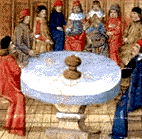
Ø Look at the
picture. What do you think the text is about? Take notes about your partner
suggestions.
Discuss with the class

RECEPTION/READING
PRODUCTION/WRITING
·
Extensive reading and skimming
AIM Glancing
rapidly though the text for its gist and reading for pleasure.
TIME 10
minutes
Ø Read the following text individually.

The
legend of King Arthur dates back to the 5th century. It refers to a
timeless world where the Knights of the Round Table fought for the love of
virtuous girls who were exalted as ideal love objects. The keys themes of these
stories are courtly love and the Quest of the Holy Grail, the cup which once
contained the blood of Christ.
Writers
from England, Germany and France wrote stories of different Knights of the
Round Table, Lancelot, Perceval, Tristan, Gawain. The most famous English
version is “Le mort d’ Arthur” by Thomas Malory, published in 1485. Malory
translated, arranged and rewrote the adventures of King Arthur and The Knights
of the Round Table from the original Latin, French and English sources.
The
knights assembled in Camelot, a caste which is supposed to be in Cornwall, at
Tintagel. Arthur’s Knights sat with him at a Round Table, the symbol of their
equality: no knight was superior to any other.
These
legends were easily adapted to the big screen and many different films have
been published.
“The Sword in the stone” is an excellent
animated film by Walt Disney. It’s a version of the story about how Arthur
became king in a period when England was without a proper ruler. The main
character is an orphan squire-in-training called Wart. When he meets the
extraordinary wizard Merlin he learns to use intellect, wisdom and love. When
it was time to decide who would be wing, Wart pulled a sword from stone when
his brother needed one for a tournament. He did not realize that none of the
other knights could do this, and that he who succeeded was the rightful king.
·
Intensive
reading
AIMS:
-
to
read for accuracy
-
to
have detailed understanding of the text.
TIME: 15 minutes
Ø Read again and divide the text into
four paragraphs and match each of them with a title choosing from the following:
1. Film link
2. Historical background
3. The quest for the Holy Grail
4. English version of the legend
5. Description of the setting
6. Queen Guinevere and Lancelot
·
Scanning
AIM:
to catch
specific information
Ø Answer the following questions
1.
When
does the legend of King Arthur date back?
2.
What
were the key themes of the Arthurian Romance?
3.
What is the most famous English version of
the legend of King Arthur and the Knights of the Round Table?
4.
What
is “The sword in the stone”?
5.
How
was the young Wart recognized as the rightful king?
AIM: to focus on different kinds of text
Ø What kind of text is it? Why? Which
are their main features?


 Descriptive Argumentative Narrative
AIM: to work on vocabulary
Ø Underline in the text, the words
used in the spidergram.
Do you know the meaning of all these words? If
not could you guess the meaning from the context? Otherwise find synonymous in
the dictionary.
AIM: to work on grammar structures
Ø Word game. Find out 7 (regular and
irregular) past in this word square
|
|
|
|
|
|
|
|
|
|
|
|
|
|
|
|
|
D |
G |
W |
A |
S |
S |
E |
M |
B |
L |
E |
D |
|
|
|
T |
J |
E |
R |
Q |
E |
W |
T |
Y |
U |
I |
O |
|
|
|
A |
S |
R |
R |
T |
T |
G |
H |
J |
K |
L |
P |
|
|
|
K |
F |
E |
A |
U |
R |
F |
Q |
W |
D |
R |
T |
|
|
|
A |
K |
G |
N |
D |
A |
S |
A |
S |
F |
G |
H |
|
|
|
L |
H |
U |
G |
A |
N |
Z |
X |
C |
V |
B |
N |
|
|
|
M |
D |
H |
E |
S |
S |
A |
T |
A |
Z |
X |
C |
|
|
|
B |
W |
G |
D |
J |
L |
S |
F |
G |
H |
J |
K |
|
|
|
S |
E |
L |
T |
K |
E |
Y |
U |
I |
O |
P |
L |
|
|
|
R |
E |
W |
R |
O |
T |
E |
P |
A |
Q |
S |
C |
|
|
|
M |
N |
Q |
W |
A |
E |
X |
A |
L |
T |
E |
D |
|
|
|
B |
V |
C |
X |
Z |
D |
O |
F |
T |
G |
B |
V |
|
|
|
|
|
|
|
|
|
|
|
|
|
|
|
|
Ø Circle in the text all the verbs in
the simple past and complete, filling in, the grid. Complete the
paradigms of the irregular ones.
|
|
|
|
|||||||||||||||||||||||||||||||||||||||||||||||||||||||||||||||||||||||||||||||||||||||||||||||||||||||||
|
|
|
|
|||||||||||||||||||||||||||||||||||||||||||||||||||||||||||||||||||||||||||||||||||||||||||||||||||||||||
|
|
|
|
|||||||||||||||||||||||||||||||||||||||||||||||||||||||||||||||||||||||||||||||||||||||||||||||||||||||||
|
|
PRODUCTION/WRITING
|
|
|||||||||||||||||||||||||||||||||||||||||||||||||||||||||||||||||||||||||||||||||||||||||||||||||||||||||
|
AIM: to guide a written summary. Ø Read the text. When you find a
blank space look at the words that precede or follow it, and try
to predict if the missing words are nouns, verbs or adjectives. Insert
the right words. Everybody knows the famous legend of King
Arthur and the……….of the Round Table. Arthur became king when he pulled a
……….out of a stone. He lived in a ………..at Camelot where his knights sat at a
table which had a special…………: it was round so that…………..was respected and
there weren’t any privileged seats. The knights…………..for the love of
virtuous…………..and went to………..the Holy Grail. The favourite knight of King
Arthur was Lancelot. RECEPTION/LISTENING Ø PRODUCTION/WRITING AIM: to use language in a freer
way, to develop abilities of synthesis and to point on the use of linkers (cohesive
devices). Ø Now write down your own summary. PRODUCTION/SPEAKING Refer orally your own summary.
|
|
||||||||||||||||||||||||||||||||||||||||||||||||||||||||||||||||||||||||||||||||||||||||||||||||||||||||||
|
|
The learning process will be monitored and tested
during the development of the lesson. |
|
|||||||||||||||||||||||||||||||||||||||||||||||||||||||||||||||||||||||||||||||||||||||||||||||||||||||||
|
|
The check will
be individual and choral. The teacher will test students learning step
by step, in progress, checking if the aim of all the activities has been
achieved. She/he also will check the overall understanding through the
following test, checking also the correct use of linkers: Ø Match each sentence with the
correct ending: 1.
The
Holy Grail is….. 2.
At
medieval times women were…. 3.
The
famous realm of Camelot….. 4.
The
Round Table had that shape…. 5.
The
wizard Merlin teaches Wart….. 6.
Wart
proved that he was the rightful king….. A)
…..to
use intellect, wisdom and love. B)
…..so
that there was no grade of importance among the knights C)
…..
by pulling the sword out of a stone. D)
……the
cup that contained the blood of Christ. E)
……is
supposed to be in Cornwall. F)
……exalted
as ideal love objects The teacher
could also choose to give only the first part of the exercise and to make
students to complete in a freer way. |
|
|||||||||||||||||||||||||||||||||||||||||||||||||||||||||||||||||||||||||||||||||||||||||||||||||||||||||
|
|
Example
of a
|
|
|||||||||||||||||||||||||||||||||||||||||||||||||||||||||||||||||||||||||||||||||||||||||||||||||||||||||
|
|
|
|
|||||||||||||||||||||||||||||||||||||||||||||||||||||||||||||||||||||||||||||||||||||||||||||||||||||||||


From 1 to 4
|
|
MARKS |
|
Communicative effectiveness |
3 |
|
Grammatical propriety |
3 |
|
Content/understanding |
4 |
|
Fluency |
3 |
|
Use of lexis |
3 |
|
Pronunciation |
3 |
|
Appropriate use of connectors |
2 |

Students will be assessed according to:
·
Involvement
·
Commitment
·
Knowledge of the content
·
Appropriate
use of structures and functions
As it comes to the evaluation,
three different grades are provided, corresponding to following descriptions of
competence levels:
GRADE DESCRIPTION
|
VERY GOOD |
Can express
him/herself accurately and fluently, also in an interactive context; has a
good command of all levels of linguistic competence |
|
GOOD |
Communicates
with reasonable accuracy and fluency, even if with some hesitation,
imprecision and errors on some linguistic levels |
|
NOT SUFFICIENT |
Communication
process (production/interaction) impeded/ seriously obstructed because of
insufficient level of language competence |
Time: 3/4 hours approximately