VII. Apologetics
The Golden Ratio
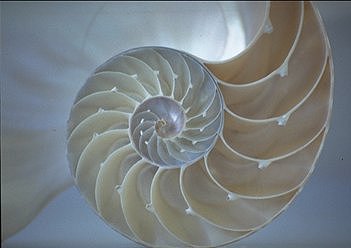
Seashell from mediatheek.thinkquest.nl
 ) that seems to appear so commonly in nature that logically it cannot be coincidental. Studies in The Golden Ratio, dubbed phi (), have shown that it creates the "perfect" ratio in many things because when this ratio is used it causes humans to subconsciously think that this thing, compared to others, is the most appealing. In geometry, supposedly the best looking rectangle is the one with 1 : side ratio. In art, Da Vinci's work uncannily incorporated often into his work such as the size of the Mona Lisa's canvas and the proportions of her face. In architecture, the Greeks built the Parthenon which incorporated into the infrastructure of the building. And lastly, and most interestingly, some seashells, among other things, spiral using the Golden Ratio. Because of 's commonality in nature, it has caused many people to believe that evolution progresses with some sort of intelligent design (not THAT kind of intelligent design!). This is also used as proof of knowledge of God because it shows that our evolution was not entirely arbitrary.
Phi () has been equated to approximately: 1.618...
Remember! Phi is irrational, therefore the number just keeps going and going.
. This is called the Fibonacci Series and is used to create peculiar proportionate spirals like those found in certain seashells. In the 1500s it was deemed the "Divine Proportion." Finally, in the 1900s, this divine proportion was given a name, phi. Also to note is the phi sign is the combination of 0 (nothing) and 1 (unity), creating what goldennumber.net calls "Nothing split by Unity is Phi, the constant of creation."
The colors on this page were chosen by using a Phi relationship between three colors using a+b=c on a gradient color scale. The program utilized was called PhiBar.
