Experiential knowledge is knowledge obtained through firsthand encounters with something. They are perceived through the five senses: sight, hearing, taste, touch, and smell.
| An example of experiential knowledge is fire. Those who have experienced fire, which should be most people our age and older, know that fire produces heat, perceived through the sense of touch; fire produces light, perceived through the sense of sight; fire has a distinct smoky scent, perceived through the sense of smell. All of these things are firsthand. |

from www.its.caltech.edu/ |
 from whysanity.net |
Another form of experiential knowledge is that of empirical knowledge. Basically, it is the knowledge obtained through observing experiments and measuring the results. |
| Authoritative Knowledge is the knowledge obtained from an authority, or a person who claims to have knowledge that you do not. Where experiential knowledge was firsthand, knowledge from authority can be secondhand or third-hand. Authority knowledge can be knowledge from Jesus Christ. Doesn't he know something of God that we do not? |
 from family-genealogy-online.com |
|
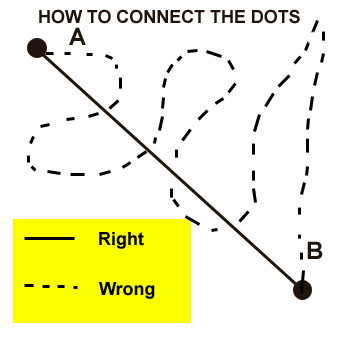
Reason is the power to think in such a way that we proceed from what we know to what we do not yet know. Basically it is the process of connecting the dots to form the picture. You connect from dot A to dot B in a straight or gradual line. Logically, you do not jump around until you hit B. |
- Deduction
All p are q, a is p, therefore a is q. a > b, b > c, therefore a > c. if p then q, not q, therefore not p. No p are q, but q, therefore not p. All DVD players can play cartoons.
Cartoons are movies.
All DVD players can play movies.Two is better than one.
Three is better than two.
Three is better than one.If you are in Seoul, then you are in Korea.
You are not in Korea.
You are not in Seoul.No boy is a girl.
It is a girl.
Therefore it is not a boy.
- Induction
Induction is the universal generalization of a situation that you have had limited experiences with. It is a statement that you make after eliminating the possibility of it in your mind. It is not justifiable in fact and could very easily be contradicted if there does exist that thing you claimed did not. These statements have to be supported by personal experience.
A few examples of this:
- All needles hurt. Do acupuncture needles hurt? Has this person experienced acupuncture? I have not, but I hear it does not hurt.
- Every person has a brain.
- Rain is never red.
- All needles hurt. Do acupuncture needles hurt? Has this person experienced acupuncture? I have not, but I hear it does not hurt.