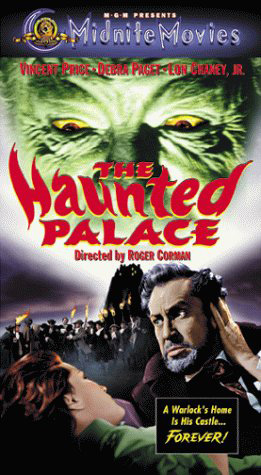
from amazon.ca
|
from amazon.ca |
The library is a wonderful place for discovery. A few years back when I got into Vincent Price movies, I encountered a low-budget Roger Corman film entitled The Haunted Palace (1963) that scared the pants off of me (I still have not finished it to this day). It was part of an MGM Midnite Movies collection, a treasure-trove of cult B-movies about vampires and monsters and the like. On the back of this particular cassette box, there was a little factoid stating that although the film had a title taken straight off of a work from Edgar Allen Poe, the plot was most definitely based on the work of a lesser known author named H.P. Lovecraft. |
Lovecraft, Lovecraft. Just the name conjures images of witchcraft and black magic, which is precisely what his stories were about. It's hard to believe that it is his real name and not a pen name. I am a huge fan of science fiction and horror stories, so when I looked up a few of the treasuries of his stories, I instantly loved them. His stories were written similar to those of Edgar Allen Poe, in a sort of antiquated almost scientific English, but at the same time his lack of the minute vivid descriptions forced your imagination to kick in and fill in the gory detail.
A resident of Rhode Island, his bizarre tales did not make it very far. A significant number of them were printed in the magazine Weird Tales. Although he wrote three novella sized stories, he was so disdainful of them that he was never going to release them to the public. Had it not been for his friend August Derleth, of whom he sent most of his manuscripts, the story would have never been released. The story in question was the one The Haunted Palace was based on.
Editor S.T. Joshi has classified the entirety of his stories into three cycles. Each cycle contains stories that have knowledge continuous to each other, dubbed a mythos. Two of the three cycles are particularly fascinating to me while the third is just mediocre.
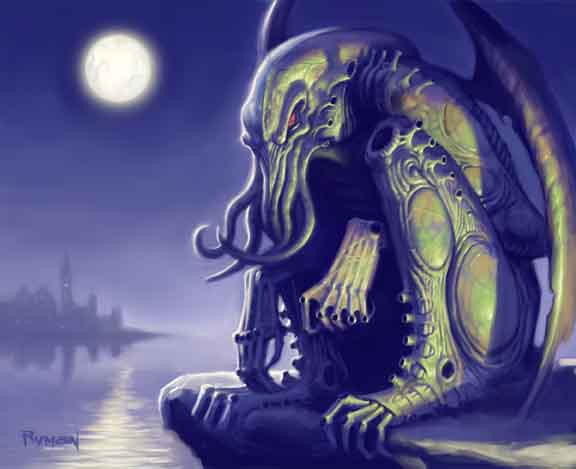
from fantasyflightgames.com |
The Cthulhu Mythos revolves mainly around a world of other-worldly beings. Aliens living in the Vermont hills, frozen five-lobe brained beings in the Antarctic, an enormous tentacled slumbering demigod who upon awakening burns dreamlike images into Man's mind and causes them to uncontrollably praise him (Cthulhu), a woman who bears a half-alien child, and an entire town of people who gradually transform into fish-like beings (dubbed the Deep Ones). And that's only a sample of the scenarios presented.
The sheer volume of Lovecraft's imagination is enough for the amount of praise I like to credit him with. He used hard facts, accurate for its day, to create his worlds. He described abstract dreamworlds that only the most potent imaginations can visualize. |
| Although the above title could be used to describe the entirety of Lovecraft's work, it contains stories dealing mainly with the consequences when humans delve too deep into magic, or predominately, science. From re-animating dead corpses with a serum and preserving your decomposing body in a state of suspended animation through the usage of refrigeration to reading a little bit too far into the Necronomicon and starting to become your warlock great grandfather. The scientific mind was king throughout these stories, and in most cases it ended in failure. The detail of science Lovecraft dedicated to his stories is enormous. Where most science fiction authors of the time fabricated the fiction, Lovecraft used the science to create the fiction. I absolutely adore this cycle because of the minute details and generally thick mood to all of these stories. |
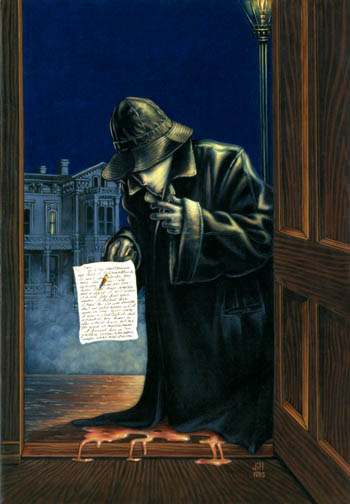 from darkartstore.com
|
|
The Necronomicon is the ancient evil book that many of the Macabre Cycle stories revolve around. It is the book of the dead, written by the mad Arab Alhazred. In it are incantations and writings on the darkest of magicks: Necromancy. The Necronomicon is probably the single-most important contribution of H.P. Lovecraft to pop culture. The Necronomicon is the definitive Book of the Dead. Although many writers and storytellers told stories of the Book of the Dead, Lovecraft was the first to successfully coin a title and backstory to this fated volume. He included many other dark books that he would mention, if not go into detail about, in almost all of his stories.
The very popular series of Evil Dead films have brought the Necronomicon to new light. In these movies, dubbed the Necronomicon Ex Mortis, it is the key to the release of the demons that begin the scenario and present the viewer with all the shocks and gags that are contained in the entire film. The Evil Dead franchise is the first to give the Necronomicon an image, so to speak. It is a tattered, almost skin-bound book with a horrendous gaping face on the cover. It has been rumored that Lovecraft may have had a copy of a real "Necronomicon," but these have never been proven, nor have they been taken very seriously by scholars. |
 from the film Evil Dead II from miskatonic.net |
Cthulhu Cycle
|
Macabre Cycle
|
