 If we run this testing
procedure on IMKB (weekly logarithmic close values of IMKB100 between the date of Jan 5,
90 and July 7, 00) we have the following results. (# of datas: 539)
If we run this testing
procedure on IMKB (weekly logarithmic close values of IMKB100 between the date of Jan 5,
90 and July 7, 00) we have the following results. (# of datas: 539)
Sequences and Reversals
Niederhoffer and Osborne (1966) presents two departures from complete randomness in common stock price changes from transaction to transaction. First, their data indicate that reversals (pairs of consecutive price changes of opposite sign) are from two to three times as likely as continuations (pairs of consecutive price changes of same sign). Second, a continuation is slightly more frequent than after a reversal. To summarise, the events (+/++) and (-/--) are slightly more frequent than
(+/+-) or (-/-+).
One of the first tests of Sequences and Reversals was proposed by Cowles and Jones (1937). It consists of a comparison of the frequency of sequences and reversals.
Suppose that log prices follow a normal random walk with drift:
Pt = m + Pt-1 + e t e t µ IID (0, s 2) and denote by It: the following random variable:
It = ‘1’ if rt=pt-pt-1>0 with probability p , ‘0’ if rt=pt-pt-1<0 with probability 1-p
The number of Sequences Ns and Reversals Nr is expressed simply by It’s:
Ns= S t=1n Yt and Nr=n-Ns where Yt=ItIt+1+( 1-It)(1-It+1)
For any pair of consecutive returns, a sequence and a reversal should be equally probable but if drift is positive than CJ (Cowles – Jones ratio) should be greater than 1 or vice versa.
CJÙ =Ns/Nr= p s/1-p s ? (p 2+(1-p )2) / (2p (1-p )) ³ 1 ( eq1 )
Where p =Pr (rt>0)=Æ (m /s ) ( eq2 )
Here, we should consider that whether CJ^ is statistically different from one or not? If we look at the distribution of CJ^, it is found that;
CJ^» IID [p s/1-p s, {p s/1-p s+2(p 3+(1-p )3-p s2)}/n(1-p s)4] ( eq3 )
Under the null hypothesis of p =1/2, we will test whether CJ^ is statistically different from 1.
If we run this testing
procedure on IMKB (weekly logarithmic close values of IMKB100 between the date of Jan 5,
90 and July 7, 00) we have the following results. (# of datas: 539)
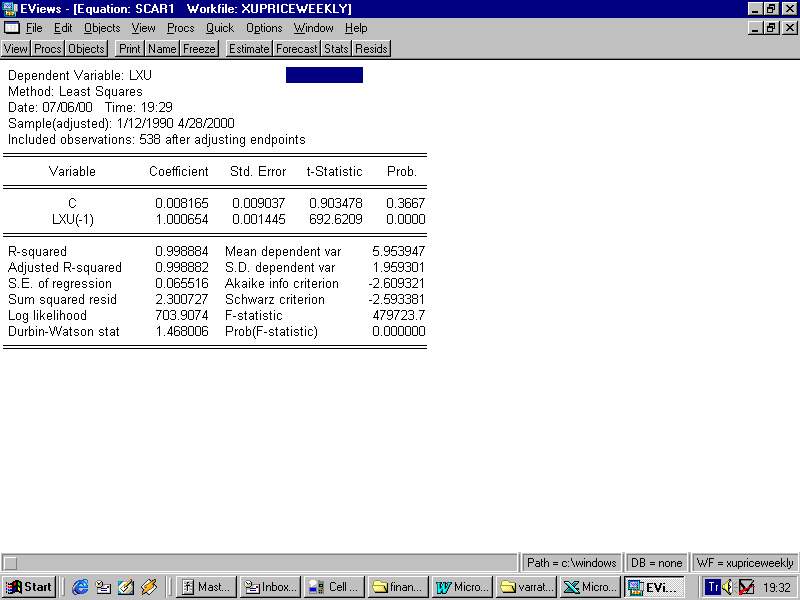
Table-1
According to Table-1, C represents the drift which is m =0,008165. The volatility (s ) of the weekly logarithmic close values of XU-100 is; s = 0,000116.
Other variables are:
# of positive returns= 283 Ns=332 Nr=206
Then;
p ^=Æ (m /s ) = 0,525046 from (eq2)
p ^s=p ^2+(1-p ^)2 = 0,501255 from (eq1)
CJ^=p s/(1-p s) = 1,005031 from (eq1)
Under the null hypothesis of p =1/2 that means for any pair of consecutive returns, a sequence and a reversal are equally probable; hence the Cowles – Jones ratio (CJ^) is approximately equal to one.
The results of CJ^ distribution as follows: CJ^» N (1,005031, 0,000116) from (eq3)
See that “CJ^=1,005031 + or – (0,000116) is not significantly equal to 1.
These results shows us that, pairs of consecutive price changes of the same sign is not equal to the opposite sign ones. Again, it couldn’t be said that IMKB is an efficient market.