| Home | Table of Contents |
General Intelligence :
version 0.4
Basically the platform allows members to make contributions to a collaborative project. Contents are open to all members and membership is granted automatically. A member claims credits for each piece of contribution s/he makes. If the self-claimed amount is "outrageous" other members can complain. The income generated by the product is re-distributed back to the contributors' accounts instantaneously as it is earned. A special agreement specifies how contributed materials may be used outside of the web site. Also, the web site supports branching of the "project tree" which users can browse with a web-based GUI.
But members can select a set of items and obtain the rights to use them in external projects by applying to the Managerial Board. See "external-use" agreement.
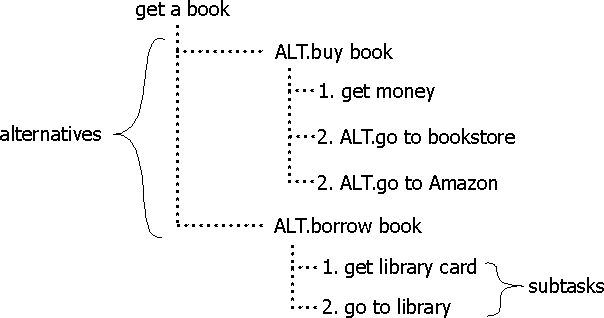
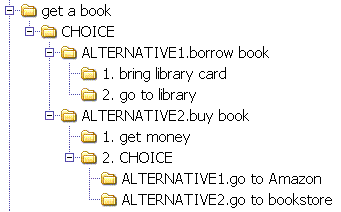
The difference between alternatives and subtasks is that alternatives represent choices whereas all subtasks must be sequentially completed.
For example:
The "tree view" of this example is like this:
The data structure should be a tree and linked-list hybrid.
There should be a web-based GUI for browsing and modifying this tree structure.
Modifications include:
Histories of modifications must be stored and browsable.
Members can specify certain items to be free-opensource. They will automatically be under an opensource license, except that they are only visible to members of the platform. As long as the disclosure of the opensource items do not violate our protected contents (for example, with references that will reveal protected ideas), they will be published on our publicly-accessible web pages.
This allows to collect knowledge about:
An intelligent agent, called G0, will reside on the client side.
It can help:
There is no need for voting on the collected facts, but there is a need for cross-validation by other users.
Cross verification means whether the fact is incorrect or partially correct (correct but has exceptions), or estimate P/Z.
This is done on the site.
The facts need to be classified into various categories, such as: C/C++/C#.
Maybe this is done on the GUI.
Done on the site.
Can be done on site or on G0.
For facts, simply throw into a central database, and give the contributor the fact id.
Comments are a way for members to discuss the contributions. Comments do not carry any Credits. They appear below the wiki entries (similar to the comments on YouTube).
The branches of the project can be downloaded by the public with a fee, thus generating income for the web site.
At the initial stage, customers can pay a fixed fee and download all the branches of the project. Later, when the branches have become sufficiently differentiated, we will allow selective payment and downloading of branches.
Income is re-distributed to the corresponding contributors instantly. This makes sense because contributions yet to be made in the future have nothing to do with the income generated at present. The income generated at present should be distributed to members who contributed thus far.
It seems that Virtual Credits are fundamentally different from real stocks in the sense that every member's set of contributions is unique, and they generate income differently according to which branch(es) they belong to. Therefore the value of a contributor's portfolio is dependent on its contents. Real stocks, on the other hand, are essentially interchangeable.
In principle, Virtual Credits can be traded in a market, but we'll explore this possibility later.
This agreement states that, if a member decides to use other members' contributions in an external project, s/he must pay our company a percentage of his/her new project's revenue. The percentage will depend on the selected items, and will be decided by the managerial board.
A member can always use his/her own contributions in external projects, without payment.
The collaborative platform can accept cash funding from investors.
First, the investor needs to register as a member.
The investment mechanism is as follows:
Note: Currently, all investments will be made on the entire project (all branches), but later we may allow investors to make branch-specific investments. When we allow that, re-distribution of funds will be handled accordingly.
I'm still preparing it... 
| Home | Table of Contents |
6/Jan/2008, 24/Sept, 17/Jun/2007 (C) GIRG