Coffee Contact
The Independent Forum for Coffee Issues
In the Shadow of the Giant:
Coffee in the Selva Central of Peru
Certainly, the coffee of Peru is produced and marketed on a much smaller scale than it is in neighbouring Colombia. Peru is so dwarfed by the volume and promotion of Colombian coffee that most people don�t know that coffe can be and is grown there. However, one can find quality Arabica coffee, between 1,000 and 2,000 m, in the central highlands. Coffee from the northwest part of Departamento Junin and a neighbouring section of Pasco is collectively known as �cafe de Chanchamayo�, taking the name of that district in Junin. Reasons for Peru�s modest production are several. There is not a strong national market for Peruvian coffee. There is not a well-organized and agressive promotional program as there is in Colombia, for example, home of the legendary Juan Valdez and his donkey. What�s more, economic upheaval and terrorist activities in the 1980�s weakened the local economy and coffee production itself around the two principal coffee towns of Villa Rica and La Merced. Nevertheless, the coffee of Chanchamayo has persisted, and growers and buyers from this region are confident that the coffee business will increase.
I visited with several coffee growers in Villa Rica, where the majority of the quality coffee is grown, and with the Chanchamayo Coffee Cooperative in La Merced, the major urban center and coffee collection point in the area. The frontier town of Villa Rica was founded in 1925 by a German settlers and German names are not uncommon in Villa Rica and other towns. The Bracks are one of the principal coffee families. Hans Brack and his wife Teresa kindly gave me a tour of their chacras or coffee plots in the hillsides of the Cedropampa valley. Several of the Brack brothers farm coffee here and have formed along with some of their neighbours a marketing enterprise for their coffee.
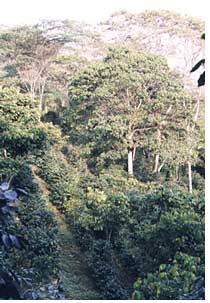 The coffee plots of the Brack�s and neighbouring chacras are grown in partial shade afforded by different species of trees of the genus Inga, a fast-growing legume whose broad but relatively sparse canopy provides the right amount of shade for optimum coffee production. In some cases, the hillsides appear at first to be untouched forests and the presence of coffee is only given away by the tell-tale white trunks of the Inga trees. Teresa tends not only the coffee chacras but the Brack�s home garden, where she cultivates several species of native orchids, mosses, and other plants found in the chacras. It is this diversity of plant life and the shelter afforded by the trees in these cafetales that make them good habitat for birds. Despite the semi-wild appearance of the cafetales, the coffee plants are carefully teneded. Some plants harmful to the coffee must be removed. Shade trees are occasionally pruned or removed. Entire coffee plots are replanted when the coffee has reached the end of its productive life.
A part of the Bracks� chacras
Because the coffee fruit ripens at different times at different altitutdes and not all at once on the same plant, it is harvested carefully by hand. The season in Chanchamayo extends from April to September, with the peak harvest in May and June, when the Bracks and other coffee growers hire workers from outside Villa Rica. Most come from Junin and neighbouring departments but some from as far away as Trujillo. The coffee cherries are wet-processed and sun-dried on site. Villa Rica lacks the electicity for a large dry-processing mill (called beneficio), therefore the final processinig of all Chanchamayo coffee takes place in Lima.
The trees in these cafetales not only shade the coffee plants but also retain moisture, convert nitrogen to a usable form, and retain the earth on these often steep slopes where heavy rain can wash away sections of hillside. Some recent landslides were evident around Villa Rica. Farmers burn hillsides and plant corn, coffee, or other crops on what seem like impossibly steep ground. Hopefully the ecologial and economic sense of keeping and-or planting trees will become more apparent and the soil and water of the Selva Central protected. In the hillsides around Villa Rica, there is no obvious distinction between what some call �organic� vs. �technified� coffee. As the Bracks pointed out to me, what we call organic or shade coffee involves very definite technologies; therefore, "ecological coffee" might be a better descriptor.
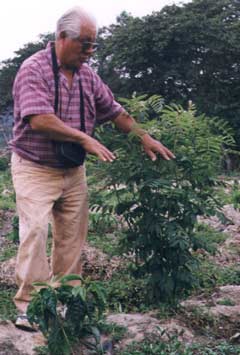
Another grower, Antonio Aira, showed me strictly organic coffee growing next to a plot where some artificial ammendments, such as manufactured urea, had been added. I could see no difference between the two plots: both had some tree cover but lacked a mid-story, both had some herbaceous plants in the understory, and the coffee plants seemed equally healthy. Birds flew indiscriminately between the two plots. Without knowing the precise effects of the agrochemicals, both plots might be called "ecological". Sr. Aira pointed out that the plot receiving chemicals was producing more fruit. However, in times of low coffee prices, the cost of producing this coffee could equal the value of the harvest. It is mainly for this reason that coffee growers in Chanchamayo, especially holders of less than 10 hectares, are planting benefical trees, recycling coffee cherry pulp, and applying other �organic� practices.
Sr. Aira showing a leguminous shrub
used to protect the young coffee
Next: story of a survivor, the Chanchamayo Coffee Cooperative