












Trip Reports
The Economics of Coffee Picking in El Salvador
— by Peter Balint, March 2000
(The author is a Ph.D. candidate at the School of Public Affairs, University of Maryland. He traveled to El Salvador this winter to assess the viability of several conservation and development projects and, while there, visited some coffee farms.)
|
|
|
 |
|
|
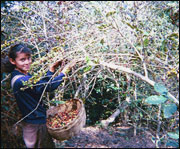
Families, including men, women, and children as young as eight or nine, often work together picking coffee during harvest season. Obviously, adults—who are stronger and more experienced—earn more than children do, so individual daily earnings vary considerably. A child may pick only one or two arrobas a day, for example, while an adult working in a productive plantation may be able to pick as many as 10. The thirteen-year-old girl pictured below harvested 160 lbs.—a little more than six arrobas—on the day she was photographed, earning the equivalent of $4.75 for eight hours’ labor, or about 60 cents an hour.
The work is difficult. Coffee grows on mountainous terrain, and at the end of each day workers have to haul full sacks weighing 100 to 200 lbs. down—or sometimes up—to central locations where the harvest can be loaded onto trucks. Moreover, coffee picking takes place during the season when it is dry and hot in El Salvador. Months pass without rain, and temperatures rise daily into the low 90s. The steep hillside soils loosen, making footing treacherous, and the coffee plants become covered with wind-blown dust. By the end of a day of coffee picking, workers are soiled with dirt and sweat.
Prices for many things are cheaper in El Salvador than they are in the United States, of course, so the pay goes further than it would here. Nevertheless, price differences are not enough to compensate for the very low wages, and families that depend on income from agricultural work such as coffee picking live in poverty, even by the reduced standards of the developing world.
Yet, the work is in demand. There is a surplus of unskilled agricultural labor in El Salvador, unemployment is high, and people are happy to have the chance to pick coffee. The mood among workers on the day the accompanying photos were taken was cheerful. Hard work is better than no work, and low pay is preferable to no income at all.


