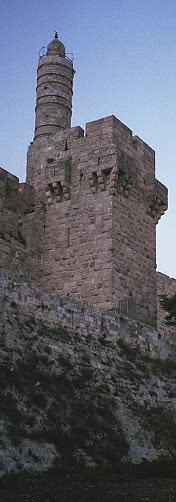
Four Questions What is a
Stronghold? How do you
Handle a Stronghold? How are
Strongholds Built or Demolished? What are Some
Strategies for Tearing Down and Building?
1.
What is a Stronghold? 2 Corinthians
10:3-5 Spiritual Boarding House
Strongholds
Can Be Holy or Wicked Holy: Psalm 18:2; 27:1; 43:2; 2
Samuel 22:3; Joel 3:16. Wicked:
Micah 5:10-15
Not a
demon or group of demons Not sin or
iniquity Explains
how Christians can be demonized
TEMPLE - FORTRESSES In 2
Corinthians 10:4: µ (ochurma) “fortified place” “It is
possible that Paul is referring to the Tower of Babel.” —
Gerhard Kittel TDNT, V, 591 “Often a temple
within a city was the city’s highest point and its
stronghold” — Dictionary
of Biblical Imagery, 822
cf. Judges
9:46: “the citizens . . . went into the stronghold of the temple” cf. Psalm
27: 2, 4-5: David calls God “the stronghold of my life” and pictures
the stronghold as “the house of the LORD, . . . the shelter of his
tabernacle . . . high upon a rock.” In Psalm 43:2-3: “your holy
mountain . . . where you dwell.”
“It is obvious
from the context of 1 Corinthians 10:4 that these strongholds are not
demons or geographical locations* but psychic habitats. It is
from these “head nests” that Satan and his cohorts endeavor to
manipulate our inner world. The word arguments, often translated
imaginations, is an interesting one. Taken from the Greek word
logismos, it is defined more precisely as ‘calculative reasonings over
time’ (as opposed to random occasional thoughts). This definition
makes these arguments or imaginations look more like what they almost
certainly are -- religious or philosophical
systems.” — George Otis,
Jr. Twilight Labyrinth, p. 281 (*Footnote:
“Places can be viewed as strongholds . . . where spiritual and cultural
realities converge.”)
“And
even if our gospel is veiled, it is veiled to the perishing. The
god of this age has blinded the mind of unbelievers, so that they
cannot see the light of the gospel of the glory of Christ, who is the
image of God.” — 2 Corinthians 4:3-4
Definition
of a Stronghold Strongholds are habitations in the spirit
realm built in the mind and can be described as mindsets, attitudes,
thinking patterns, and some elements of worldview formed through
consistent willful sin, iniquity, or alternately, acts of obedience to
God.
2.
How Do You Handle a Stronghold? Our Job: Acts 26:18: “I am
sending you to open their eyes and turn them from darkness to light,
and from the power of Satan to God, so that they may receive
forgiveness of sins and a place among those who are sanctified by faith
in Me.” Prophetic
Mandate Jeremiah
1:9-10, 18 God destroys wicked strongholds as we
stand on the battlefield Isaiah
31:8-9; 2 Samuel 22:46; Psalm 18:45 God builds holy strongholds as we submit
to his authority Isaiah 32:
2, 17-18
3.
How Are Strongholds Built or Demolished? Consistent
willful acts over time become commitments. Commitments almost
always involve sacrifice of some kind. Sacrifices always take place on
altars. Altars are the central tool in a stronghold. Corollary:
Sacrifice requires a commitment, which is an act of the will, which is
done in a mindset. Mindsets are strongholds. Actions ===> Commitments
====> Sacrifices ====>
Altars ====> Strongholds 4.
What are Some Strategies for Tearing Down and Building? The Point of Centrality in understanding
Strongholds is the ALTAR Hebrew:
mizbeah, “place of sacrifice”; from zabah “to sacrifice” Greek: thusiastesion
“place of sacrifice”; from thusiazo “to slaughter; to sacrifice” same
root: enthusiasm or enthusiastic. Principles
of the Altar
Altar
is the place of sacrifice, and therefore, covenant. Altars are built as
witnesses of covenant. Joshua 22:34; Genesis
31:45-49
The altar
is a most important tool in spiritual technology. Matthew 23:18-22
The altar
is the point of contact or portal to the spiritual realm. Both holy and wicked
altars are portals. 1 Corinthians 10:18-21
All altars
are invisible but some may be visible. 1 Corinthians 6:19
There
are holy altars to be built and wicked altars to be
destroyed. Deuteronomy 12: 2-3,
5, 7
All
altars can be built up or destroyed through wicked or holy
prayer.
The
building or tearing down of an altar correlates with the building or
tearing down of a stronghold. Micah 5:11-14
However,
an altar and a stronghold are not the same. The altar comes
first. The stronghold emerges and increases in strength from
numerous sacrifices on the altar. Ezra 3:2, 6
Many
altars may empower a single stronghold.
Some
altars and strongholds are connected with a place. 2 Chronicles 3:1; 2
Samuel 24:18-25
The
wickedness or holiness of the altar is imputed or invested to the
offering, the offerer, and the stronghold. James 2:21-24
BUILDING
HOLY STRONGHOLDS We are in
as much or more need of building holy strongholds as we are of tearing
down wicked strongholds in our land. America’s original
strongholds had a measure of moral holiness. We should focus on
building these holy strongholds as well as tearing down wicked ones. “A holy stronghold is a “place of safety
from the enemy. . . . A stronghold may be any inaccessible place of
refuge, especially an elevated one. [Colossians 3:1-3] The KJV
generally uses ‘high tower’ rather than the NIV’s and other versions’
‘stronghold.’ . . . In the narrative and prophetic books, strongholds
are literal places of military refuge, while in Psalms they tend to be
metaphors for God.”
— Ryken, Wilhoit, Longman, Dictionary of
Biblical Imagery,
822. THE
MOST IMPORTANT HOLY STRONGHOLD IS A PERSON “He who
dwells in the shelter of the Most High / will rest in the shadow of the
Almighty. / I will say of the LORD, ‘He is my refuge and my fortress,
my God, in whom I trust.’” — Psalm 91:1-2 NIV Principles of Holy Altars
Rejection
of a Holy Altar Brings Judgement
But there
is a hope – God sacrificed Himself on His Own Altar, the highest
sacrifice. (Isaiah 49:8-9)
Call on
the Covenant of Christ and the Covenants God made in the past with our
fathers. In His authority and the authority of the covenants reassign
the desolate inheritances.
Holy
strongholds can be eroded and destroyed through judgement.
(Ezekiel 24:21, 25; Amos 3:11)
A family
or home altar is important. (1 Samuel 7:17)
Since
Christ’s Atonement, holy altars (including inner heart altars) receive
living sacrifices of prayer and praise.
Altar of Burnt Offering Obsolete --
Only Altar in use now is altar in holy place.
The large altar of sacrifice is not used by anyone who has moved into
the New Testament (the Kingdom of Jesus Christ). Now only the
inner altars are operational. –
Revelation
8:3-5
– Leviticus 6:13 – 1
Thessalonians
5:17
– Romans 12:2 –
Revelation
6:9
– 2 Corinthians 2:14-15 Even an
idolater or pagan knows that to receive power each day, he must service
his altar every morning with offerings to the spirit behind the
altar. As Christians, temples of the Holy Spirit, how do we
expect to have power each day when we do not even care to service our
inner altars? DEMOLISHING
WICKED STRONGHOLDS “A wise
man attacks the city of the mighty and pulls down the stronghold in
which they trust” – Proverbs 21:22 NIV
Wicked
altar sacrifices include forms which defile the land such as idolatry,
shedding of blood, sexual immorality, and breaking covenant.
Manasseh in 2 Kings 21: 1-18. King Josiah in 2 Kings
23:4-25. See also the prophecy: 1 Kings 13:1-5; Numbers 35:33-34
“Scripture gives pictures of those who
have tried to build their own strongholds apart from the presence of
God. Such strongholds are generally shown to be high places of
pride that will be brought down low in the end. It is predicted
that God will ‘bring . . . down to everlasting ruin . . . the man who
did not make God his stronghold but trusted in his great wealth.”
(Psalm 52:5, 7). — DBI, 822
THE RULES OF ENGAGEMENT IN THE SPIRIT REALM
There is only one set of Rules of Engagement. Set in place by the
Sovereign, everyone on both sides must follow them. The
enemy’s strategy is always one or more of three things:
Hide the
existence of the Rules (Biblical illiteracy) (The World)
Encourage
the Godly to break the Rules (Temptation) (The Flesh)
Use the
Rules against the Godly (Generational Curses) (The Devil)
Principles
of Wicked Altars
Spiritual
forces behind wicked altars will manipulate circumstances to receive
sacrifices to reassert wicked covenants.
Example,
Union County, SC: Buzzard’s Roost, Susan Smith; Example: Yamassee War
1712-1715; Revolutionary War 1780; Sherman, 1865;
Example:
Cherokee War, Broken Treaties, WT Sherman torches the very area which
called for Genocide on Cherokees 100 years earlier -- Demons using Law
of Sowing and Reaping - Galatians 6:7-8; Hosea 8:7
Example:
Hindu Elephant god Ganesh statues drinking milk.
God’s
Nuclear Arsenal (Jeremiah 50:25)
Thanksgiving
& Praise (Psalm 100:4)
Confession
(1 John 1:8-9; Nehemiah 1:6-7)
Repentance
(Daniel 9:3; Mark 1:15)
Forgiveness
(John 20::23; Luke 23:34)
Blessing
(Deuteronomy 28:3-6; Romans 12:14)
Cut
The Enemy’s Supply Lines “Achieving
victory in every battle is not absolute perfection: Neutralizing an
adversary’s forces without battle is absolute perfection. . . .
Therefore the skillful leader subdues the enemy’s troops without any
fighting; he captures their cities without laying siege to them; he
overthrows their kingdom without lengthy operations in the field.
With his forces intact, . . . without losing a man, his triumph will be
complete. This is the method of attacking by
stratagem.” – Sun Tzu, The
Art of War, Book 3, “Offensive Strategy.”
Two
Godly Examples Gideon –
Judges 6 Gideon
deals with fear but builds an altar named “YHWH Shalom” after he tears
down the strongholds over his family, cleansing them and the land, then
he overcame the Midianites. “So Gideon
built an altar to the Lord there and called it “The Lord is Peace.”
– Judges 6:24 NIV King
Josiah – 2 Kings 23