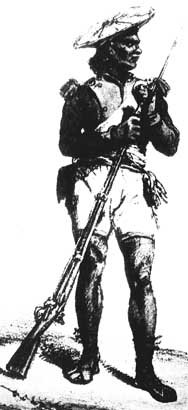
 CANKERS
OF A CALM WORLD:THE SEPOY REVOLT
CANKERS
OF A CALM WORLD:THE SEPOY REVOLTThe Sepoy Revolt of 1857-1858 in India was "the most dramatic event in nineteenth-century India, . . . . the most enigmatic event in British Indian history."(1) In Shakespeare's The First Part of King Henry the Fourth, the character Falstaff speaks of the cankers of a calm world in which the cosmos is now peaceful but has a corruption which threatens to explode and ruin all.(2) The Sepoy Revolt was the result of the explosion of festering social wounds, and the sight of the situation was pitiful.
Indian soldiers in the British East Indian armies were known for their loyalty to the Crown and their affection for their officers, but they were torn by their religion and their way of life which many of them believed the British were there to destroy. The event was a pivotal point in British Indian history, "the swan song of old India."(3)
THE REVOLT'S IDENTITY
Just what was the identity of the Revolt of 1857? Four basic opinions are held. First, that it was "only a military revolt caused by ignorance, negligence, and astonishing ineptitude on the part of the [British] government and army."(4) However, if this event were purely military, there is no explanation why the Muslims would support the Hindu caste grievances concerning the greased cartridges. Second, some historians have said that the event was a conspiracy. Those holding this view break down into two religious sides which state that either the Brahmans were using Kshatriya grievances for orthodox purposes, or the Muslims were trying to retake control of the old Mogul Empire. Unfortunately, there is no clear evidence to support this idea. More than that, the Hindu Maratha and the Mogul Emperor were taken by surprise at the uprising. Third, a small group believe the Indians were fighting their first war for independence from British rule. However, there was no Indian nation, no common language, and nationalist groups were few and opposed to the insurrection, looking to bring back the past rather than forge a new future. Fourth, some believe that socio-political tensions were set off when military problems came to a head over greased cartridges. A military mutiny stemming from agitating social forces is the most reliable explanation.(5)
The revolt had been secretly and well organized, but a premature outburst rather upset the plans of the leaders. It was much more than a military mutiny, and it spread rapidly and assumed the character of a popular rebellion.(6)
THE REVOLT'S CAUSES
The cause of the rebellion was a "clash of old and new on the material, ideological, and religious planes. It was the last passionate protest of the conservative forces in India against the relentless penetration of the West."(7) New Western institutions were a source of great fear and an unavoidable canker to the Indians. The spread of English education and "the appearance at the same moment of the steam engine and the telegraph wire seemed to reveal a deep plan for substituting an English for an Indian civilisation."(8) The natives believed the British education was a threat to the Indian society. Hindu education was belittled and Christian missions pushed. The teaching of European science and medicine was at the "expense of oriental learning."(9) English endangered Sanskrit and Arabic studies. Christianity and infidelity were set against the Hindu and Muslim religions. The telegraph was evil, and the railroads put crowds together, threatening caste.(10)
Fear of the loss of caste was a great problem for Indians. In 1856 the British brought in the General Service Enlistment Act which provided that new army recruits must serve overseas as well as in India. To cross the dark waters would stain a Hindu's caste standing beyond repair. The act was passed to ensure plenty of soldiers for Burma where four years before the native regiments there refused to obey orders to march, but the sepoys believed the act was a conspiracy to pollute the Brahmans and other high caste people, thus making them more likely to become Christian.(11)
Hindus made much of the canker they saw as a conspiracy to make all Indians Christian. The Case Disabilities Act of 1850 provided that Christian converts could inherit property, thus giving the religion of the West a material advantage. In 1856 an act was passed which permitted widow remarriage. Hindus believed these laws were direct attacks on their religion to force them into Christianity. The Hindus also disappoved of reforms suppressing suttee and infanticide.(12) When the problem with greased cartridges came, it was "proof of an insidious missionary plot to defile them and force their conversion to Christianity."(13)
Economic factors added to the causes of the revolt. When the Mogul government and clergy were forced from power, they had no jobs to fall back on. The Hindu middle class had to keep the economy going while the unemployed Muslims could only "sigh for the past and hate the present."(14) When the soldiers in Oudh were disbanded, there was no other employment. Agricultural reform to put farmers on their own land had dispossessed and disgruntled great landowners.(15) What employment was available was usually in the army and a native could not advance enough to suit his own ambitions.(16)
An important immediate cause of the insurrection was the Governor General Dalhousie, a
man who embodied the progressive go-ahead spirit of the Victorian age, . . . . [and] one of those proud and intelligent but impecunious Scotch lords who sought fame and fortune in official service.(17)
Dalhousie encouraged commerce, industry, education, and some welfare, though democracy was not part of his plan. He was an "aggressive Westernizer and reformer"(18) who had no time for Oriental tradition and culture. He was a freight train ready to usher in a new era of a Westernized India. Following Dalhousie's arrival in India and his defeat of the Sikhs, in his words "with a vengeance," he annexed the Punjab and ruled it with an intense public works and military might. He built irrigation canals, roads, railroads, telegraph systems, an engineering college, and three Western universities. He believed in direct British utilitarian rule.(19) Dalhousie's annexation policy was distasteful to the natives because he offended Hindu custom which provided for an adopted son to have the full inheritance rights of a natural son.(20) When Dalhousie saw an area which he deemed misgoverned or without natural heir, he would turn out the dynasty, causing unemployment and discontent. Dalhousie said the British must approve of adoptions and if not, the state lapsed to the English.(21) Dalhousie left India in 1856 believing he had done India a service, and the next governor-general could look forward to peace and the benefits of public works. But Dalhousie had forgotten the feelings of the Indian people.(22)
The new Westernization was very strange to the Indians. Steam and electricity were magic; the Enfield rifle was a mystery. Those laying railroad and telegraph lines were binding India in chains. The sepoys believed they would be used to conquer Persia and China, and the new governor general would destroy caste and force Christianity, beer, and beef on them.(23) The sepoy revolt was the
last effort of the old conservative India(24) [to resist Western penetration which] was bound to sow suspicions that the new measures were deliberately undermining the old and that they portended ruin and disgrace.(25) The imposition of a wholly alien civilisation on a society which was already becoming chaotic, and in which the long-standing struggle between Hinduism and Islam was coming to a head, necessarily produced tension and discontent.(26)
THE REVOLT'S EVENTS
Forty-four year old Lord Canning succeeded Dalhousie in 1856(27) to the governor-generalship of India. At the farewell banquet in London given in his honor by the Court of Directors, Canning said these prophetic words:
I wish for a peaceful term of office, but I cannot forget that in the sky of India, serene as it is, a small cloud may arise, no larger than a man's hand, but which, growing larger and larger, may at last threaten to burst and overwhelm us with ruin.(28)
The very life-blood of the British enterprise in 1857 was the Company Army which was divided into three divisions located at Bengal, Madras, and Bombay numbering 238,000 troops--38,000 of whom were Europeans. The Army of Bengal itself consisted of 128,000 men including 23,000 Europeans,(29) and extended from Calcutta into the Northwest of India. Many sepoys of this army were Brahmans and Rajputs who had started four minor mutinies in the last thirteen years. Lax discipline ruled; they were idle and restless and "imagined that all India was at their feet."(30) Dalhousie said "the discipline of the Army from top to bottom, officers and men alike, is scandalous."(31) However, the general loyalty of the sepoys had never been questioned. Right up to the revolt, Company army officers "seemed to vie with one another in apparently genuine declarations as to the loyalty of their troops."(32) Disreali later said about the rebellion: "For a considerable period of time the state of India was one of menacing combustion, and all that was wanting was the occasion and the pretext."(33)
Combustion came and Canning's cloud soon darkened the sky of northern India. The issue of greased cartridges for the new Enfield rifle came to the fore. The grease was rumored to be of cow and pig fat, detestable to both Hindus and Muslims. Four sepoy regiments were stationed at Barrackpore, sixteen miles from Calcutta.
One day a low caste native known as a Laskar asked a Brahman sepoy for a drink of water from his brass pot. The Brahman refused, as it would defile his pot. The Laskar retorted that the Brahman was already defiled by biting cartridges which had been greased with cow's fat. This vindictive taunt was based on truth. Laskars had been employed at Calcutta in preparing the new cartridges, and the man was possibly one of them. The taunt created a wild panic at Barrackpore. Strange, however, to say, none of the new cartridges had been issued to the sepoys; and had this been promptly explained to the men, and the sepoys left to grease their own cartridges, the alarm might have died out, but the whole Bengal army was upset.(34)
The order to bite the cartridges was revoked and the men allowed to use vegetable fat. This prompt correction should have prevented any problems, but it was seen "as the last straw to break the orthodox camel's back."(35) Though as poor as Job, they were not so patient. To the soldiers, it was firm evidence that the officers wanted to destroy caste. News of greased cartridges raced quickly up the Ganges and Jumna Valleys to Benares, Allahabad, Agra, Delhi, and Meerut. From Meerut, a rumor came that cow and pig bones had been ground to powder and put in wells and sugar to destroy caste and make people Christian.(36) Factories in Woolwich, England, had used animal fat in the production of the cartridges.(37) When regiments refused the cartridges, they were stripped of their uniforms and sent home without pay, pension, or pride.(38) The officers' denial of animal fat being used meant to the Hindus that a plot was surely afoot to destroy them.(39)
The Mutiny was not entirely subcontinental. Southern India, central and east Bengal and Rajputana remained loyal. One Briton said: "There were many who had tales to tell of the loyalty of Indian friends and soldiers, and of the devotion of Indian servants by whom their children were taken to places of safety."(40) Trouble developed only in the Punjab, Ganges Valley, and central India where the army insurrection was "encouraged by social unrest and discontent."(41) There the people rose up sometimes before the military. In Muzaffarnagar, the villagers plundered and destroyed the town on May 14, 1857, while the military did not mutiny there until June 21. Lucknow's people rose up several days before the 71st Infantry did on May 30. Banda had some popular commotion, and Fatehpur, though not a military outpost, had civilian natives arming themselves in June. In Bijnor the people rose up as early as the nineteenth of May, and Budaun's people were rebellious long before the mutiny there on June 2.(42)
One of the first incidents occurred in March 1857, when a sepoy named Mungal Pandy of the 34th Native Infantry "walked about the lines with a loaded pistol, calling upon his comrades to rise, and threatening to shoot the first European who appeared."(43) When a Lieutenant Baugh with a European sergeant and Muslim orderly rode up, there were shots and a fist fight. A group of twenty sepoys stood by watching and began to beat the Europeans' heads with their rifle butts. General Hearsey himself broke up the fight, and Pandy and other leaders were hanged in April.(44)
On May 3, 1857, at Lucknow, a regiment of Oudh Irregular Infantry mutinied. Sir Henry Lawrence with a European regiment of foot cavalry and eight guns took the Oudhs by surprise. The natives ran from the cannon, but they were caught. With their regiment disbanded, all was believed well. But there was something rotten in this Denmark. All over Hindustan and Punjab there was arson at military stations and a lack of usual respect for European officers, but the British believed erringly that all would soon be back to normal.(45)
Meerut was the largest military station in northern India with a strong European force. At Meerut there were three sepoy regiments--two of infantry and one of cavalry--with "enough Europeans to scatter four times the number."(46) All the major rumors of bone dust and animal grease were here; therefore, on May 6, the British tested a native cavalry regiment for loyalty by ordering them to use old cartridges and parade in the presence of the Europeans. Eighty-five sepoys refused, were arrested, and convicted by a native court martial. On May 9, the eighty-five were stripped of their uniforms, placed in irons, and jailed under native guard. "No one dared to strike a blow in the presence of loaded cannon and rifles."(47)
On Sunday, May 10, 1857, the sepoys were taunted by the loose women about allowing their companions be imprisoned. "We give no kisses to cowards!" they said.(48) The European and native barracks were separated by shops and trees, and a fear ran through the natives that the Europeans were about to attack them. All was quiet on the European front until 5:00pm as the British were heading to evening worship service. The sepoys, having been worked into a frenzy, let all the jail inmates out and went wild. A colonel of one regiment was shot and killed by the sepoys of another regiment, and in great excitement they went about killing every European they met, burning buildings, and wreaking havoc. The Europeans had trouble regrouping. While British officers were being murdered, the European regiments went through roll call. Men and women were shot and sabred as they ran from church. When the Europeans did get to the native barracks, they found the sepoys gone to Delhi to put the old emperor back on the throne.(49) As they went they shouted, "Chalo Delhi!" (Let's go to Delhi!)(50) Soon "the Maratha leader Nana Sahib found himself the head of the mutiny in Oudh with Lucknow as the center,"(51) while the Punjab stayed relatively quiet, hating a revival of Mogul rule. On May 11, 1857, the sepoys killed European officers in Delhi and took over the city.
Generally the Sepoy Revolt is divided into three periods. First was the summer of 1857, as the revolt spread and was put down and held until reinforcement could ensure British control. The relief of Lucknow occurred in the autumn of the year, and third, the mopping up operations which were completed by April 1859.(52) The purpose here is not to discuss military strategy of the suppression of the rebellion, so it will but briefly be given with attention to items of interest.
At Cawnpore, rumors that the parade ground was mined with gunpowder which would be detonated when the natives assembled caused mutiny there on June 4. They shot and burned and went screaming off toward Delhi, too. With no excitement in Delhi, the sepoys came back. Hearing there were immense riches in the British fort, they besieged it Alamo-style until the Europeans agreed to surrender because of the suffering women and children. The natives agreed to allow safe passage of everyone to Allahabad, but as soon as the British were in their boats, the sepoys opened a raking grapeshot fire on them. Only four men survived of the 450 who boarded ship. A few days later 200 refugees of mutiny upstream landed at Cawnpore unaware of previous events. The men were butchered, and the 125 women and children imprisoned.(53) The British sent relief to Cawnpore and defeated the sepoys outside the town. On the night of July 15, they returned to Cawnpore with news of their defeat, and the women and children were hacked to pieces and "the bleeding remains of dead and dying were dragged to a neighboring well and thrown in."(54)
On the Indian side were the conflict of religious and military loyalties, the fear of disgrace, and the certainty of death with defeat; on the British, desperation and ferocity produced by the fear of treachery on all sides and the feeling of fighting with one's back to the wall. These explosive forces, reinforced by extreme climactic conditions, led to the savage acts on both sides that gave to the mutiny its sinister reputation.(55)
On June 11, 1857, Neill retook the fort at Allahabad, and from July 7 through September 25, General Havelock fought his way from Cawnpore into Lucknow but was driven off by 50,000 rebels.(56) On September 14, 8,000 British troops reinforced by troops from outside India(57) assaulted Delhi's 30,000 sepoys inside (58) and recaptured the city in six days of street fighting.(59) Havelock re-relieved Lucknow in November, and by March 1, 1858, he had driven the rebels under Tantia Topi into Nepal. By July 8, 1858, Lord Canning proclaimed peace, though some areas still needed straightening.(60) Town by town through January 1859, the revolt was put down.(61)
THE REVOLT'S SAVAGERY
The revolt "was essentially a feudal rising, though there are some nationalistic elements in it."(62) Parliament as a result took over the government of India, and the Indian Army was started over. There was a "race mania and lynching mentality . . . [which] prevailed on an enormous scale."(63) Native women and children were not actually hanged or burned, but sometimes they were "accidentally shot."(64) To the British, these sepoys were "nigger natives." After news of the Cawnpore Massacre, "wanton attacks on passive villagers and unarmed Indians, even faithful domestic servants, became common practice."(65) Many mutineers were strapped to cannon and blown away. The Raja Shankar Shah and his son were blown from cannons because a piece of paper found on his person had written on it a prayer "invoking a multi-armed goddess to aid him to upset the British government."(66) "Even the great and wise John Nicholson, maddened by the atrocities at Cawnpore, demanded that 'the flaying alive, impalement, or burning of the women and children at Delhi should be legalised.'"(67) John Blick Spurgin wrote:
I told the guard
that any man who wanted to fire off his musket (in
case of damp) might come and shoot a sepoy. Several men at once came
forward,
and I told them to march the prisoners down to the riverbank to avoid
having
to carry the bodies there. Only one prisoner--a low caste man-- fell at
my feet and asked for mercy. I told him that the only mercy I'd give
him
was to have him shot first. All the rest died bravely and their bodies
hove into the river."(68)
THE REVOLT'S AFTERMATH
The cost to put
down the mutiny was 36 million pounds,(69)
and it was charged back to the Indians in higher taxes. As a result of
this revolt, the Crown took over the administration of India with the
Act
for the Better Government of India signed by Queen Victoria on August
2,
1858,(70) to go into effect November 1,
1858. Amnesty was granted officially to all rebels, and a solemn
promise
was made that the British had no desire to tamper with caste.(71)
All direct government was transferred from the British East India
Company
to the Crown, and the governor-general's title was changed to viceroy.(72)
The Company's European troops became part of the royal forces, and the
Indian navy was abolished.(73) The
sepoys
had lost from the beginning. The sepoys had no confidence, and only a
fear
of the loss of caste with no new ideas. Their only goal was to turn
back
the clock to the old days. The British, on the other hand, had to win
this
contest. They had reinforcements and good leadership, a belief in their
right and moral responsibility to rule. British national pride was at
its
height in a world where the self-confidence of the West reigned.
"Neither
Mughal, Maratha, or the Company was the real victor of the struggle. It
was the pervasive spirit of the West."(74)
Though the British government still had cankered problems, they could
be
assured of a calm British Indian world and a long enforced peace.
Basham, A.L., ed., A Cultural History of India. Oxford: Oxford University Press, 1975.
Chaudhuri, Sashi Bhusan. Theories of the Indian Mutiny. Calcutta: The World Press, 1965.
Collier, Richard. The Great Indian Mutiny. New York: E.P. Dutton and Company, 1964.
Griffiths, Sir Percival. The British Impact on India. n.p.: Archon Books, 1965.
Hibbert, Christopher. The Great Mutiny: India 1857. New York: Viking Press, 1978.
Hunter, Sir William Wilson. The Indian Empire: Its Peoples, History, and Products. New York: AMS Press, 1966.
Lyall, Sir Alfred. The Rise and Expansion of the British Dominion in India. New York: Howard Fetig, 1894, 1968.
Majumdar, R.C., et. al. An Advanced History of India. New York: St. Martin's Press, 1967.
Myrdal, Jan. India Waits. Chicago: Lake View Press, 1986.
Nehru, Jawaharial. The Discovery of India. New York: The John Day Company, 1946.
Spear, Percival. India: A Modern History. Ann Arbor: The University of Michigan Press, 1972.
Spear, Percival, ed., Smith, Vincent A. The Oxford History of India. Oxford: Oxford University Press, 1958.
Wheeler, J. Talboys. India. New York: Peter Fenellon Collier, 1899, Volume II.
Wolpert, Stanley. A
New History of India. Oxford: Oxford University
Press, 1982.
1. Percival Spear, India: A Modern History (Ann Arbor: The University of Michigan Press, 1972), pp. 264, 269.
2. William Shakespeare, The First Part of King Henry the Fourth, Act IV, Scene ii, Lines 32-33. "the cankers of a calm world and a long peace." The idea to use this quotation comes from Sir Alfred Lyall, The Rise and Expansion of the British Dominion in India (New York: Howard Fetig, 1894, 1968), p. 331.
6. Jawaharial Nehru, The Discovery of India. (New York: The John Day Company, 1946), p. 324. Nehru adds that the rebellion was "a war for Indian independence, . . . . [though] nationalism of the modern type was yet to come." pp. 324-325.
8. Sir William Wilson Hunter, The Indian Empire: Its Peoples, History, and Products (New York: AMS Press, 1966), p. 288.
9. Percival Spear, ed., Vincent A. Smith, The Oxford History of India (Oxford: Oxford University Press, 1958), p. 665.
11. Stanley Wolpert, A New History of India (Oxford: Oxford University Press, 1982), p. 233.
14. Spear, p. 232. Spear adds: "That is why the Mutiny, which began as a Hindu outbreak, came to be identified more with the Muslims in the end." The problem with this statement is that the Muslims were also upset about the animal grease, and the mutinous sepoys ran to the Mogul emperor at Delhi at the outbreak.
15. Sir Percival Griffiths, The British Impact on India (n.p.: Archon Books, 1965), p. 103.
17. Spear, p. 264. Dalhousie had been undersecretary to Gladstone when he was president of the Board of Trade in Peel's government. In the 1840's he worked with the railroads during the boom and was governor-general from ages 35 to 44 (1848-1856.)
20. The custom arose from the sometime need of a son at a funeral. Ibid., p. 268.
21. Ibid. In this way he took over Satara in 1848, and Nagpur and Jhansi in 1854. J. Talboys Wheeler, India (New York: Peter Fenellon Collier, 1899), Volume II, pp. 718-719, says that Dalhousie's civil court system in the newly annexed Oudh upset Indians. Before, a grievance was reported to the British Residency at Lucknow. Now, however, he could be no big man and appeal to the British office for redress; he must present his case before equals and lower caste people.
23. Wheeler, pp. 717-718. Muslims had forced Islamic conversion of Hindus by making them swallow beef.
29. Spear, p. 271. Oxford History, p. 666, states the Bengalese army at 151,000 of whom 23,000 were European, including 13,000 men in the Punjab and in support of the Crimean and Persian Wars. 40,000 or 1/3 of the army were high caste Brahmans or Rajputs, and were hard to control. Bentinck said they were "the most expensive and inefficient army in the world."
33. Sashi Bhusan Chaudhuri, Theories of the Indian Mutiny (Calcutta: The World Press, 1965), p. 40.
48. Richard Collier, The Great Indian Mutiny (New York: E.P. Dutton and Company, 1964), p. 33.
49. Wheeler, p. 723. Spear, p. 272, says that it is 40 miles to Delhi from Meerut. Also, the emperor's name was Bahadur Shah.
68. Christopher Hibbert, The Great Mutiny: India 1857 (New York: Viking Press, 1978), p. 331.
70. R.C. Majumdar, et. al. An Advanced History of India (New York: St. Martin's Press, 1967), p. 775.
