 POOR
LEADERSHIP: Matthew 15:1-14
POOR
LEADERSHIP: Matthew 15:1-14
©2003 by Gene Brooks Home
Notes partially
from Chuck Swindoll
How to
Recognize Poor Leadership
- When human opinion is valued above the Word of God. (v. 3-6)
- When hypocrisy prevails over authenticity (v. 7-11)
- When money is being handled to suit oneself and not to honor the
Lord (v. 5)
- When trusted, capable leadership is not honored (v. 4-6)
- When rules and policies are put in place without consulting those
who will be affected (v. 3, 9)
- Jesus is railing against the rules laid down by
the rabbis called the "Tradition of the Elders," which is an
interpretation and policy manual on how to live a holy life. For
example, since priests are required to
ritually wash before entering the Temple, and since a man's body is his
Temple, a man (like a priest)
should wash ritually before sitting down at his table (the altar) to
eat his food (sacrifice).
- See Colossians 2:20-23 on legalism.
- When things are done for the sake of appearance and are not from
the heart (v. 8)
- When outward behavior is honored more than inner heart life and
having a good appearance
is enough to cover black deeds done behind the scenes (v. 7-10).
- When personal offense is taken if anyone asks for accountability
(v. 12)
WHAT
SHOULD YOU DO IF YOU FIND YOURSELF UNDER POOR LEADERSHIP?
- Remember that positional leadership is not necessarily
God-ordained, Spirit-anointed leadership.
- Be confident that God will take them out with impunity at His
timing. His discipline will be
severe.
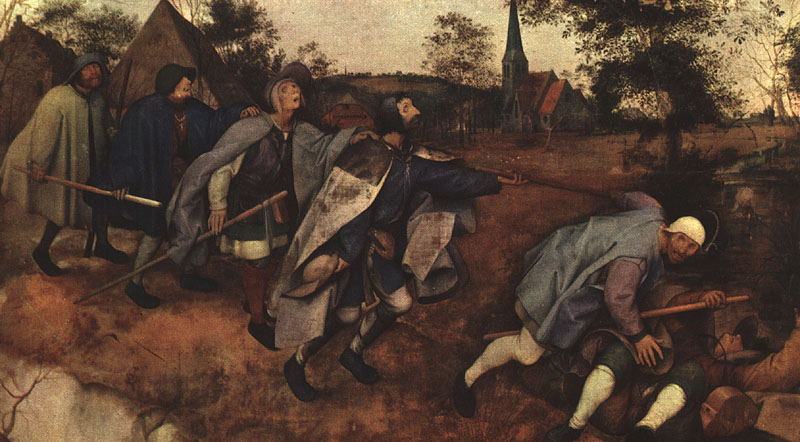
- "Leave them. They are blind guides" (v. 14). If you don't, you
will find regret it and waste the
time you have left on this earth for the Kingdom's work.
Picture above:
BRUEGEL, Pieter the Elder
The Parable of
the Blind Leading the Blind
1568
Tempera on
canvas, 86 x 154 cm
Galleria
Nazionale, Naples
Page created July 22, 2003
Updated November 29, 2003
 POOR
LEADERSHIP: Matthew 15:1-14
POOR
LEADERSHIP: Matthew 15:1-14