 INTEGRATING
HISTORY AND COSMOLOGY:
INTEGRATING
HISTORY AND COSMOLOGY:
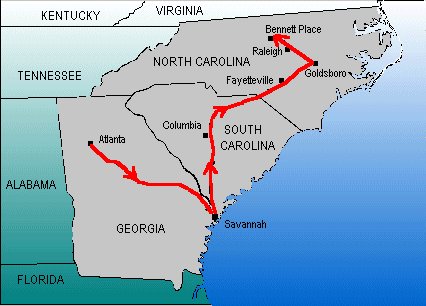
In November 1864, after capturing and torching Atlanta, William Tecumseh Sherman's army marched through Georgia and the Carolinas in a devastating psychological blow to the Confederacy. Recently the AD2000 United Prayer Track began preparation for Operation Restoration , a prayer expedition along Sherman's route scheduled for October 1-November 15, 1996. Four intercessors scouted the 800-mile trail through Atlanta, Savannah, Columbia, Fayetteville, and Raleigh in August and December 1995, following a planned prayer expedition route focusing on repentance and reconciliation along the 60-90 mile wide swath which Sherman's 60,000+ army cut through the region in late 1864 and early 1865. Sherman himself called this march "one of the longest and most important marches ever made by an organized army in a civilized country."
In a daring military move, Sherman struck out across this breadbasket aiming to bring the Southern people to their knees by sheer force and wholesale destruction. The war atrocities committed by United States troops and the bitterness and hatred nursed in Southern homes for over a century have never been subjects of wide-scale repentance. It is time for believers to ask the Lord's forgiveness for these corporate sins and petition Him to clear another obstacle to nationwide revival and spiritual awakening.
THE CHALLENGE
The challenge has been to integrate history and cosmology, something I was never taught in taking my undergraduate degree in history. We Westerners have no concept of how to mesh cosmology and history. According to Hiebert and Shaw, history can be defined as "our story," and cosmology as the "universal story." As modernists, we were trained to "dispense with cosmology, treating it as mere "myth," i.e., untrue and unimportant.
Lacking a cosmology that gives meaning to history, history must make sense out of things within itself. This leads to a desperate search for a total reconstruction of history." In the Judeo-Christian view, however, "derived primarily from the Bible, history is placed into the center of cosmology and linked to it by creation, intervention, and end. Because of this linking, history takes on meaning."
Perhaps a post-modernist understanding will move toward a more Biblically validated integration of cosmology and history. Below I have attempted an integration of cosmology and history along Sherman's swath that emerges from the reconnaissance missions taken in late 1995.
STRONGHOLDS OF DESPAIR
A haunting, hopeless desperation marked the Union army's path through Georgia and the Carolinas. In South Carolina where Sherman's scourge was worst, we found crossroads historical markers in pine swamps which said things like, " Here stood Robertville, SC, burned by Sherman's troops." No one ever rebuilt the town, and the swamps reclaimed it. In illustration of this stronghold, we found a similar marker in Gillisonville, SC, just north of Savannah. There were a few post-Depression houses there, but the marker was in front of a large green field. On or near that site had been the town of Gillisonville until Shermanwiped it out, the marker stated. Today, as a sign of the deed, only a field in the swamp remains. Sherman was adamant: "When I go through South Carolina it will be one of the most horrible things in the history of the world. The devil himself couldn't restrain my men in that state." Earlier in Georgia he had said, "I could look forty miles in each direction and see smoke rolling up like one great bonfire."
OCCUPATION CONTINUES
We also discovered declarations of freedom in the midst of spiritual tyranny. While declared free, the region seems occupied by an enemy still. Motifs include political independence vs. military occupation, master vs. slave, white settler vs. indigenous peoples. Indeed, in McDonough, GA, the Lamp of Liberty on the town square has been shot out. Churches are small and usually lifeless, and a spirit of old-time Religion reigns in place of a vibrant Christianity.
FREEMASONRY
Masonic lodges were often among the few buildings left standing in a town on the March since Sherman and his officers were sympathetic freemasons themselves. The lodge in Sandersville, GA, is an example. The historic marker next to it commemorated its being built by slave labor as a replica of the Temple to Athena. "Of all the public buildings" in Sandersville, it was the only one untorched because of the pleas of two Methodist ministers, themselves faithful lodge members. Solomon's Lodge #1 in Savannah, adjacent to the first Georgia capitol and across from the federal building, is the oldest continuous lodge in the Western Hemisphere. A marker there celebrates James Oglethorpe, founder of Georgia, as the first Grand Master of this Mother Lodge of all Georgia Masons, numbering 100,000 in 1969.
SAVANNAH
Artwork, building pedestals, fountains, and the riverfront park at Savannah's Solomon's Lodge are inundated with griffins and two-legged mermen. Two hundred feet away is the place where Oglethorpe set foot on soil belonging to the Yamacraw Nation in 1732. The grave of Tomochichi, the Yamacraw headman who gave the land for Savannah, is on a major ley line called Bull Street which includes Forsyth Park on one end (its sidewalks forming a mirror image of the Masonic insignia) and the Capitol building on the other, now City Hall.
Sherman's and earlier British military headquarters, a significant synagogue, five prominent obelisks, important Presbyterian and Episcopal churches, former slave markets, and the sites of secession rallies, the first Sunday School and John Wesley's first American sermon are all found on Bull Street. At nearby Fort McAlister we noted "a despair unto death" as 230 Confederates fought hand-to-hand, Alamo-style against thousands of US troops in a fifteen minute confrontation.
BENTONVILLE, NC
In regard to this American wound, it seems as if Georgia is desperate, South Carolina's spirit has been broken, and North Carolina has tried hard to forget. One exception in North Carolina is the Fayetteville area where Sherman ordered the magnificent Arsenal there "deliberately and completely leveled," "blown up with gunpowder, its wall knocked down with rams, and fire applied to the wreckage."
In 1994, citizens there voted down a referendum proposal to place a monument at the nearby Bentonville battlefield memorializing the Union dead there whose graves are still unmarked. Site of the last Confederate offensive against Sherman's army, the offense still remains. Most Confederate monuments in the South went up around 1910 when the last of the veterans were dying. Not Bentonville. They erected a large memorial in 1992 to the heroism of the seventeen and eighteen year-old boys who defended their land against what they would call the barbaric hordes of Sherman.
RIVERS BRIDGE, SC
Speaking of battlefields, the only real battle fought in South Carolina on this campaign was Rivers Bridge on the Salkehatchie River swamps between Columbia and Savannah. When we arrived there, we were befuddled to find two diminutive statues--a wretched-looking old man in a violent wind trying to cover himself with a sheet, and a sad woman pulling her cloak around her. No inscriptions. When I asked the Lord about these 4 1/2 feet statues, I heard a howling scream. It was agonizing, desperate, deep, and unceasing. I do not know what it was, but Burke Davis' Sherman's March offers a suggestion from his description of the battle: "men mutilated in every shape conceivable, groaning, begging for assistance and gasping in death. Many had their heads propped up out of the water where they lay to keep them from drowning." I heard the screams until we were several miles away. It was deafening and sickening. Seven miles later we passed near the site where Sherman turned the Confederate flank on the Salkehatchie. There was a simple granite stone at the intersection which stated, "Site of the town of Buford's Bridge, burned 1865."
GENERAL ROUNDUP
Sherman's trail passes Martin Luther King, Jr.'s birthplace in Atlanta, the site where the Creeks were forced to sign away all their lands in Georgia in 1821, an active old-time Methodist camp meeting in operation since the Second Great Awakening, and Milledgeville, Uncivil War capital of Georgia and home of the State Mental Hospital. Here, strangely, the capitol building (now the centerpiece of Georgia Military College) is perched on top of an ancient Native ceremonial site with huge gates at the north and south entrances built of bricks from the arsenal that Sherman destroyed. Just 100 yards away is the former site of a slave market and state gallows, now on the grounds of a Presbyterian church.
Farther down is Louisville, a strategic-level eye-opener ,at the convergence of Native paths, a former state capital, and centered on a c.1758 remarkably unrottable wooden Market House where slaves were auctioned. The oldest standing wooden slave market in the US, it was the scene of a Sunday morning riot in 1870 when freed slaves commandeered the village. Later in 1971, African-Americans, protesting the mysterious jailhouse death of a young black there, tried unsuccessfully to burn the Market down, but armed deputies were promptly stationed to protect the landmark.
Bulloch County, GA, in another strategic-level indicator, has permanently closed the north and south doors of its courthouse. In Cheraw, SC, the Masonic Lodge meets on the second floor of the c.1858 City Hall, and Old St. David's Church there is the site of the first Confederate monument erected in the South in 1867.
In Columbia the State House of South Carolina has bronze stars to draw attention to the marks which Sherman's cannon fire made on its walls. Winged dragons are frequent motifs on the State House grounds, similar in form to the flying serpents prominent in Native American archaeology of the Southeastern Ceremonial Complex.
Barnwell, SC was systematically burned. The women inhabitants were forced to participate in a Nero dance complete with violins while their own homes were in flames. Meanwhile, the Church of the Holy Apostles there served as a Federal stables. Sheldon Church in Yemassee became Sheldon Ruins after being burned twice in a century--by British troops in 1779 and Sherman's army in 1865. Raleigh's Memorial to Confederate Women depicts deep, groaning grief, and the rugged farmhouse near Durham which hosted the surrender proceedings is simple, hidden, and strangely powerful. Here the atrocities ended and a granite monument of two pillars at North and South compass points support a lintel called "Unity." Here the deep bitterness finds a birthplace where the decision was made not to "bind up the nation's wounds," but to force a Radical Reconstruction on a defeated people. The Confederate Monument in Bennettsville, SC, grasps the vision of this proposed prayer expedition well: "As to the grief which lieth behind,/Let us turn to the grace of forgiving."
NATIVE AMERICAN CONNECTIONS
Was Sherman's March a Divine judgment for earlier atrocities against the American Indians? The brutal Cherokee War (1760-1), the desolation of the Loyalist Cherokee Nation during the American Revolution (1776), a Spanish massacre of Guales (1579) and illegal cession of all Creek lands in Georgia (1821), in South Carolina two Yamassee Massacres (1715), the Waxhaw Massacre (1716) the Waccamaw War (1720), and the Neoheroka Town Massacre of the Tuscarora people in North Carolina (1712) could not have brought blessing on Georgia and the Carolinas. Four of these events occurred on or near the line of Sherman's March.
An overlay of Yamassee Nation towns to a modern South Carolina map shows Sherman's troops destroyed towns which were built on or near Indian town sites sacked by whites in 1715. The nearby Sheldon Church Ruins mentioned above are near a Yamassee town undoubtedly destroyed by white settlers in 1715. Sherman unwittingly followed the early frontier line of these three states--the same areas which called for elimination of the indigenous peoples.
In South Carolina in 1761, the Royal Government called for British regulars under Colonel Grant who decimated the Cherokees' midsection, burning almost all of the twenty-two Middle Towns in north Georgia and western South & North Carolina, raping women, and destroying crops and livestock. Sound familiar? Soon Cherokee headmen sued for peace from the governor. The Royal Assembly dissented, stating that the only thing "that will have any Effect to bring these Savages to a firm and lasting Peace is to destroy as many of their people as we can."
These rebelling colonies did just that in 1776 when the Cherokees declared loyalty to the Crown in the midst of Revolution. Simultaneous raids by Georgian, North and South Carolinian, and Virginian troops brought the Cherokees to their knees in a conservatively estimated seventy-five massacres. By 1777, Carolinians had made five treaties with the Cherokees alone. Even slavery's first appearance in South Carolina was not with Africans, but in marketing captured Indians to the West Indies' sugar plantations. Truly the curses outweigh the blessings in the Carolinas and Georgia.
POWER CONSOLIDATION
Though these atrocities deserve repentance and seem to settle the judgment question, there is a complicating contortion in Southeastern spiritual issues relating to Sherman's trail. If, indeed, Sherman's March was simply God's punishment on Georgia and the Carolinas, then why did WT Sherman lay a march route which unwittingly passes over major ancient ceremonial sites of the Southeast?
The mysterious Eatonton, GA, Rock Eagle and Rock Hawk Mounds; the Catawba Mounds near Camden, SC; the city of Milledgeville, GA, whose War-era state house straddles an ancient temple mound; the possible site of the ancient, illusive city called Cofitachequi near Columbia, SC, which de Soto visited; the Irene Mound in Savannah, GA; the nearby rebuilt temple at Town Creek Mound in Mt. Gilead, NC; Hanging Rock, SC, an important Native and Revolutionary War area; and the enormous ceremonial site of Ocmulgee National Monument at Macon, GA, which has been a ceremonial center since 1000 BC, are all on Sherman's route. Earlier in the Union campaign from Chattanooga to Atlanta, Federal forces had battled Confederates over the sites of the Cherokee capital New Echota, and the significant Etowah Mounds.
By comparison, only four of the estimated 100 Native Massacre Sites are even near Sherman's path. Of these, only two are directly on his route of march. Could Sherman's March through Georgia and the Carolinas have been a spiritual consolidation of power hosted by the ancient Native gods of the tri-state area? Did Sherman unwittingly continue the ancient raiding warfare that had been instituted thousands of years before by territorial spirits whom the Aborigines worshipped? Archaeologists agree that Southeastern ceremonial symbols are focused more on war and conjury than fertility--the usual subject of religious symbolism. In an effort to exert and expand control over the new European generation within their domain, could these old territorial spirits have coordinated a power consolidation with an invading army's route of devastating march?
PROPHETIC TIMING OF THE PRAYER EXPEDITION
OPERATION RESTORATION is scheduled for October 1-November 15, 1996. Since that time, we have discovered the timing of the expedition, which was for convenience on our part, has turned out to be prophetic on God's. First of all, the Presidential election will be held while we are on the trail repenting for national sins. Following are more examples.
HEAL THE LAND PRAYER THRUST
During October 1996, OR will be done in the midst of many prayer expeditions worldwide as part of AD2000's Heal the Land Prayer Thrust. This will put our team as one of many who are walking, praying, repenting, and forgiving in a global air assault on the Kingdom of Darkness.
THE LAST AMERICAN AWAKENING
Another coincidence is that the last national awakening began in New York City prayer meetings in October 1857, then slowed at the advent of war and jump started in the Confederate camps in October-November 1863. As furloughing Southern troops visited their homes over Christmas, revival spread throughout the South. In the spring Confederate POW's carried revival into the Union army camps, and furloughed wounded Union troops carried this renewal home to churches to reignite the flame that began in the North six years earlier.
THE FIRST SHALL BE LAST & THE LAST FIRST.
Early on we realized that the date we finish the expedition--November 15--is the anniversary of Sherman's leaving Atlanta, beginning his infamous march! His army began its move toward Savannah on its March to the Sea on November 15, 1864. Our team will pray at the Bennett House surrender site in Durham, NC, where it all ended on November 15, 1996. While I was in Durham in September 1995, talking for the first time to a group about OR, a lady commented that Durham was the place of surrender and is the last leg of OPERATION RESTORATION, but that these North Carolinians had been first to hear God's vision for OR. She said, "The last shall be first and the first shall be last." That statement has turned out to be precisely prophetic!
THE RECONCILIATION FEAST
Recently we discovered a really strange but exciting thing. Southeastern Natives have very similar religious systems to one another, but are relatively unlike the rest of the country in their culture and historic religion. The Cherokees had an important feast every fall ten days after the first new moon after the leaves begin to turn in the mountains. In this religious holiday, four days called the Reconciliation Feast, the members of the nation clean their homes top to bottom of any dirt (similar in fashion to the Jewish search for leaven at Passover), clean their towns, throw away their old clothes and get new ones, take away the council's old sacred fire and bring in new fire, and the people all go down to the river and are baptized to cleanse their spirits from any sin or pollution before their Creator. What a redemptive analogy!
What is really striking is that in lunar year 1996 the Reconciliation Feast occurs October 22-25--the four most heartbreaking days of the whole expedition in the bounds of the Yamassee Nation roughly between Savannah and Orangeburg. During these days we had already been planning an intensive week of repentance and reconciliation. In this area, the Yamassees were entirely wiped out, and the British were unmerciful to the patriots in this area during the Revolutionary War. Here some of the largest plantations in the South with the huge numbers of slaves existed. Today the area has some of the lowest per capita income in the nation (Barnwell County's is $5000 a year) and is a haven for African traditional religions as African Americans reject the Christianity of the white man. Here Sherman's troops were unleashed with a vengeance that was not seen before or after. This area is indeed one of the most prayer needy areas along the route. Since we have found that the Reconciliation Feast falls during these dates as if prophetically, we have been in awe, wondering what the Lord is doing.
THE LORD'S WORK
OPERATION RESTORATION is not the only thing He is doing in the Southeast. Major evangelism will occur in Atlanta during the Olympics, and the place of our orientation for the team will be in the same facility--Blood-N-Fire Ministries, an old cotton warehouse used as an inner city mission by Vineyard Downtown and on the site of Sherman's headquarters. Pastors in Fayetteville, NC, are gathering NC pastors to impart a vision for winning the whole state.
In September the East Coast International Conference on Prayer and Spiritual Warfare will be held in Fort Mill, SC, a Charlotte suburb. During those same dates Billy Graham will host probably his last crusade in his hometown of Charlotte, NC. The firstfruits of Carolina leadership will be depositing his final seed in his native state.
THE WORK IS EXPANDING RAPIDLY
Because of the Olympics (the first time Atlanta has been in the international spotlight since it was burned) Georgia will have received megaprayer from the whole world. North and South Carolina will also have been saturated with prayer in preparation for the Billy Graham Crusade which targets both states. We are finding out about Indian massacre sites and ceremonial and occult sites in the three states regularly where the Lord apparently wants us to pray.
Certainly the Lord is doing many things that we do not know about, and He has more things up his sleeve that are too big for us to imagine right now, but the integration of history and cosmology in order to understand and strategize against the cosmic-level powers for the prize of souls in the Kingdom of Christ Jesus has captured my vision and intrigue.
ENEMY INTELLIGENCE
The enemy apparently knows quite a bit about this venture already. A week before this scouting trip, I met with a Cherokee traditionalist whom I believed to be Christian to discuss this Native American connection. As the interview progressed, I discovered her to be a Unitarian/Universalist and practitioner of "ceremonies to heal the land." It was then that I discovered why the Holy Spirit had directed me before our meeting to pray about Native spirits.
Suddenly her face revealed insight: "Everything moves in fours. There were two wounds: the smashing of the Natives and the smashing of South Carolina. Now there are two healings. Your work is the first healing--a foundation for a building of God's purpose. You will plow the ground and plant the seed of healing in the land. Then the fourth work will come. It will be called Harvest."
Bottom line is that the enemy knows much more about this expedition's outcome than we have faith to admit. We are dealing with some of the most powerful principalities in the United States who are operating out of great strongholds built of unforgiveness and disobedience.
GATEWAY OF OPPORTUNITY
We find ourselves, therefore, at a gateway of opportunity. The last revival our whole nation experienced was during the War Between the States. Since then, the legacy of war atrocities, Southern bitterness, unheard-of strains of racism, and new waves of Indian massacres have given the enemy every right to hold back national revival and spiritual awakening.
Will our generation rise up and throw off the tyranny of the evil one? Will we servants of the Living God no longer consent to live in an enemy-occupied nation rapidly approaching judgment? Will we walk the land in repentance, seek reconciliation of our peoples, restoration of our beloved land, and freedom for our captives? We must do it, for this is perhaps the greatest opportunity and most pressing need for our nation's future.
Davis, Burke. Sherman's March. New York: Vintage Books, 1980.
Hiebert, Paul G. And Shaw, R. Daniel. The Power and the Glory: A Missiological Approach to the Study of Religion. Pasadena, CA: Hiebert & Shaw, 1993.
Sherman, William T. Memoirs. New York, 1875.