Diagramming Sentences
Sentence Diagrams
~ One Way of Learning English Grammar ~
The Basics of Sentence Diagramming
~ Sentences 36-40 ~
|
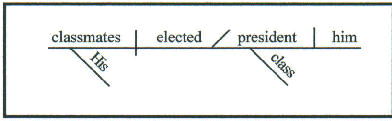
Sentence 36: His classmates elected him class president. |
||
 |
||
| An objective complement completes the action of the verb with reference to the direct object. In a diagram, it precedes a direct object and is signaled by a line that slants from lower left to upper right and rests upon the base line. In the above sentence, president is the objective complement. | ||
|
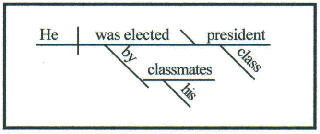
Sentence 37: He was elected class president by his classmates. |
||
|
||
|
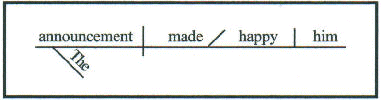
Sentence 38: The announcement made him happy. |
||
 |
||
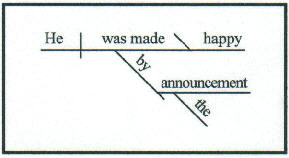
| In this sentence, the adjective happy is an objective complement. All objective complements, whether nouns or adjectives, are diagrammed the same way. | ||
|
Sentence 39: He was made happy by the announcement. |
||
|
||
|
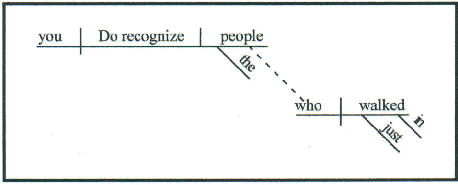
Sentence 40: Do you recognize the people who just walked in? |
||
 |
||
| Subordinate clauses are adverbial (those introduced by the subordinating conjunctions because, although, etc.), adjectival, and nominal (i.e., noun clauses). Prominent among the adjective clauses are relative clauses, which are subordinate clauses introduced by a relative pronoun. The relative pronouns are who, whom, whose, which, and that, and have an antecedent (a noun or pronoun previously mentioned in the sentence) to which they refer. In Sentence 40, who is the relative pronoun and people is its antecedent. A broken line connects the two. Notice that the word in, often a preposition, is an adverb in this sentence. Prepositions have objects. |
| Return to the Basics of Sentence Diagramming, Part Two |
| Return to Sentence Diagrams, page 1 |
| Return to German, Latin, English |