
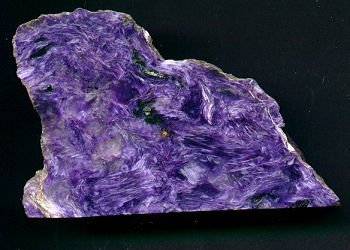
Since Charoite is found in only one part of the world: the Chara River area of Siberia, this part of Russia is known for its forbidding climate and terrain and as a traditional place of exile for political prisoners. There is a deep appropriateness to Charoite's origins, for it deals with an internal exile, that of fear. When we're afraid, we separate ourselves from a full appreciation of life, from the complete expression of our creativity. Most of all, we prevent ourselves from realizing all that we are spiritual beings.
It is a purple stone with black and white patterns. Purple is a sixth-chakra color, and the sixth chakra is where many of our limiting mental programs, including our fears, are stored. The color purple, among its other roles, helps to bring us closer to spirit by showing us that everything, even the thoughts we hold as true, can be dissolved and replaced with more empowering energies.The color black in this stone grounds the purple ray, and enables us to explore the nature of our fears; while white represents the connection to spirit.
It has been said that if we are not completely manifesting our potential as human beings fear is in some way stopping us. Look for those areas in which you feel limited, and you will find a fear which blocks you.Charoite will help to bring these fears to the surface. It helps to make this process easier by also giving you a boost of courage and commitment to dissolve fear patterns. If you choose to meditate with this stone, it's often a good idea to allow time afterwards to contemplate what you've learned. Another way to work with Charoite is to put it beneath your pillow, especially if you are prone to disturbed sleep or fears which surface in dreams. In combination with amethyst, it will help to release these fears
Assists in opening up our life's purpose. A protective transmuter of negative energies. Helps to discover our deepest fears and allows us to heal and release them. Gives us the courage to take our highest path.
Color: The colors in each piece of Charoite range from bright lavender, violet and lilac to dark purple with both white, gray and black veining. It forms a swirling pattern of interlocking crystals. Royal lavendar flows with chatoyant streaks of white around bits of black, peach and opalescent gray.
Description: (Ca,K,Na)3Si4O10(OH,F)H2O. Charoite is an unsual mineral and of rare occurence. It formed from alteration of limestones by the close presences of an alkali-rich nephline syenite intrusion. The heat, pressure and more importantly, the infusion of unique chemicals into the rock is responsible for the transformations into new minerals such as charoite.
The name's origin: Charoite is named after the nearby Charo River.
From the stone history: The Russians first discovered charoite in 1947 in the Murun mountains in Yakutia, but it was not known in the West until 1978. Charoite is used as an ornamental stone and as a gemstone.
Healing ability: Put charoite beneath your pillow, especially if you are prone to disturbed sleep or fears which surface in dreams. In combination with amethyst, it will help to release these fears.
Mystical power: Charoite is said to be useful for the cleansing and purification of one's energy body as well as for the transmutation of negative energies within oneself.
Charoite transmutes negativity and cleanses the aura. Charoite facilitates the release of fear and dissolution of negative energies encountered in the process of aligning with your soul's purpose. Work with Charoite to foster a synthesis between the heart and crown chakra, walk your spiritual path with awareness, and manifest your soul's wisdom and light in daily life. The purple color of Charoite, among its other roles, helps to bring us closer to spirit by showing us that everything, even the thoughts we hold as true, can be dissolved and replaced with more empowering energies.
The color black in this stone grounds the purple ray, and enables us to explore the nature of our fears; while white represents the connection to spirit.
Deposits: Charoite is found in only one location - along the Chary River at Aldan in Russia. This part of Russia is known for its forbidding climate and terrain and as a traditional place of exile for political prisoners.
Why charoite has not been found in other locations is not fully understood. But it is probably due to a combination of a chemically unique limestone reacting with a chemically unique intrusion and subjected to unique physical conditions.
