
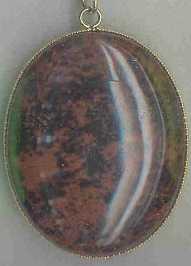
Obsidian is natural glass that was originally molten magma associated with a volcano. This volcanic glass has an almost total absence of sizable mineral crystals within the glass matrix. When I say "crystals," don't visualize those beautiful pointed prisms of quartz found in geodes. All rocks consist of mixtures of various crystalline minerals. When crystallization occurs, the atoms that comprise a mineral become arranged in regular, geometric patterns that are unique to the specific mineral. Crystal faces form only where there is enough open space in the rock mass to allow the natural geometric forms of the crystals to develop as free faces. Granite is composed entirely of intergrown crystals of quartz, feldspar, mica and other minerals. These relatively large mineral crystals (easily visible to the naked eye) give granite a rough fracture surface.
Like all glass and some other types of naturally occurring rocks, obsidian breaks with a characteristic "conchoidal" fracture. This smooth, curved type of fracture surface occurs because of the near-absence of mineral crystals in the glass. The intersections of conchoidal fracture surfaces can be sharper than a razor. This had obvious advantages for our Stone Age ancestors, who used obsidian extensively for tool making.
Obsidian consists of about 70 percent or more non-crystallized silica (silicon dioxide). It is chemically similar to granite and rhyolite, which also were originally molten. Because obsidian is not comprised of mineral crystals, technically obsidian is not a true "rock." It is really a congealed liquid with minor amounts of microscopic mineral crystals and rock impurities. Obsidian is relatively soft with a typical hardness of 5 to 5.5 on the mineral hardness scale. In comparison, quartz (crystallized silicon dioxide) has a hardness of 7.0.
Native Americans discovered almost all of the obsidian locations in North America. Each obsidian source area has a unique assemblage of trace elements, allowing identification of the original source locality for the obsidian used in prehistoric artifacts. Trace element analyses have shown that native peoples traded this valuable commodity many hundreds of miles from the volcanic source areas along numerous trade routes. The fact that obsidian was transported great distances attests to the mystique of this unique material
NOTEWORTHY LOCALITIES: Parts of Italy; the Caucasus Mountains of the former U.S.S.R; and areas in Mesoamerica -- e.g., the vicinity of Real Del Monte, State of Hidalgo, Mexico (especially for sheen obsidian) -- have been major sources. Also, several localities in the western United States are well-known for one or another kind of obsidian that has been used as a gemrock -- e.g., Mariposa and Pinal counties, Arizona; Glass Mountain, south of Lava Beds National Monument, Siskiyou County and near Davis Creek in adjacent Modoc County, northern California (especially for rainbow obsidian, but also for other varieties -- see Mitchell, 1987); near Milford, Beaver County Utah (especially for rainbow obsidian, but also for several other varieties, especially Apache tears); Glass Buttes, in northeastern Lake County, Oregon (photographs of fire, gold sheen, mahogany and rainbow obsidian from this locality are given in Pough, 1996); Millard County, Utah (especially snowflake obsidian); and Yellowstone National Park, Wyoming.
Used to produce honesty in ones actions, and insight into the future. Induces creativity and independent thought and action. A grounding, releasing stone that helps connect with the Earth.
