
DESTREHAN TOWN HISTORY
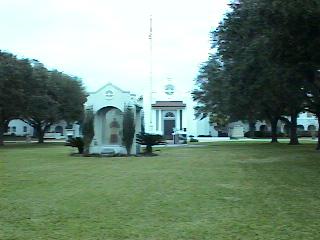
Little Red Church , St. Charles Baromeo, located in Destrehan. Second church located in the German Coast. Named for its red roof that River travelers could see from the river and used as a landmark.
The town of Destrehan is named for Jean Noel Destrehan, the son of Jean Baptiste Honore d'Estrehan de Beaupre, who was royal Treasurer of French Louisiana.�
Jean Baptiste Arrived in New Orleans in 1722 cleared his first home site and built in what is now Harvey.� That same year, he began work on what is now the Harvey Canal, the workmen for which lived in a settlement called New Mechanicam.� Nowadays, it is called Gretna.� He died in New Orleans in 1771, but not before he sired seven children.
Jean Noel Destrehan was born in New Orleans in 1754, the seventh child and third son.� He married Marie Celeste de Longny, whose father built Destrehan Plantation, where they raised 14 children.��� He added the two garconnaires and enclosed the ground floor in 1810.� His career included serving in the Louisiana Territorial Government from 1803 to 1812 and was vice mayor of New Orleans in 1803, was speaker of the First House of the Legislature and president of the Legislative council.� However, it was in 1794 where Jean Noel made his mark in Louisiana history, for it was his financing by $5,000 of Etienne de bore's experiments I present day Audubon Park which resulted in the first successful granulation of sugar cane.
This spawned a sugar industry, which, inside of 60 years, generated more millionaires in Louisiana than in the rest of the United States, prior to the civil war.� He died in 1823, after which the house went to his daughter, Eleonore Zelia, and her husband, Stephen Henderson, both of whom died prematurely.
The estate passed to her sister and, in 1839, acquired by Pierre Adolphe Rost, who served as a state senator.� At the time of the purchase, he was a state Supreme Court justice.� During the Civil War, he was and envoy to Great Britain and France.� He died in 1868 and passed it to his son Emile, who kept it until 1910.� Finally in 1914, the Mexican Petroleum Company purchased Destrehan Plantation and later became the Pan American Southern Corporation, later Amoco.� The plant closed in 1958 and the historic plantation house crumbled into an abandoned and vandalized ruin.
In 1972 the River Road Historical Society finally acquired the house and its surrounding five acres and began restoration work.
Upriver neighbor Ormond Plantation was built soon after Destrehan by Pierre d'Trepagnier on a Spanish land grant. However, in 1798, he was summoned from a family meal and mysteriously disappeared, never to be seen again.� In 1805, the house was bought from Mrs. Trepagnier by Richard Butler, who named it "Ormond" after his ancestral Irish home, Castle Ormonde.� The property was acquired by Samuel McCutcheon in 1819.� However, after the civil War, hard times forced Ormond on public auction twice in the 187's.� It was later acquired by State Senator Basile LaPlace Jr., but in 1899, he was called out and murdered by a band of men who visited one night.� One version says he fell afoul of the local Klan and another was that it was family members of his mistress, outraged at his behavior.� The next 40 years saw a succession of owners and tenants as the house crumbled.� However by 1942, Mrs. Alvin Brown began a major renovation and remained in the house until her death in 1968.� By 1974 it was acquired by betty LeBlanc, executive vice president of Barq's Beverages, who continued the restoration work until her death in 1986.� The house is now owned and operated as a restaurant and bed and breakfast by her son, Ken Elliott.
Destrehan gained its post office on June 2, 1916, as the refinery developed and attracted residents.� The first postmaster was Charles E. Smith.� Destrehan High School was dedicated on March 21, 1925.� However the original school burned down in the early 1970's and its present day replacement built soon afterward.�
Disasters occasionally hit Destrehan.� On Christmas Eve 1951, a gasoline barge exploded burning the 1.000-foot wharf. Bunge Grain Elevator exploded in 1970, with one killed in that accident, the explosion prompting the closing of Pecan Grove Elementary School.� On October 20, 1976, the Luling / Destrehan Ferry was reamed in the fog by the Norwegian tanker, "Frosta," and sank, drowning 78 people.� A memorial to the accident victims was later placed in Edgard in front of the St. John Parish courthouse.� The ferry itself closed on November 13, 1983 after 96 years in operation.� Yet, business thrived. In 1978, construction began on Plantation Business Campus immediately upriver from Destrehan Plantation and downriver from two-grain elevators.
Hubert St. Pierre, 72, has seen much of the sweep of 20th Century Destrehan history. Now the founder of St. Pierre's Air conditioning, he was born on Modoc Lane, the son of Denis St. Pierre had come from a family of 15 where everyone played music, from harmonicas to the elder St. Pierre's clarinet.� He started at Shell Oil in 1926 and played at the Saturday night dances.� He retired after a 33-year career.� Hubert was one of three sons, including Laurey (now a Baton Rouge resident and Gulf State Utilities retiree) and Roland (now a Norco resident, Shell retiree and member of the St. Charles School board).� He used to catch river shrimp in eight shrimp boxes in front of what is now the Dust Bowl lounge, a little bar which had been the Bouvier Drug Store, the blue Room with dances and movies, and Sal Portera's service station
Hubert's youth also included a lot of softball, movies three nights a week at the Shell Theater and swimming in the river. We had too much fun back then.� However, he added, "One thing that helped me the most was the Boy Scouts.";� All three boys earned Eagle Scout honors.� Then there was church and Father John F. Basty, who served from 1918 to 1949.� Associations with the church were always good.� He had known his future wife, Shirley, from high school but it wasn't until 1948 when he saw her at church and realized his true feelings.� They married in 1949 and now have seven children, 19 grandchildren and two great grandchildren
His wife still tends the candles at church every morning.� Also, in 1990 he worked with the committees organizing the 250th anniversary of the church's establishment on the East Bank.� He finished at Destrehan High School in 1943, joined the Merchant Marines and then finished his studies at Delgado to learn a craft. He followed his father like so many sons did in those times, to Shell, where he stayed until 1963.� However, in 1960, he began his part time Air conditioning business and he began running it full time in 1963, where he still puts in a day's work there, joined by his sons.