
Ressource Center

Luftwaffe's Aircrafts
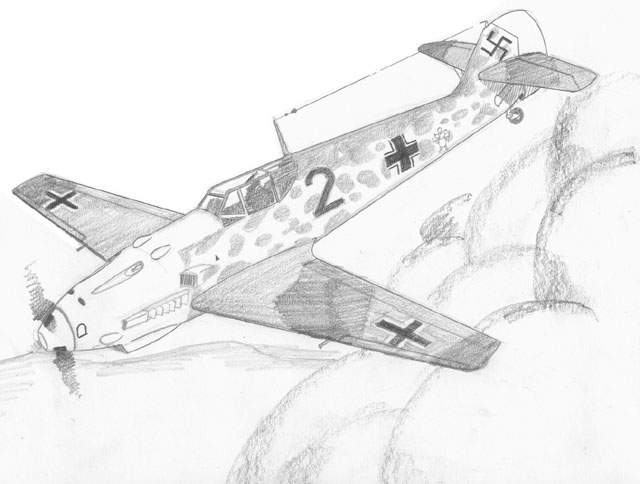
Messerschmitt Bf 109E "Emil"
Design
Luftwaffe's Aircrafts
Messerschmitt Bf 109E "Emil"
Design
The Bf 109 is an air superiority fighter that was the mainstay of the Luftwaffe for most of the late thirties and that bore the brunt of the fighting between 1939 and 1940.A monoplane in the midst of biplanes that were in service when it was designed, it is the first fighter that benefited from the 1935 Vienna conference where superscience theories were applied to aerodynamics and showed to the world, particularly to the scientific attending the conference.There it was made clear that future fighters if they were to be successful needed a lot of streamlining and different wing layouts and planforms.The Bf 109 showed the world how to do just this.Equipped with a mildly tapered cantilever wing, it was made entirely of flush riveted skin panels and all its underlying structure was either streamlined or hidden under the skin for reduced drag.The wing was also fitted with newly found high lift devices like wing leading slats.Those helped to produce lift in the same way as LE flaps but without the high drag penalty, thus the pilot was able to use them at high speed during a fight.This was a big departure from how other fighters-monoplane or biplane- of the time were designed.Most of them were either braced monoplane not very safe, or safer but less quick biplanes.The Bf 109 V1 of 1935 broke the speed record in level flight and subsequent development versions raised the mark during the late thirties.The basic Bf 109 version to enter service was the Bf 109B-0 in 1937, it received a Jumo 210A inverted V12 as powerplant and was able to reach 550 km/h in level at 3 250m.It was quickly replaced by an evolution called the Bf 109C-1 and entered the fray in Spain with pre-production Bf 109B-1 and B-2 sweeping all opposition in the skies over Madrid.In the meantime the fledgling Luftwaffe back in the fatherland was reequipping with the Bf 109D ìDoraî with a DB 600Aa engine, a 20mm MG-FF cannon and two MG 17 machine guns.At the start of the Invasion of Poland this was already being replaced in most of the Jägergeschwader by the Bf 109E-1, the ìEmilî.The Bf 109E-1 retained the same wing configuration but the front fuselage was modified a bit to fit and cool the new DB 601A engine of 1 100BHp output at sea level.It was much like the DB600Aa of the previous version but solved many reliability problem found in the previous version, there was also less pieces to break in the new engine and it was less difficult to cool down.Therefore a simpler and less draggy radiator box was added to the port side of the engine cowling, instead of the previous air traps.The biggest difference was in armament with two 20mm MG-FF with 60 rounds each in the nose plus two 7,9mm MG 17 machine guns in the wings.Although this differed slightly with Rustsatz, most of the fighters that were operational had this fitting while others only got 7,9mm MG 17 instead of the cannons.In the years in which it was used the Bf 109E-1 was a no beater for any of its opponents, it was fast, about 600 km/h, very well armed and rugged.
Service History
Bf 109s of the Luftwaffe had first appeared during the Spanish civil war.Flown by german volunteers like the famous Adolf Galland in the Légion Condor, the Bf 109 proved decisive in attaining air superiority over Madrid and Morocco.However, the Bf 109E-1 didnít see action in this conflict.The ìEmilî got its bloodying in late 1939 when the Wehrmacht and the Luftwaffe launched a surprise attack on Poland.At the time the Bf 109E-1 was the most numerous fighter in service and was already a symbol for the Luftwaffe.Even today when you show a Bf 109 picture to an uninitiated he will identify it as a german warplane.In september 1939 the ìEmilî was beginning to show its age compared to other Luftwaffe birds waiting on the drawing boards, but the Polish Air Force with its motley crew of PZL.11 and other simpler machines was simply no match for the technical superiority of the ìEmilî.Combats were swift and decisive the ìEmilî gaining the upper hand on the Polish in a week or so.This quick success and the propaganda around the Bf 109 built the warplane a fearsome reputation that will last until the Battle of Britain.During the Polish campaign numerous versions began to appear and unaccountable Rustsatz were developed by the manufacturer for fitting in the field.Below is a list with statistics of the most important type to enter service during the Polish campaign.Included are only the aircraft which have differences game wise, that is that their modification will change the outcome of a game.
Game Stats
Messerschmitt
Bf 109E-1 with MG-FF cannons in the nose.
Messerschmitt
Bf 109E-1 with MG 17 machine guns in the nose.
Note: you will need Adobe Acrobat Reader for viewing and printing these files.Click on the link to get the latest version.
Design
The Bf 109E-1/B was a simple modification to the Bf 109E-1.A bomb rack was fitted able to carry a 250kg SC 250 bomb under its belly.The rack was simple and reliable and added a useful capacity to the Bf 109E-1 transforming it into a fighter-bomber without too much hassle.However, this version didnít incorporate any bomb sights so accurate bombing was more guesswork than real bomb sighting.
Service History
Most of the Bf 109E-1 that entered the fight in 1939 either were brand new E-1/B fresh from factory or retrofitted ones with their kit installed in the field or before leaving for the first strikes.This helped a lot the Luftwaffe bringing additional firepower with the usual Ju 87 dive bombers.Normally the group will be escorted by a mix of Bf 109E-1 or unloaded E-1/B and another half of loaded Bf 109E-1/B.Once the strike group reached the target, the Stukas would attack the primary target while the loaded E-1/B would tackle secondary targets or anything of interest in the vicinity.That is if there was no opposition in the air, which after the first week of the invasion was often the case.However, most ìEmilî pilot despised the E-1/B because it rendered their mount less maneuverable than the unloaded version and could pose a problem even in weak opposition like what the poles were able to fly.The E-1/B was the first of numerous similar versions for the Bf 109 and many other fighters.
Messerschmitt Bf 109E-1/B with MG 17 machine guns in the nose.
Note: you will need Adobe Acrobat Reader for viewing and printing these files.Click on the link to get the latest version.Also please see the 250kg Special Rule for this Datacard.
Design
The Bf 109E-3 was an evolved version of the basic ìEmilî with better armament.Firstly the armament was composed of four 7,9m machine guns in the nose and the wings instead of the combination of cannon and machine gun found previously in some Rustsatz.In addition to these machine guns the Bf 109E-3 carried a single MG FF/M 20mm cannon in the propeller hub outfitted with 50 rounds of ammunition.A faster firing weapon than the MG FF cannon and a bit lighter too the MG FF/M proved devastating against soft-skinned ground targets or lumbering bombers and attack aircraft.The E-3 also incorporated the 250-kg bomb rack found on the Bf 109E-1/B.
Service History
Messerschmitt Bf 109E-3 datacard
Design
Service History
Messerschmitt Bf 109E-4 datacard
Design
Service History
Messerschmitt Bf 109E-4/N datacard
Design
Service History
Messerschmitt Bf 109E-7 datacard
Design
Service History
Messerschmitt Bf 109E-7/U2 datacard
Design
Service History
Messerschmitt Bf 109E-7/Z datacard
Design
Service History
Messerschmitt
Bf 109E-8 datacard
All the content of this site, unless otherwise stated, is Copyright © '2001 Philippe Lemieux.All rights reserved.All the text is Copyright © '2001 Philippe Lemieux.All rights reserved.All images, unless otherwise stated, are Copyright © '2001 Philippe Lemieux.All rights reserved.No part of this website maybe reproduced, on paper or on the World Wide Web or by any other means without the express written permission of the owner of the Copyrights or the webmaster.The webmaster wishes to point out that Dream Pod 9 Inc. is in way no associated to this website and project, it's a private endeavour that is dedicated solely for Gear Krieg, Luft Krieg and gaming fans in general.
The webmaster can be reached at this e-mail:
[email protected]
Luft Krieg, Gear Krieg and their associated logos are Copyright © 2001 Dream Pod 9 Inc.All rights reserved.Luft Krieg, Gear Krieg, Panzerkampfer and their associated logos are Trademarksô of Dream Pod 9 Inc.
Dream Pod 9 Inc. can be reached at this address:

http://www.dp9.com