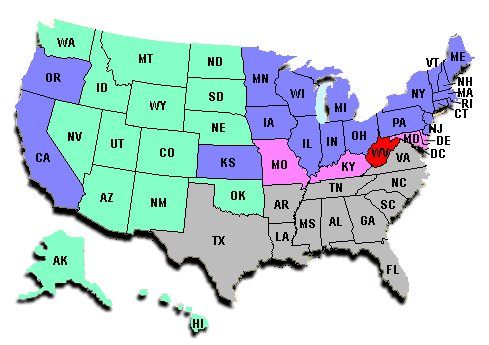
Confederate States, Border States, and Union States Map
CSA States: AL, AR, FL, GA, LA, MS, NC, SC, TN, TX, and VA.
Border States: DE, KY, MD, MO.
Union States: CA, CT, IA, IL, IN, KS, MA, ME, MI, MN, NH, NJ, NY, OH, OR, PA, RI, VT, WI, and WVA.
|
Confederate States, Border States, and Union States Map CSA States: AL, AR, FL, GA, LA, MS, NC, SC, TN, TX, and VA. Border States: DE, KY, MD, MO. Union States: CA, CT, IA, IL, IN, KS, MA, ME, MI, MN, NH, NJ, NY, OH, OR, PA, RI, VT, WI, and WVA. |
|
|
Dred Scott v. Sanford, 60 U.S. 393 (1857)
Facts: Scott, a slave, was taken by his owner, Sanford, into northern federal territory. Scott felt that he was free because of the Missouri Compromise of 1820, which excluded slavery from specified portions of United States territories. When he came back to Missouri, Scott sued his owner for his freedom.
Issue: Whether Dred Scott, a slave, was a citizen of the United States and legally entitled to use the courts to sue.
Opinion: The Supreme Court of the United States ruled that slaves were property, not citizens and, therefore, Dred Scott was not entitled to use the courts. The Court focused on the rights of the owner, not the slave, saying that black people had no rights that white people were bound to respect. Justice Taney said that freeing Scott would be a clear violation of the Fifth Amendment because it would amount to depriving Sanford of his property without due process of law. He also said that Congress had no power to prohibit slavery in the territory and that the Missouri Compromise was unconstitutional. [Taney believed that if he decided the case in favor of Scott, immediate civil war would have resulted. Associate Justice Curtis of Massachusetts disagreed so strongly with Taney’s decision that he left the Court.]
Unfortunately for Scott, the political divisions over slavery worsened from the time his case first came to trial in 1847 through 1857, when the Court finally announced its decision. Events of this period that increased conflicts included the passage of the Fugitive Slave Act (1850), publication of Uncle Tom's Cabin (1852), enactment of The Kansas-Nebraska Act (1854), violence in "bleeding Kansas" (1856), and Representative Brooks's battery of Senator Sumner in the U.S. Senate (1856).
|
Andrew
Johnson
|
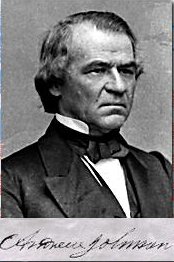 |
| Succeeding to the presidency on Lincoln's death, Johnson sought to carry out Lincoln's policy, but without his political skill. The result was a hopeless conflict with the Radical Republicans who dominated Congress, passed measures over Johnson's vetoes, and attempted to limit the power of the executive concerning appointments and removals. The conflict culminated with Johnson's impeachment for attempting to remove his disloyal secretary of war in defiance of the Tenure of Office Act which required senatorial concurrence for such dismissals. The opposition failed by one vote to get the two thirds necessary for conviction. |