Birth of a Nation
| America's Colonial Era |
Norse, Spanish, French involvement with America
England's late start
Roanoke - "The Lost Colony"
Jamestown
Early Troubles
Drought; Indians; starvation; bad choice of settlers; no cohesion of family, religion; monocultural economy
Representative Assembly
New England
Religious reasons for founding
Reasons for relative stability
(Examples of instability, too, i.e., Salem...)
Social contract with consent of the governed (Mayflower compact)
Other colonies
Similarities and "Separateness" of the colonies
|
The Road to Revolution |
Early European Americans were generally proud to be English
England, after all, did a lot for the colonies (e.g., fought the French and the Indians)
But over time, things changed for many social, economic, and political reasons
Best one (I think) relates to "snubbing" of America's elite
Several key events are significant in leading to revolt
1763 - The Proclamation of 1763 prohibits English settlement west of the Appalachians to ease tensions with Native Americans.
1764 - The Sugar Act is passed by Parliament to offset the French and Indian war debt. It increases the tax on imported sugar and other items.
1764 - Customs court is established in Canada that will have jurisdiction over colonies in trade matters.
1764 - The Currency Act prohibits the colonists from issuing any paper money. This threatens to destabilize the entire colonial economy.
| 1764 - Bostonian James Otis raises the issue of taxation without representation and urges a boycott of British goods. | |
|
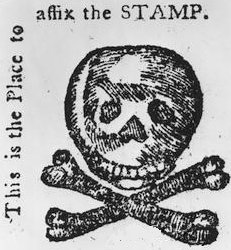
1765 - In March, the Stamp Act imposes the first direct tax on the colonies to pay for British troops in America. (First time Americans will pay tax not to their own local legislatures but directly to England.) All printed materials are taxed, including; newspapers, legal documents, licenses, even playing cards. The colonists unite in opposition, led by lawyers, publishers, land owners, ship builders and merchants - who are most affected by the Act. |
 |
1765 - March, the Quartering Act requires colonists to house British troops and supply them with food.
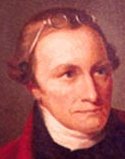 |
1765 - Patrick Henry presents seven Virginia Resolutions to the House of Burgesses claiming that only the Virginia assembly can legally tax Virginia residents. |
1765 -
Sons of Liberty formed. 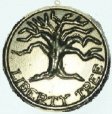
1765 - August 26, a Boston mob attacks the home of Thomas Hutchinson, Chief Justice of Massachusetts, as Hutchinson and his family narrowly escape.
| 1765 - In October, the Stamp Act Congress convenes in New York City, with representatives from nine of the colonies. The Congress prepares a resolution to be sent to King George III and Parliament requesting the repeal of the Act. The petition asserts that only colonial legislatures can tax colonial residents and that taxation without representation violates basic civil rights. | 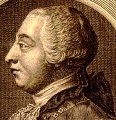 |
1765 - On November 1, most business and legal transactions cease as the Stamp Act goes into effect as nearly all the colonists refuse to use the stamps. In New York City, a mob burns the royal governor in effigy and loots houses.
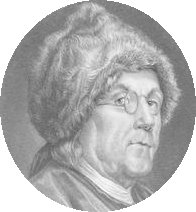 |
1766 - In March, King George III repeals the Stamp Act after much debate in Parliament, which included an appearance by Ben Franklin warning of possible revolution in the colonies if the Act was enforced. On the same day, Parliament passes the Declaratory Act stating that Britain has total power to legislate any laws governing the colonies in all cases whatsoever. |
1766 - In August, violence breaks out in New York between British soldiers and colonists over the continuing refusal of New York to comply with the Quartering Act. In December, the New York legislature is suspended by the king after again voting to ignore the Act.
1767 - In June, Parliament passes the Townshend Revenue Acts, imposing new taxes to offset the costs of administering the colonies. Items taxed include imported paper, tea, glass, lead and paints. The Act also establishes a colonial board of customs commissioners in Boston. In October, Bostonians reinstate a boycott of English goods which had been lifted.
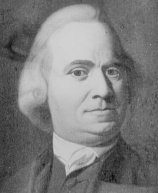
| 1768 - In February, Samuel Adams of Massachusetts writes a Circular Letter opposing taxation without representation and calling for the colonists to unite against Britain. Most colonial assemblies receive the letter, which instructs them on methods Massachusetts is using to oppose the Townshend Acts. |
 |
1768 - Harassment of customs officials worsens.
1768 - In September, English warships sail into Boston Harbor and unload many troops into Boston.
1769 - In March, Philadelphia joins the boycott of British goods. George Mason presents Virginia Resolves to the Virginia House of Burgesses, which opposes taxation without representation. Ten days later, the crown dissolves the House.
| March 5, 1770 - The Boston Massacre occurs as a mob harasses soldiers guarding a customs collector's house who then fire into the crowd, killing and injuring several. Afterwards, the Governor withdraws Redcoats out of Boston. The British captain, Thomas Preston, is arrested along with eight of his men and charged with murder. At trial, John Adams and Josiah Quincy defend Captain Preston and six of his men, who are acquitted. Two others are found guilty of manslaughter, branded, then released. | 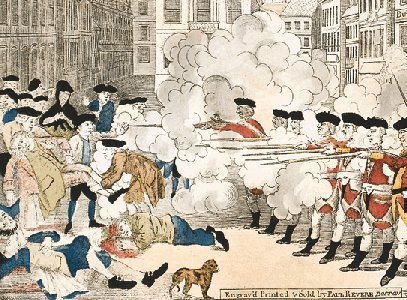 |
1770 - In April, Britain repeals the Townshend Acts. All duties on imports are eliminated except for tea. Also, the Quartering Act is not renewed.
1772 - 1723 - Committees of correspondence to communicate with the other colonies regarding common complaints against the British form in several colonies.
1773 - May 10, the Tea Act takes effect, which maintains a small tax on tea arriving in the colonies.
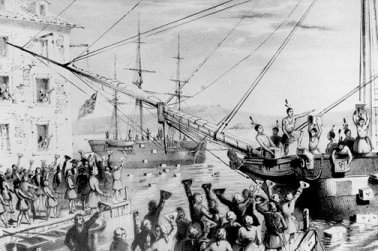 |
December 16,
1773 - Colonists disguised as Mohawk
Indians board ships carrying British tea, and dump all 342 containers into
the harbor. |
1774 - In March, an angry Parliament passes the first of a series of Coercive Acts (called Intolerable Acts by Americans) in response to the events in Massachusetts. The Boston Port Bill closes the harbor.
1774 - General Thomas Gage, commander of all British military forces in the colonies, arrives in Boston, putting Massachusetts under military rule. He is followed by the arrival of many more troops.
1774 - May 20, Parliament enacts more Coercive Acts, which include the Massachusetts Regulating Act and the Government Act virtually ending self-rule by the colonists; the Administration of Justice Act which protects royal officials from suit in colonial courts; and the Quebec Act, which upsets colonists by extending the boundary of Canada into Massachusetts territory.
1774 - In June, a new version of Quartering Act is enacted requiring all colonies to provide housing for British troops.
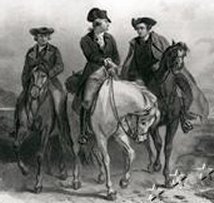 |
1774 - September 5 to October 26, the First Continental Congress meets in Philadelphia with 56 delegates, representing every colony, except Georgia. Attendants include Patrick Henry, George Washington, Sam Adams and John Hancock. On September 17, the Congress declares its opposition to the Coercive Acts, saying they are "not to be obeyed," and also forms local militia units. |
| On October 14, a Declaration and Resolves is adopted that opposes all acts undermining self-rule. The colonists assert their rights to "life, liberty and property." On October 20, Congress adopts the Continental Association which boycotts of English imports. | |
| 1775 - February 9, Parliament declares Massachusetts in rebellion. March 23, in Virginia, Patrick Henry delivers his "Give me liberty or give me death!" speech. In April, Massachusetts Governor Gage is ordered to suppress rebellion by all necessary force so he sends 700 troops to Concord to destroy colonial arms. That night, Paul Revere and William Dawes ride to warn the colonists. Revere reaches Lexington about midnight and warns Sam Adams and John Hancock. | 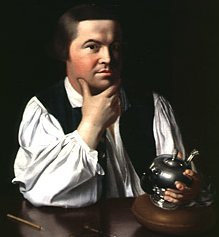 |
 |
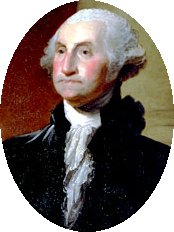
May 10, 1775 - The Second Continental Congress convened in Philadelphia, with John Hancock as president. On June 15, the Congress unanimously votes to appoint George Washington general and commander-in-chief of the new Continental Army. |
 |
July 5, 1775 - The Congress adopts the Olive Branch Petition, appealing directly to King George for reconciliation. He refuses even to look at the petition and instead declares all America to be in a state of open rebellion.
July 6, 1775 - The Continental Congress issues a Declaration on the Causes and Necessity of Taking Up Arms detailing the colonists' reasons for fighting the British and states the Americans are "resolved to die free men rather than live as slaves."
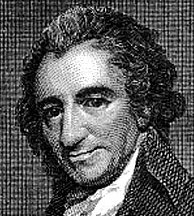 |
January 9, 1776 - Thomas Paine's "Common Sense" is published in Philadelphia. The 50 page pamphlet is highly critical of King George III and attacks allegiance to Monarchy in principle while providing strong arguments for American independence. It becomes an instant bestseller in America. "We have it in our power to begin the world anew...American shall make a stand, not for herself alone, but for the world," Paine states. |
| He later writes "...These are the times that try men's souls: The summer soldier and the sunshine patriot will, in this crisis, shrink from the service of his country: but he that stands it NOW deserves the love and thanks of man and woman. Tyranny, like Hell, is not easily conquered. Yet we have this consolation with us, that the harder the conflict, the more glorious the triumph." | |
May 2, 1776 - The American revolutionaries get the much needed foreign support they had been hoping for. King Louis XVI of France commits one million dollars in arms and munitions. Spain then also promises support.
June-July, 1776 - A massive British war fleet arrives in New York Harbor consisting of 30 battleships with 1200 cannon, 30,000 soldiers, 10,000 sailors, and 300 supply ships, under the command of General William Howe and his brother Admiral Lord Richard Howe.
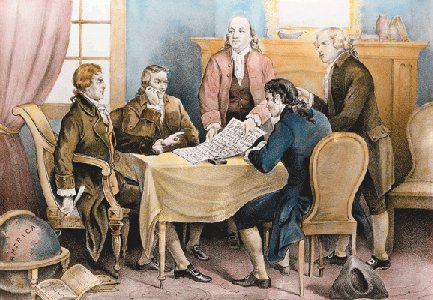
June-July, 1776 - On June 7, Richard Henry Lee, a Virginia delegate to the Continental Congress, presented a formal resolution calling for America to declare its independence from Britain. Congress decides to postpone its decision on this until July. On June 11, Congress appoints a committee to draft a declaration of independence.
|
Committee members were (left to right) Thomas
Jefferson, Roger Sherman, Benjamin Franklin, Robert Livingston, and John
Adams. Jefferson is chosen to prepare the first draft of the declaration,
which he completes in one day. |
 |
| On June 28, Jefferson's Declaration is presented to the Congress, with changes made by Adams and Franklin. On July 2, twelve of thirteen colonial delegations (New York abstains) vote in support of Lee's resolution for independence. On July 4, the Congress formally endorses Jefferson's Declaration, with copies to be sent to all of the colonies. The actual signing of the document occurs on August 2, as most of the 55 members of Congress place their names on the parchment copy. | 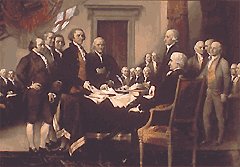 |
|
Important concepts in the Declaration of Independence |
Natural Rights – the idea that individuals hold certain rights because they are human; governments cannot take away these “inalienable”(can’t be transferred) rights
· Locke describes these rights as “life, liberty and property”
· Jefferson describes these rights as “life liberty and the pursuit of happiness” (dropped property language because of slavery issue)
|
Important concepts in the Declaration of Independence |
Social contract – general agreement between the people and the government, where the people agree to give up some of their liberties, so that the remainder are protected.
Major Battles of the American Revolution
|
Battle |
Place |
Date |
|
Lexington And Concord
|
Massachusetts |
Apr 19, 1775 |
|
Ticonderoga |
May 10, 1775 | |
|
Bunker Hill |
Massachusetts |
June 17, 1775 |
|
"...the
whites of their eyes." |
||
|
Montreal |
Quebec |
Nov 13, 1775 |
|
Quebec |
Quebec |
Dec 31,
1775 |
|
Long Island |
New York |
Aug 27, 1776 |
|
Trenton |
New Jersey |
DEC 26, 1776 |
|
Princeton |
New Jersey |
Jan 3, 1777 |
|
Bennington |
Vermont-New York Border
|
Aug 16, 1777 |
|
Brandywine |
Pennsylvania |
Sept. 11, 1777 |
|
Freeman's Farm (First
Battle) |
New York |
Sept 19, 1777 |
|
Germantown |
Pennsylvania |
Oct 4, 1777 |
|
Freeman's Farm (Second Battle)
|
New York |
Oct 7, 1777 |
|
Saratoga |
New York |
Oct 7, 1777 |
|
Valley Forge
Encampment |
Winter, 1777-78
| |
|
Monmouth |
New Jersey |
June 28, 1778 |
|
Bonhomme Richard vs.
Serapis |
North Sea |
Sept. 23,1779 |
|
Benedict Arnold
|
July 15, 1780 | |
|
Camden |
South Carolina |
Aug 16, 1780 |
|
Kings Mountain |
South Carolina |
Oct 7, 1780 |
|
Guilford Court-house
|
North Carolina
|
Mar 15, 1781
|
|
Yorktown |
Virginia |
Oct 6-19, 1781 |
Victory!!! But now, how to
run the
country?
Articles of Confederation
|
Ratified in 1781, though nation operated
under it throughout war for independence |
Shay's Rebellion
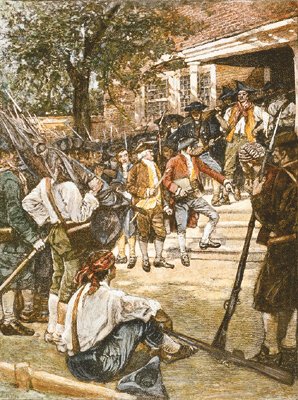 |
Under the leadership of Daniel Shays, a group of farmers took possession of the courthouse in Northampton, Massachusetts, in 1786. Crushed by debt and taxes, Shays led his followers to a rebellion aimed at preventing farm foreclosures. His movement forced judges out of their courtrooms and freed debtors from jails. Washington and other Federalists were outraged, viewing Shays' rebellion as a threat to the principles of property rights. The Constitution of 1789 was designed, in part, with the motive of protecting these rights. |
Philadelphia Convention
to
"revise" the articles
|
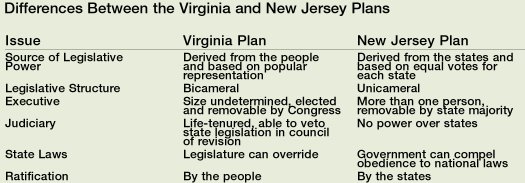
VA plan 3 branches of government |
|
NJ plan Multiple executive |
|
CT ("Great") Compromise The Connecticut Compromise established equal representation for all states in the Senate and proportional representation by population in the House of Representatives.
|
|
Compromise Summary |
The Great Compromise – resulted in a bicameral legislature, with one house based on equal representation, the other on population.
The Three-Fifths Compromise – resulted in slaves being counted as “3/5” of a person for the purpose of determining population
Dispersion of Power by the
U.S.
Constitution
Federalism – sovereign powers are divided between the states and the national government (Next Chapter)
|
Separation of
Powers |
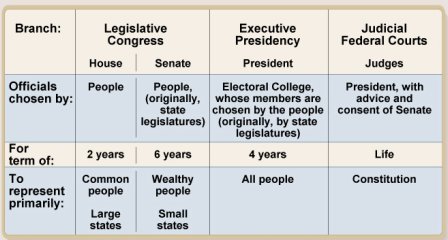
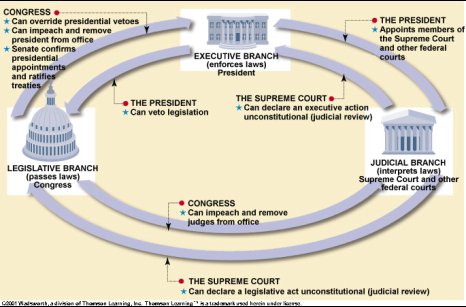
Dividing governmental powers between different branches using checks and balances
Why disperse power?
(Ans: Lord Acton's quote)
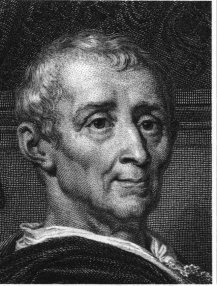
Montesquieu
Legislative Branch
|
 's 's |
AND |
 's 's |
|
|
|
|
| 1. CABINET meetings held to discuss activities in the
Executive Departments http://www.flagsale.com/POLS%201101. Appointment of policy-making officials in Executive Departments 3. SUPERVISION of the Bureau of the Budget |
1. POWER OF the PURSE: approval of congress is necessary
for all government expenditures
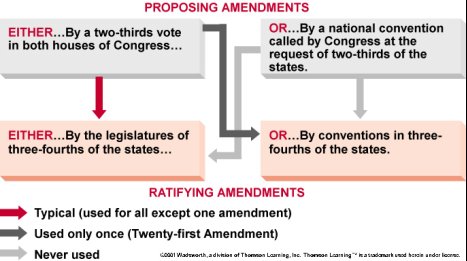
http://www.flagsale.com/POLS%201101. OVERRIDING THE VETO: by a two-thirds majority in both houses of Congress 3. IMPEACHMENT by the House and trial in the Senate of the President and all major Federal officials 4. ELECTION OF PRESIDENT by the House in the event that no candidate receives an electoral majority 5. APPROVAL of the Senate of all major appointments, by a majority (Senatorial Courtesy is involved) 6. APPROVAL of the Senate of all treaties by a two-thirds majority 7. INVESTIGATIONS by Congressional committees 8. CONSTITUTIONAL AMENDMENTS proposed by a two thirds majority in each house |
1. JUDICIAL REVIEW: power of the Supreme Court to interpret
the Constitution and to declare Federal legislation unconstitutional,
first asserted by Chief Justice John Marshall in case of Marbury vs.
Madison http://www.flagsale.com/POLS%201101. CHECK DECISIONS of independent regulatory agencies or the Executive Dept. 3. CHECK PRESIDENTIAL DISMISSAL of a member of a regulatory agency 4. INJUNCTION and MANDAMUS WRITS |
Checks and Balances on Congress
| 1. VETO: disapproval of legislation within ten days, and
return to House of origin; POCKET VETO: no signature and Congressional
adjournment within ten days http://www.flagsale.com/POLS%201101. LEGISLATIVE RECOMMENDATIONS: in special messages and in State of the Union Message mandated in the Constitution 3. PATRONAGE: power of appointment 4. PARTY LEADER 5. PUBLIC OPINION: use of mass media to gain support 6. EXECUTIVE ORDERS (Emancipation Proclamation) and EXECUTIVE AGREEMENTS with foreign countries without Senatorial approval 7. COMMANDER-IN-CHEIF of Armed Forces at all times 8. EXECUTIVE POWER: to call special sessions of Congress and to ignore subpoenas |
1. A piece of legislation must be passed by BOTH
HOUSES http://www.flagsale.com/POLS%201101. Differences in bills passed in each house are adjusted by CONFERENCE COMMITTEES |
1. CHECK the work of Congressional investigating
committees http://www.flagsale.com/POLS%201101. JUDICIAL REVIEW |
Checks and Balances on the Supreme Court
| 1. Appointment of all Federal officials, including judges, US
Marshals, US Attorneys http://www.flagsale.com/POLS%201101. PARDONS AND REPRIEVES for all Federal crimes 3. Use of EXECUTIVE POWER to ignore court orders when they deal with presidential matters |
1. APPROVAL of all judicial appointments by the Senate
http://www.flagsale.com/POLS%201101. LIMITING JURISDICTION of the Supreme Court and inferior Federal Courts 3. VARYING number of Justices on tie Supreme Courts from five to ten 4. IMPEACHMENT by Judges by House; TRIAL by Senate 5. CONSTITUTIONAL AMENDMENTS |
I. JUDICIAL REVIEW of cases heard in and decided by other Federal and
state Courts http://www.flagsale.com/POLS%201101. REVERSAL of previous decisions of the Supreme Court |
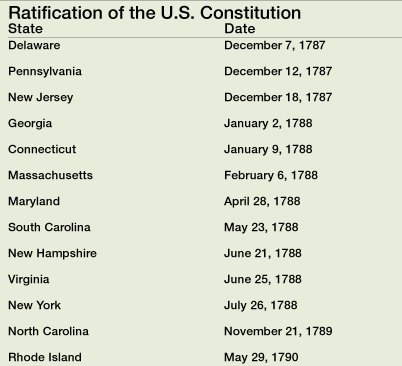
Ratification of the US Constitution
Federalist Papers
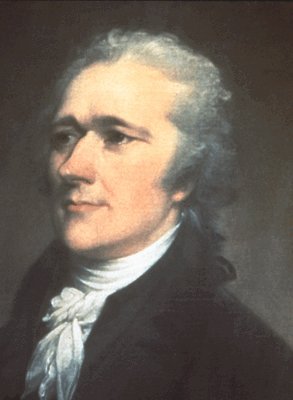
The Constitution
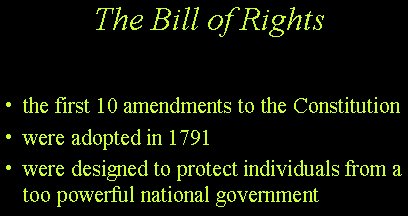
Amendments--Bill of Rights