
|
||||
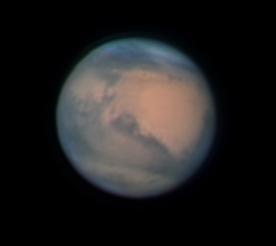
Mars is closest to the earth on Dec 18! The picture above appears on the Spaceweather homepage on Dec 17. It was taken through a medium size backyard telescope(a 14 inch Celestron!). That is a tribute to how sophisticated amateur equipment and image processing techniques have become, well withing range of the average person on a moderate budget, but also a tribute to the skill and patience of the observer, in this case Peter Garbett in the UK.
Mars is impressive enough to the naked eye as the brightest reddish orange object among a grouping of bright stars in the winter constellations that form what I call the "vault of heaven." The other bright planets Jupiter and Saturn, when seen through a telescope for the first time, generally draw a reaction of oohs and aahs as the observer sees the rings of Saturn of the moons of Jupiter with their own eyes for the first time. But in the case of Mars, there is only a period of about a month every 2 years when it is close enough and large enough for surface features to be seen easily, as in the picture above. That picture is amazing- especially since it was taken through a backyard scope! You can see deserts, mountains, haze, and bluish clouds near the poles.
Oh by the way, when I was taking out my trash to the shed last week, I saw a great Geminid meteor streak all the way across the sky from northeast to northwest. There may be a few straggling fireballs left from that shower, and Mars is in Gemini near the origin point as seen from earth. So while looking at the red planet, keep your eyes open for meteors!