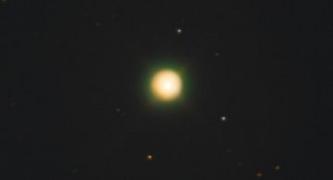
There is a "new" comet visible to the naked eye in an easy to find location in the constellation Perseus in the evening sky after dark.
You MUST see these photos!?
... and on the next clear night (it's finally raining all up and down the east coast, as you know if you watched World Series Game 1 last night) I plan to go outside and see this bad boy with my own eyes, binoculars, and small telescope! It is the most perfect spherical comet I have ever seen, at least in photos. I wonder what the "contrast" will look like when seen through a normal eyepiece, not a time exposure(?).
Let me help you out with a little math. The comet is not "new" - its an old periodic comet that had an outburst in the 1800s sometime. It recently went from magnitude 17 to magnitude 3 in a few days(!). The magnitude scale is an inverse exponential scale- in other words, a lower number means a brighter object or star, and the magnitude is the "exponent" in the equation. A change in magnitude of 2 corresponds to a brightness change of 10 times. So a magnitude 2 star is 10 times brighter than a magnitude 4 star, and 100 times brighter than a mag 6 star. Now, this thing brightened by 14 magnitudes, that's a factor of 10 to the seventh power, so it is 10 million times brighter than it was a few days ago! What could have happened to make it get that bright that fast??
When I logged into email I also found an alert message from the auroral observing group, and it makes me wonder if the reason that the comet had a sudden brightening has something to do with the "impulse" in the solar wind affecting other objects in the solar system in addition to the earth(?).
Also the Space Shuttle is on its way to dock with the International Space Station, so this is a very exciting week in space!!