


gcbear117
this is where I live, more or less: the bear's den
Copyright 2006 by R.O.Hessler.
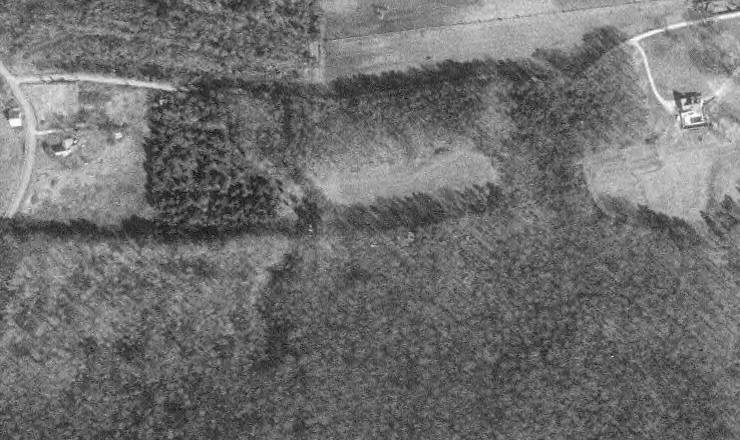
That's old Ollie's house, and his barn across the county road. He moved here about 1948, and farmed the whole cove for about twenty years. When his health began failing, and he couldn't farm any more, the owners let him live there rent-free, just for keeping the grass cut and the fencerows cleaned out. My middle son and I worked over his roof, nailing the tin back down where it had worked loose over the years. Ollie was the last one to see real bears here, until I did. He moved into town about twenty years ago, and finally died.
When I bought out here, from the same woman who owned Ollie's house, Ollie wasn't able to walk me around it to show me the corners. Curtis, who owned most of the rest of the cove, walked the side of my property that joined him, so I knew about where two of the corners were. Curtis has since died, and so has his son Hubert, and the cove was divided between Hubert's two daughters, who have since built houses there in the cove with their husbands. This is one of their houses: brick, with a swimming pool out back. We can just barely see each others' lights through the woods, so I don't feel very crowded.
After Ollie retired, the woman who owned the land leased it to a soybean farmer, but the economics changed, the land went fallow, and she finally sold it. The new owner hasn't kept it up for the twenty years since, and the woods are taking over again. This part of the bean field, for instance, is now a nearly impenetrable thicket of twenty- to forty-foot cedar, pine, and hardwood saplings stitched together with blackberry, honeysuckle, and trumpet vine.
My driveway was once a tractor road around the end of the bean field. The part that goes up the hill was really a v-shaped gully, two to four feet deep. I've driven up and down it that way ever since, but I do fill it in some with rocks, leftover concrete, and gravel from time to time, so it isn't as deep as it was. The dark area at top left is the shadow of pine trees in my powerline cut; the light area in the bottom half is my field garden.
My land runs from the foot of the mountain (at the top of the box) to the bluff at the top of the mountain (below the bottom of the picture). It's all woods, mostly oak, hickory, and sweet gum, now at least fifty or sixty years old, and with an understory of dogwood, redbud, and ironwood.
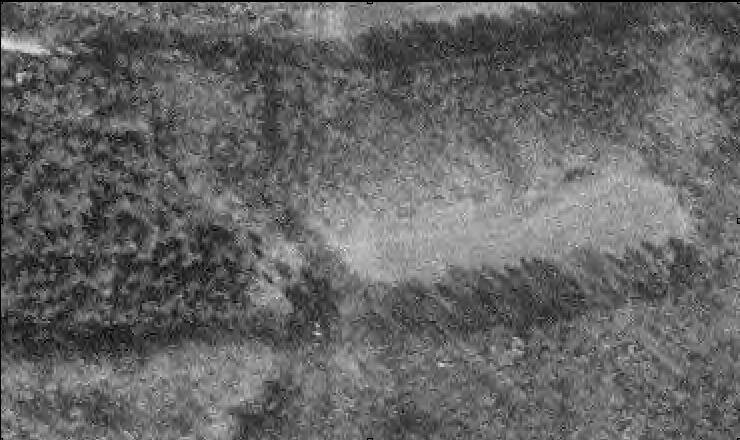
Actually, my driveway isn't as wide as it was shown in the previous view, because they put the powerline outside the driveway right-of-way. Though I only planted my field garden within the right-of-way, I cleared a buffer zone of forty or fifty feet to the west to keep it from getting entirely shaded out as the saplings in the bean field turned into trees. I left a few of the cedar trees in the buffer zone, because they grow slowly, and because they're good for bird nests.
The tractor road had also been a logging trail into my property, leftover from when it was logged about sixty years ago. They were probably still using mules to snake logs out of the woods after they'd been cut to length, then, because the logging trail just wound back and forth between the trees and rocks. Since most of my cars have not been much longer than a log, or wider than a team of mules, I didn't see much need to change, so my driveway hasn't been widened and still snakes between the trees. That's actually okay for almost any car or pickup, but poses problems for bigger delivery trucks, and for when you're towing a broken car. As a result, there are several broken cars that never made it past the end of the bean field: the three white spots here are my middle son's old Volks van, one of his Ford Falcons, and one of my old Ford pickups. There are three old Beetles sitting there, too, but they're small enough and curvy enough that they don't show up well in this photo: stealth technology.
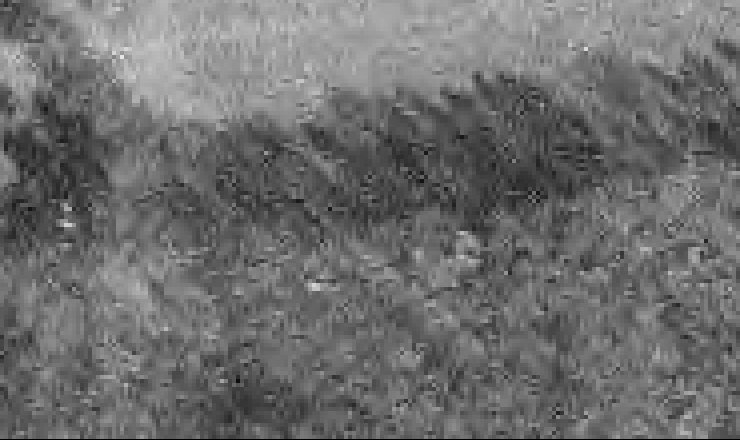
The logging trail split three ways, once it got into the woods. The forks that went south and southeast both went roughly straight up the mountain, so they eroded into v-shaped gullies two to five feet wide and a foot or two deep. The third fork runs east along the contours for some way before going southeast on up the mountain. This last one was the only one traversable in regular cars, and became the driveway by default. I know there are several broken cars parked along the sides of the driveway, but they're mostly Beetles, and I can't see them. The only one I can find is another of my middle son's Falcons.
Following the east fork of the logging trail brings us to my cabin. I flew over the cabin in a small airplane, one summer afternoon, and even though I knew exactly where to look, I couldn't find the cabin down below the treetops. I couldn't even see any cars.
So this is where I live, more or less: the bear's den. And this is the best picture readily available to show how it relates to the rest of the world. Spy satellites can likely make better pictures, but most of us can't get those and must make do with what we can find.
Ho hum, you say. So what? Who gives a fig about Bear's cabin?
And the answer is: hardly anyone besides Bear.
But that's okay:
this site ain't about Bear's cabin. It's about Bear. And, ...
just maybe, you.
Okay. Then why bother with the map rigamarole?
Well, it's like this: movies, even high-speed, slow-motion movies, are only snapshots. You think you see everything that's going on, but the snapshots only show the status at successive frame times. The mind blurs over the in-between times, so it seems like you see all the action. But you don't, and sometimes what you can't see may be very important.
The same sort of thing happens when you look at one photograph, say the aerial photo: if you look closely with a magnifier, you find that what looks like a true picture is actually a bunch of dots (on a computer, they're called pixels), and the mind blends them together, so it seems like you see the whole picture. But you don't, and sometimes what you can't see may be very important.
The same sort of thing applies when you're studying animal behavior: one snapshot of one ant is nowhere near enough to know all there is to know about ants. At the very least, you would need snapshots of each of the several types of ants in a colony. And since ants respond to hot and cold, wet or dry, you would need many snapshots of each of the types during a whole year, and maybe for several years to account for climate variation. And maybe snapshots from many geographic locations, because maybe ants from Boston communicate differently.
The more thoroughly you wanted to know ants, the more snapshots you'd need.
The same thing is true, if you wanted to know bears, or Bear, or yourself: the more snapshots, the better.
This is sort of a photo album. The figurative images are poems and stories, with a few literal photographs and a few literal photo albums thrown in here and there.
The obvious subjects of the snapshots are grasshoppers, cicadas, spiders, and scorpions; hummingbirds, hawks, and buzzards; chickens, turkeys, and peafowl; shrews, bats, and vampires; mice, rats, and squirrels; possa, raccoons, coyotes, deer, and bears; cats and dogs; toads, frogs, and snakes; orphans, princesses, and honeys; and likely a few others: I forget sometimes.
But they're all snapshots of Bear,
and some of them are probably even snapshots of you.
this is where I really live: