Research Proposal for Education Research: Factors Predicting Success in Outdoor Education Academic Programs
|
[Home] [Service Learning] [Environmental Stewardship] [Leadership] [Scholarship] [Professional Development] [Resume] [Contact Me] |
Factors Predicting Success in Outdoor Education Academic Programs
Nathaniel E. Johnson
Georgia College & State University
Submitted to Dr. Smoot
EDFS 6230
Factors Predicting Success in Outdoor Education Academic Programs
Outdoor education programs can be significantly different from other academic programs. They attract a wide variety of students, with a wide variety of interests. Outdoor education programs are often very intensive. They are usually composed of classes with difficult physical demands and above average time requirements. The nature of these programs generally necessitates that the size of the programs is kept small. At the same time, because of the exciting and different nature of these programs, demand for spots can be very high.
Outdoor Education program administrators must make difficult decisions about who to admit into their programs. Deciding what factors to consider when admitting students is a confusing and difficult process. Existing research into factors predicting success in academic programs exists, but is not focused specifically on Outdoor Education programs.
When admitting students straight out of high school, the traditional factors to consider are ability measures (SAT, ACT) and academic performance (GPA). Smittle (1995), discusses some of the difficulties of using these measures, including that each high school has different standards for GPA and that these measures may not accurately reflect the abilities of students who have taken some time between high school and coming to college. Smittle did, however, find that GPA and SAT scores are generally good predictors of college performance. A second trend of interest was a negative correlation between days of absenteeism in high school and college performance.
Carlan & Byxbe (2000) addressed the performance of transfer students, finding that the most influential predictors of performance were being older, being white, and having an existing high GPA before transferring. Standardized test scores were not found to have a significant effect on transfer student performance. There were also significant differences in performance based on major of choice.
Strage (2000) investigated the role of ethnic background, specifically the influence of family factors on confidence. White and Hispanic students were found to be more confident and to have higher grades on average. Southeast-Asian-American students were found to be less confidant and to have lower grades on average than the other group.
Harackiewicz, Barron, Tauer, & Elliot (2002) considered the different goals of students regarding performance and motivation. Students who espoused performance goals involving wanting to do better in comparison to other students tended to have better grades than those possessing work avoidance goals or goals of subject mastery. Mastery goals and self-reported subject interest were, however, important in predicting course enrollment behavior, choice of major, and completion of program.
Royer, Abranovic, & Sinatra (1987) investigated the effects of prior contextual knowledge, as measured by content related tests, on academic performance. They found that individuals with greater knowledge about a particular subject matter learn and remember more information than individuals with low levels of knowledge.
These existing predictive factors give the Outdoor Education Administrator some possible factors to consider when admitting students into a program, but there has not been any research into what specific factors are the most important predictors for Outdoor Education.
The purpose of this study is to examine what population characteristics are most important in predicting academic success in a college level Outdoor Education program.
Methods and Procedures
Participants and Setting
This study will be conducted at Georgia College & State University (GCSU), in Milledgeville, Georgia. GCSU is a public liberal arts university with 4,566 students. Thanks to the HOPE scholarship, students come from all different socio-economic statuses. Participants will be past and current students enrolled in the Outdoor Education program. The average age of enrolled students is XX years, with a range from XX to XX. The average cohort size is XX students out of XX applications to the program. Program participants are XX% male and XX% female. Participants are XX% White, XX% African American, XX% Hispanic, and XX% Asian-American, and XX% other.
All past and present students will be contacted by mail to receive their permission to participate. This is a non-random, purposive sample of opportunity of the entire population. Hopefully response rates will be high and help to make the sample representative of the population. Students from the psychology department will also be selected to participate in this study, to serve as a comparison group to determine what factors may be specific to the Outdoor Education program, and what factors may be present university wide.
Instrumentation
This study will use existing academic and demographic data for comparisons. Official school records and transcripts will be used to obtain the necessary information about grades and demographics. This will be representative of the information available to Outdoor Education Administrators when considering who to admit to the program.
Procedures
Permission will be obtained from both Outdoor Education faculty and GCSU administrative staff for access to the necessary data. Files used will have unnecessary identifying information removed for confidentiality. Permission to access files will be solicited by writing. All participants will be over 18 years old at the time of the study.
Transcripts and school records will be evaluated to obtain information on college GPA, class grades, major, minor, transfer student status, high school GPA, SAT or ACT scores, age and race.
Subject attrition will be addressed by making the permission form clear and simple, and giving participants multiple ways to respond (mail, email, telephone.) Three attempts will be made to contact all students.
Design and Data Analysis
This will be both descriptive and causal comparative research with multiple variables. The dependent variable is academic success as measured as a function of GPA for Outdoor Education classes and graduation from the program on time. The independent variables are demographic data available from school records (college GPA, class grades, major, minor, transfer student status, high school GPA, SAT or ACT scores, age and race.)
Regression analysis will be used to determine any significant relationships between variables. Alpha level will be set to .05 two-tailed since it is unknown what effect some of the variables may have on academic performance.
Table X
Significance of Age on Major GPA
|
Age |
Average GPA |
Standard Deviation |
Statistical Value |
Significance level |
|
20 |
xx |
xx |
xx |
xx |
|
21 |
xx |
xx |
xx |
xx |
|
22 |
xx |
xx |
xx |
xx |
|
23 |
xx |
xx |
xx |
xx |
|
24 |
xx |
xx |
xx |
xx |
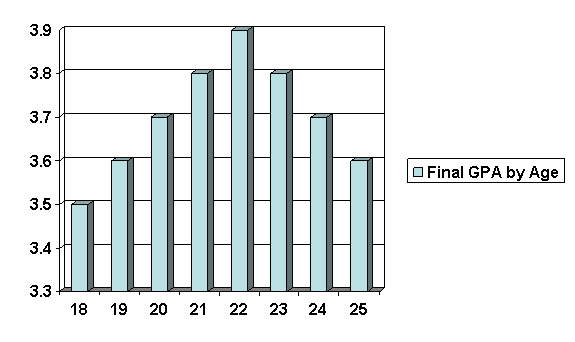
Sample Chart
References
Carlan, P., & Byxbe, F. (2000). Community colleges under the microscope: An analysis
of performance predictors for native and transfer students. [Electronic version]
Community
College Review, 28(2), 27-43.
Harackiewicz, J., Barron, K., Tauer, J., & Elliot, A. (2002). Prediction success
in college:
A longitudinal study of achievement goals and ability measures as predictors of
interest and performance from freshman year through graduation. Journal of
Educational
Psychology, 94(3), 562-575.
Royer, J., Abranovic, W., & Sinatra, G. (1987). Using entering resding
comprehension
performance as a predictor of performance in college classes. Journal of
Educational Psychology, 79(1), 19-26.
Smittle, P. (1995). Academic performance predictors for community college student
assessment. [Electronic version] Community College Review, 23(2), 37-46.
Strage, A. (2000). Predictors of college adjustment and success: Similarities and
differences among Southeast-Asian-American, Hispanic, and White students.
Education, 120(4), 731-741.