My instructional article "Cross Forward March", which presents detailed analysis of the cross-forward stroke was published in River Runner Magazine" -- May 1989. Read the full article here |
 |
| . |
|
| OUTDOORSWOMAN |
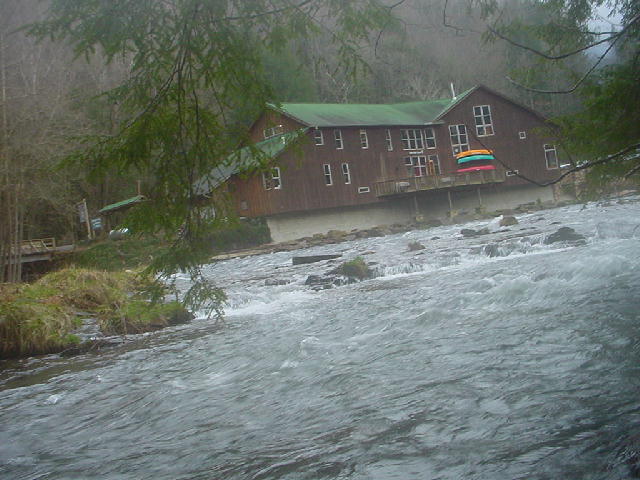
I've been active in outdoor adventure sports since 1970 when I first discovered my love for nature, hiking, camping, and paddling around in small boats. The Smoky Mountains and particluarly the area near Wesser, NC is one of the most secluded and scenic areas of the country and has always been one of my favorite places. After a few years of driving the 6 hour trek to NC almost every weekend year round, I decided to move to Western NC.. Those were the salad days of whitewater. I earned my American Canoe Association instructor certification from Bunny Johns and Tom Horton at the Nantahala Outdoor Center (NOC) in 1979, my Red Cross First-Aid and CPR Instructor certifications in 1984, and began working as a whitewater river guide and canoeing instructor at the NOC and Endless River Adventures soon after my escape from the city in 1985. Of course, I continued creating crossword puzzles, which is a job that can be done from anywhere that I have a computer connection. Wesser is situated on the banks of the Nantahala River. Paddlers consider this area of NC to be "Whitewater Mecca". It is located about 15 miles west of Bryson City and the Great Smoky Mountains National Park, in the heart of one of the most isolated and scenic areas of the country. The "town" of Wesser consists of the outdoor center and its employees who moved to the area for different reasons. Some are adventure-jocks seeking wildwater sport, while others are refugees from the city who want to raise families in a more natural and friendly setting--people who find city life to be repressive, nasty, brutish, and short- to paraphrase the philosopher, Thomas Hobbes. I worked as a river guide and trip leader on the Nantahala, Little Tennessee, and French Broad rivers in N.C., the Ocoee and Nolichucky in Tennessee, and the Chattooga, which is the National "Wild and Scenic River" made famous by the movie "Deliverance". NOC founder and president Payson Kennedy served as a stand-in for Burt Reynolds in the film. In addition to leading daily river trips on these rivers, I led 7-day instructional canoeing/camping clinics on the Chattooga River. I also served as mail-order manager of the NOC store for two years and as director of their first-aid and CPR programs. |
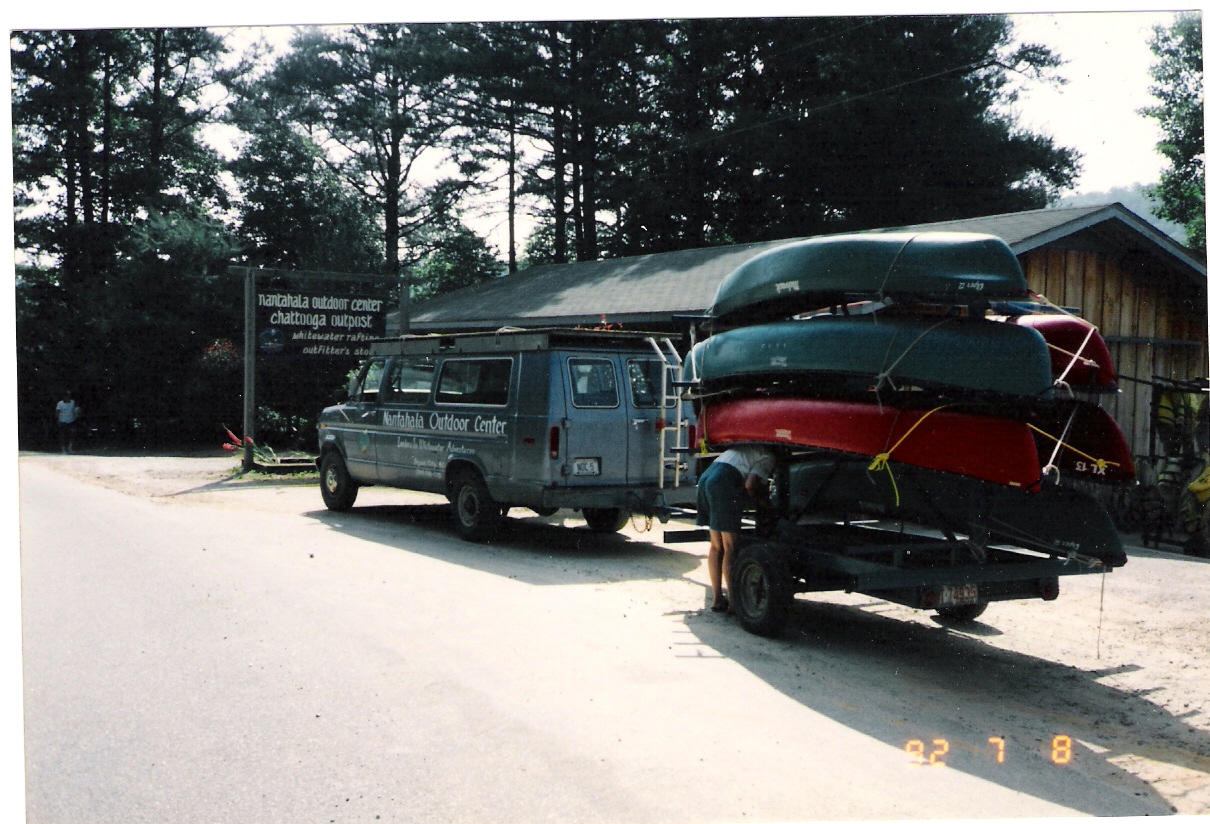 |
| Chattooga River Outpost- Canoeing Clinic -ready to go. Summer 1992 |
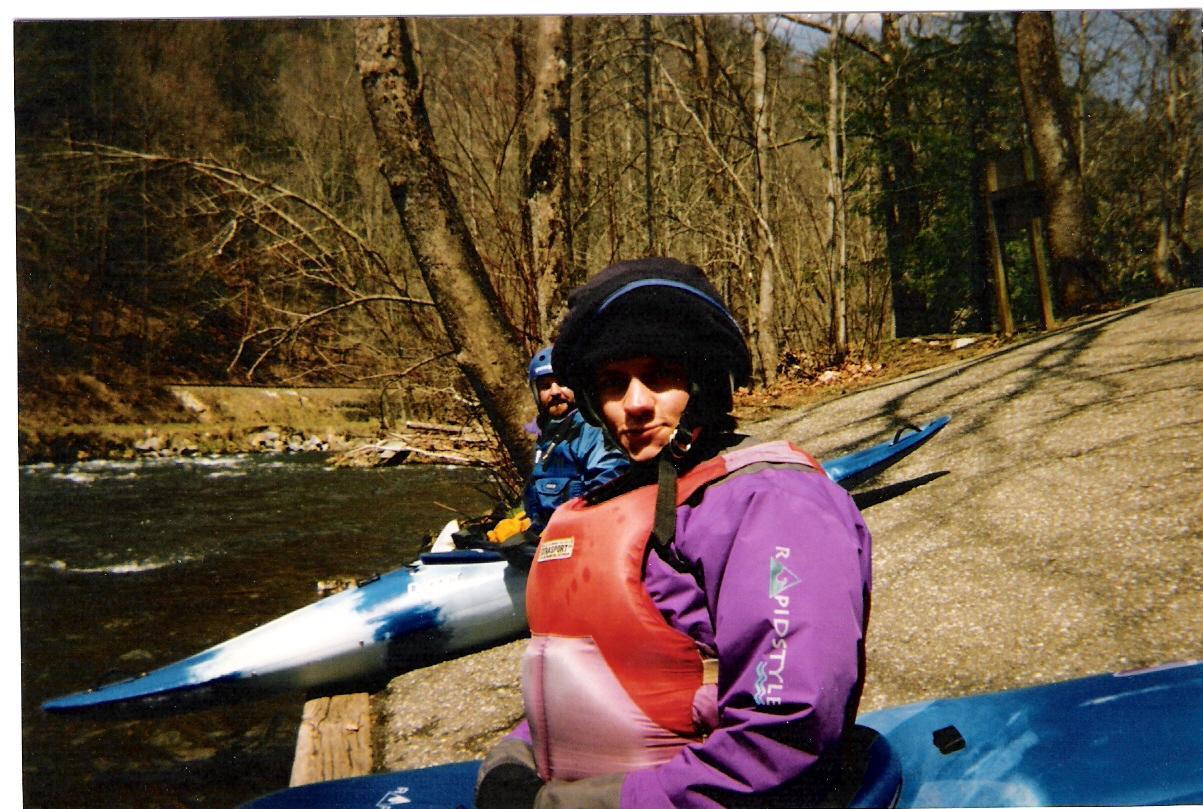 |
| Chattooga River Clinics Almost nothing stimulates the senses as much as waking up at dawn, in a tent, on the banks of the Chattooga River. Before you even open your eyes you hear the ripple of the water or the soothing roar of rapids nearby and the birds and other small animals begin scurrying about. A fish flicks his tail on the surface of a nearby pool...the sound is unmistakable. In the short term, thoughts of hot coffee cross your mind... and for the long term (measured as the end of the day) anticipation of running the class V Bull rouses you to full wakefulness. It is not quite being in the moment, but that comes soon when nature calls, and you realize you need to find a private spot in the woods. There really is nothing that compares esthetically to crawling out of your tent in those first few moments and experiencing that beautiful Chattooga River covered in the morning fog. I plan to retire there! Not on the banks of the river, but close! |
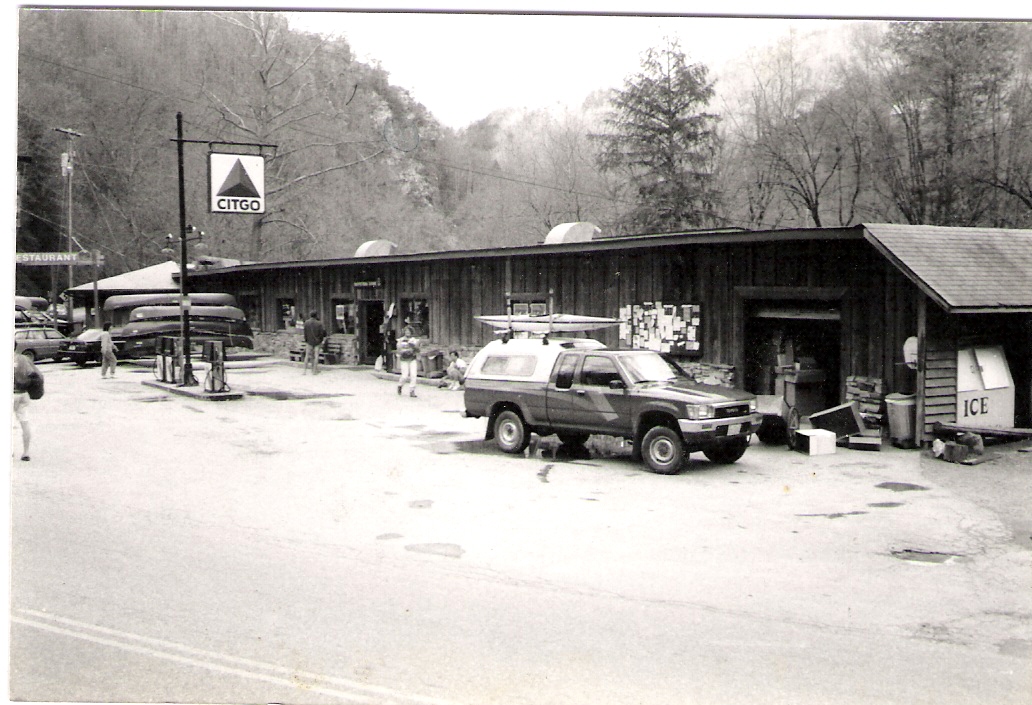 |
| This is my rare photo of the old NOC store and restaurant before it was torn down in the nineties and the new store built. (See photo of new store below.) I think character was definitely lost when the old store was demolished...character of the store, the people, and the NOC as an icon of whitewater sport.. Yes, I know...progress. But, really, what is progress?? Progress and the bottom line are not the same, and often, not even compatible. In the case of NOC, I think progress was a BAAADDD thing for everyone involved. Read the satire about progress (below)... |
| Whenever NOC river staff were injured lifting 100 pound rafts onto the tops of buses, falling off buses , or tearing tendons, rotator cuffs, or bones in class 4 rapids, we were given temporary work at other jobs at the center. The management was always accommodating to all of the Center employees. My temporary work was usually as a staff photographer. NOC photographers enjoy a life of pleasure and ease unknown to other workers in the modern world. We'd sit (in 4 hour shifts) under a beach umbrella on a large rock overlooking Nantahala Falls sipping fresh lemonade from our coolers, munching gorp, reading a book while we waited on the rafts to arrive, and then we'd snap fun photos of the raft follies for the rafting trip customers...oh, I mean guests!. As we always said, "it's a tough job, but somebody has to do it". :-) Seriously, NOC actually pays people to do this particluar job (don't tell them they could get someone to do it for free). Villa Brewer who used to be the manager of the photo department was there for about 30 years! I don't know what she's doing now at the Center, but I suspect when she dies, they'll scatter her ashes near the big "photo rock"! But the point is that working at the outdoor center makes it almost impossible to work anywhere else in the "real" world! I'll have more to say about that later. |
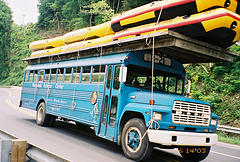
| The rafts on this bus are very stable- they are stacked only two high. But, before the state passed a law limiting the number of rafts allowed atop the buses, we stacked them 3 high and then piled kayaks and canoes on top of those. Falling off from that height was hazardous but...loading and unloading buses was just part of the whitewater experience. Aaagh! |
 |
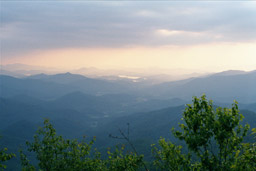 |
| Every day at lunchtime, I hiked the 4 miles up and back on the Appalachian Trail (view), which crosses at the Outdoor Center. Then, it was back to work loading and unloading buses, guiding rafts, and paddling canoes downriver. Whew! Quite a workout! |
| Satire: Relax. Meditate. Come down off that corporate ladder and think about it! An American businessman was at the pier of a small coastal Mexican village when a small boat with just one fisherman docked. Inside the small boat were several large yellow-fin tuna. The American complimented the Mexican on the quality of his fish and asked how long it took to catch them. The Mexican replied only a little while. The American then asked why didn't he stay out longer and catch more fish? The Mexican said he had enough to support his family's immediate needs. The American then asked, but what do you do with the rest of your time? The Mexican fisherman said, "I sleep late, fish a little, play with my children, take siesta with my wife, Maria, stroll into the village each evening where I sip wine and play guitar with my amigos, I have a full and busy life, senor." The American scoffed, "I am a Harvard MBA and could help you. You should spend more time fishing and with the proceeds buy a bigger boat with the proceeds from the bigger boat you could buy several boats, eventually you would have a fleet of fishing boats. Instead of selling your catch to a middleman you would sell directly to the processor, eventually opening your own cannery. You would control the product, processing and distribution. You would need to leave this small coastal fishing village and move to Mexico City, then LA and eventually NYC where you will run your expanding enterprise." The Mexican fisherman asked, "But senor, how long will this all take?" To which the American replied, "15-20 years." "But what then, senor?" The American laughed and said, "That's the best part. When the time is right you would announce an IPO and sell your company stock to the public and become very rich, you would make millions." "Millions, senor? Then what?" The American said, "Then you would retire. Move to a small coastal fishing village where you would sleep late, fish a little, play with your kids, take siesta with your wife, stroll to the village in the evenings where you could sip wine and play your guitar with your amigos." |
| u |
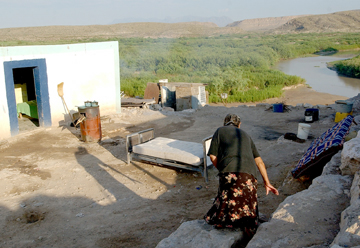 |
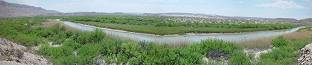
| This photo captures the essense of Boquillas- an authentic Mexcian village on the Texas-Mexico border.. |
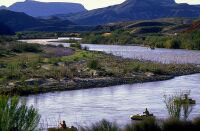 |
| Rio Grande River |
Big Bend National Park, Texas. Big Bend National Park along the Texas and Mexican Border is known as high desert at an elevation of over 5000 feet with the Chisos Mountain rising another 4000 feet in the background. This is one of my favorite places in the world. There are hundreds of miles of scenic river to paddle and gorgeous canyons along the way, including Colorado, Santa Elena, Mariscal, Boquillas, and the Lower Canyons. Mariscal Canyon's walls rise dramatically to 1800 feet above the riverbed. The river corridor is both a foreboding, yet at the same time a friendly place. Although most of the river rapids are sedate and not likely to cause problems- in themselves, you can get into trouble here in other less obvious ways. Because of the remoteness of the river corridor and unavailablity of help, one should avoid snake bites, broken bones, and even minor sprains or injuries that might make evacuation difficult. The Rio grande is a hauntingly beautiful place...and it's mood will stay with you for a long time. I've paddled the entire length of the river, often camping directly on the river, but on several visits we made base camp in the Rio Grande Village campground (simply for convenience) and then day-hiked out or mountain biked out to the nether regions of the park. It was also a short cross-desert hike (or long drive) from the campground to the hotsprings, which is a delightful end to a perfect day. You can sit in the natural hot springs which remain at 105 degrees, while dangling your arm over the side into the cold, flowing river behind you. Virtual panorama of the hot springs (this is great)... Another popular day trip is to cross over to the Mexican Village of Boquillas (now off limits), which is an authentic Mexican village of a few hundred people, located directly across from the Rio Grande Village on the American side. We brought our bikes across and road out into the Mexican countryside. Prior to 911 the impoverished people of Boquillas made a meager living paddling tourists across the river in leaky homemade boats so that the tourists could drink semi-cold beer and eat tacos in the open-air cantina, but the border closing in May 2002 put an end to that practice. Read my article about how these restrictions place hardships on Boquillas residents whose main source of income was the American tourist trade, and deprive both sides of cultural exchange, while doing nothing to stop terrorists from coming across the border. Read my article Militarizing the Borders...(not currently available) |
 |
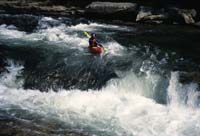 |
| Bull Sluice - Chattooga Section III - First Drop |
 |
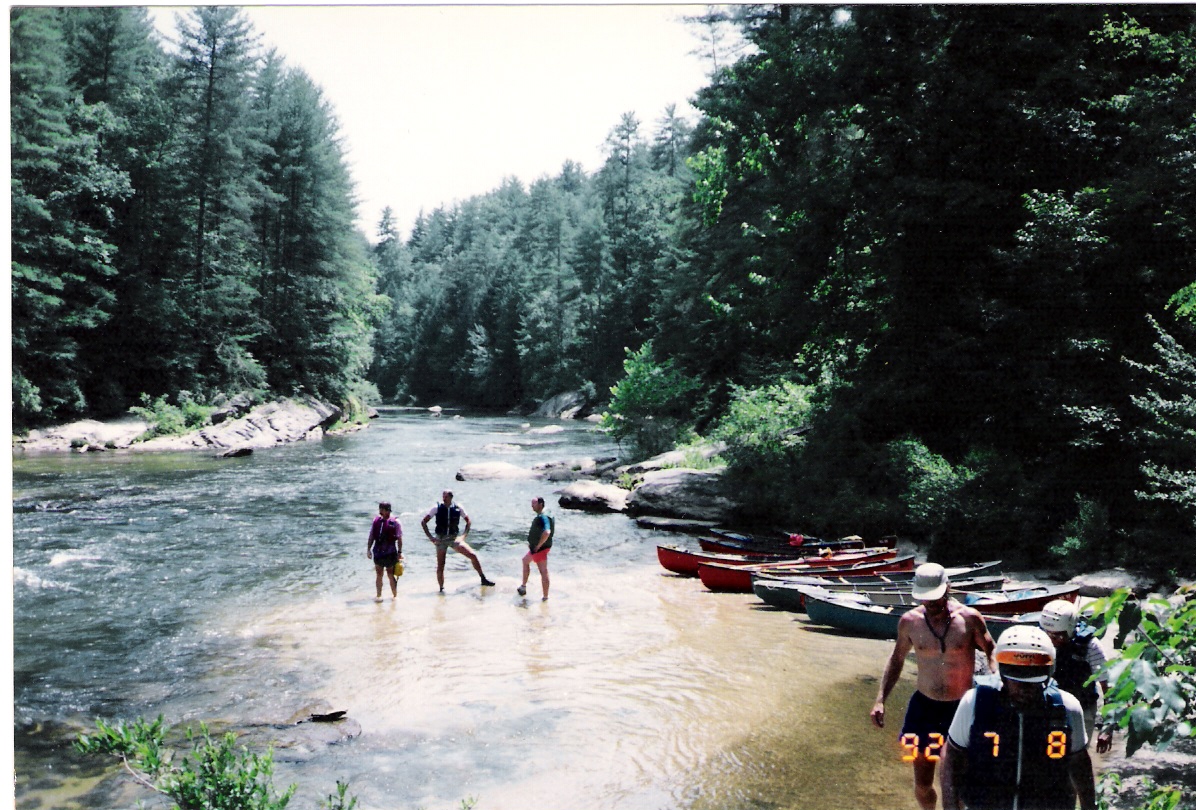 |
| Chattooga scouting break- Entrance Rapid class III to The Bull class V |
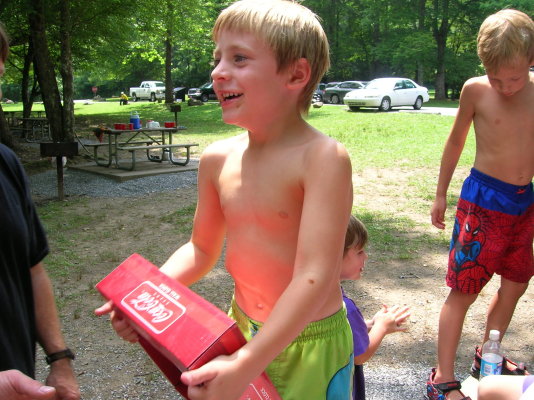 |
| Debbie Kwidd- kayaker extraordinaire and Jake at his 5th birthday party. Nantahala River, Wesser, N.C. Debbie and Jake still live in the area and they paddle, bike, hike, & enjoy life together. |