 The Sacrifice of
Praise
The Sacrifice of
Praise 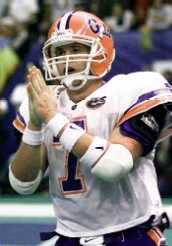
The Sacrifice of
Praise
Examining the issue of on-field prayer By Danny Wuerffel
"The Lord searches every heart and understands every motive behind the thoughts..." 1 Chronicles 28:9b Many events have become synonymous with the fall season of college football. Marching bands, dueling mascots and tailgate barbecues just to name a few. All of these familiar images remind us that the spirit of athletic competition is in the air. These spiritual practices are welcomed by fans--they are symbols of celebration. However, not every visual symbol associated with collegiate athletics is greeted with as much enthusiasm.
The simple, faithful expressions of thanks to God by His young servants, be it hands clasped together in prayer, or a group kneeling and praying at mid-field, have attracted the musings of the observers of college football almost as much as the AP/CNN football rankings. Since public prayer is a topic that remains so misunderstood by even the faithful of outside observers, an explanation of the motives behind at least one student athlete's on-field devotion will hopefully add to the ongoing discussion.
In 1995, an NCAA ruling banned excessive celebrations after touchdowns, with prayer cited as behavior that would be penalized. But is dropping down on one knee or folding hands together really an effort to draw attention to oneself?
Aubry Hill, a graduate assistant coach at the University of Florida and a former wide receiver, sees this in a much different light. "When a player scores a touchdown or makes a great play in front of 80,000 fans and a national audience, he already has all the attention," Hill said. "The real question is what is he going to do with it--praise himself or praise God?"
Fortunately, the on-field prayer never became an issue for me because Liberty University, founded by the Rev. Jerry Falwell, took the NCAA to court. The NCAA quickly re-established that the intent of the new rule did not ban prayer and that praying would not be penalized. However, while the issue was settled with the NCAA and in the hearts of the players, it was just beginning to be an issue of public discussion.
As a Christian athlete--a Christian who happens to be an athlete and not vice versa--I have found that folding my hands together following each touchdown is a humble way of thanking the Lord for the gifts and opportunities He has so graciously bestowed on me. Praying wasn't anything I planned or decided to do, but I found it to be as natural as spotting an open receiver and instinctively throwing the ball. A touchdown is a natural point of closure--a perfect occasion to humbly express gratitude to the One who gave me the gifts and the opportunity to use them; the author of Hebrews calls this "the sacrifice of praise."
My personal thanks occurring after a touchdown is never meant as an expression of my appreciation for defeating the opponent. Perhaps it is natural for people to see a football game and only care about the final score, seeing only victors and the vanquished. But what does God see?
Aubry Hill feels, as I do, that there is a bigger purpose for the game. "I don't think it's like God is rooting for Florida or Tennessee," Hill said. "Many people see football one way--winners and losers. But those who are around the game, such as players and coaches, get a much better taste of the people who are really involved--their concerns and struggles on and off the field. God cares about these things, too."
Objections to public prayer are often founded upon a superficial interpretation of Scripture. In the Gospel of Matthew, Jesus rebukes those who pray publicly to appear righteous and to draw attention to themselves. His criticism of the religious leaders of his day focused on the motive behind their public displays of religious piety. Jesus was always more concerned with the attitude of the heart rather than the physical act.
Are some athletes today guilty of this hypocrisy as was the group 2,000 years ago? Perhaps. But my study of God's Word has led me to this conclusion: The Lord alone sees into each heart, and He alone can determine the intent of the prayer, regardless of the setting in which it is made.
Some of the most beautiful prayers recorded in Scripture are set before large crowds of people. When Solomon gave the prayer of dedication of the Temple, he "knelt down before the whole assembly of Israel and spread out his hands toward heaven" (2 Chronicles 6:13b). God responded to this public prayer by filling the Temple with His glory (2 Chronicles 7:1).
When two nations came to attack the nation of Judah, Jehoshaphat, the king of Judah at the time, "...stood up in the assembly of Judah and Jerusalem at the temple of the Lord in the front of the new courtyard..." (2 Chronicles 20:5). The very words he prayed are often cited today as a model prayer.
Thus, the public nature of the prayer must not be the issue that Jesus is addressing; rather, the real issue is the condition of the heart of the one who is praying. In fact, in Matthew 10:32, Jesus says, "Whoever acknowledges me before men, I will also acknowledge before my Father in heaven."
While the act of appearing righteous to garner public approval is behavior abhorrent to Jesus, it was never his intention to force His children to hide their faith and profess it only to the inside walls of their own room. With the right heart and pure motives, a public profession of faith must certainly be pleasing to the Lord.
At the conclusion of each University of Florida football game--whether at home or on the road--my teammates and I gather at midfield to kneel before the Lord in prayer. While the media and skeptics may misinterpret what we do in worshipping God on the field, I plan to continue in the footsteps of another athlete from the Bible, Joshua, who said, "But as for me and my household, we will serve the Lord" (Joshua 24:15b).
Danny Wuerffel was actively involved in FCA at the University of Florida.
God Bless Danny for using his God given talents on and off the field and PRAISING GOD! Now you know why I proudly call myself Gator7fan!!!
Did You Know: Florida's Danny Wuerffel is the only quarterback in NCAA Division 1-A history to rank in the top four in career passing categories: Passing efficiency Percentage of passing touchdowns Passing yards per attempt Touchdown passes Passing yards per completions Ratio of TD passes per interception Ratio of average completions per TD pass Ratio of average attempts per TD pass.