World War I Journals
May 1917 – On the 6th of April, the United States finally entered into the Great War in Europe. I, Steve Johnson, have decided to enlist my services into the army to fight the good fight and serve my country. After enlisting, I was sent to a training camp known as Camp Pike in nearby Little Rock, Arkansas. Training there lasted for several weeks and was pretty rough and tumble. We had to rise at dawn every morning and undergo endless amounts of drilling. They put us to work maintaining the grounds and performing upkeep on the barracks, mess hall buildings, etc. and sometimes I wonder how this will prepare us for a war. The drilling does build up endurance and strength, and by the end of it, I felt that I had had enough training to be well prepared for the life of a soldier and fighting in combat. I am now on board the transport ship Liberty and heading overseas to England after leaving Camp Pike. The seas are very rough and many of the men, myself included, have been coming down with sea sickness. They drill us in “abandon ship” drills, in case of the ship ever sinking. These drills occur almost as often as the drills we had to undergo at Camp Pike and become very monotonous. We are often put to work doing sailors tasks and get very little rest. We will arrive in France within the next couple days though, and hopefully from there be shipped out into action and see some real combat for a change.
June 1917 – A few weeks ago we arrived at a camp in France. There, they gave us new armaments, including a new rifle called the .303 Lee Enfield. We traded in our old .306 Eddystone Enfields for those. The Lee Enfield is the standard issue of the British army, and the British commanders decided it best for the Americans to use those. They serve us British rations, which I find to be much tastier, although much smaller than the chow we used to be served back home. The training they administer here is exactly the opposite they used to give us; the training here is relevant and useful. They train us in gas masks, bayoneting, musketing, and physical exercise. When not training or performing duties, we go to the Y.M.C.A. to trade or buy goods. Every so often I can see French or British soldiers returning from the front. The looks on their faces are almost indescribable. They look forlorn and as if they’ve lost all hope for life. They now tell us that we should be moved to the front within the next month. I hope that all of the training they’ve administered will come in handy, although from the looks on the soldiers’ faces, I am starting to become extremely uneasy. On a lighter note, I also saw for the first time in my life an air battle that took place overhead. The allied fighter took down the Hun fighter in a great explosion. It was very interesting to see.
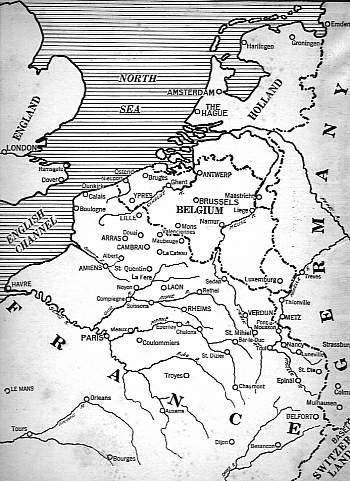
July 1917 – We are now marching towards the Western Front. We have to hike the whole way while wearing gas masks, which is almost suffocating to march in for so long. Breaks are few and far between. It seems uncomfortable to breathe the air after wearing the mask for so long, although it does feel relieving to be able to breathe fully without the feeling of constraint and suffocation. For the first time I can hear the explosions of the artillery being fired, although the shells landed far away. The hiking became so suffocating with the masks that they allowed us to remove our masks for the remainder of the hike to the front. The shelling becomes increasingly heavy as we draw closer to the front. The bombardment starts to become so heavy that there are now reports of casualties in the marching line. After two weeks of hiking, we finally reached the front. Life there is both miserable and maddening. Although I have yet to face any combat here, there are already casualties from enemy artillery. It almost seems that survival here is not based on the hours and hours of training we received, but more on luck and circumstance.
March 1918 – For the months that I have been on the front and in the trenches, life has been miserable. Everyday is a struggle between life and death. Half of the company I first came with is now dead. The casualties rise every day and show no sign of slowing. We have advanced and retreated many times, yet when all is said and done we are still in the first trench we arrived in. We are at a stalemate; both opposing trenches are too heavily fortified for the enemy to seize them. Machine guns, often operated by two or three people, have a devastating effect and often kill enemy advances by the hundreds. I realize now that all of the drilling is completely useless to me now, and everything I now know has been taught on the front. The food here is foul and unfit for consumption. The rationing of this food is equally unfit; we receive so little that it is a wonder that any of us get by. Besides the food being unsanitary, we ourselves are also growing rotten and spoiling. Water is scarce to come by and hygiene is of little importance to our superiors. Our bodies are covered with lice, which the men now refer to as their “little friends.”
November 1918 - At eleven o'clock on the eleventh day of the eleventh month of 1918, the war finally came to a close. I should be returning home soon, thankfully unscathed physically. Within the past couple of months, things really started looking dreary for the Germans, as we had pushed them back at our offensive at the Somme, and we had broken through their fortifications at the Hindenberg Line. The thing the men fear more than being killed in battle is the flu. Influenza is killing far more people than I believe the war to have ever killed. It’s by luck alone that I did not catch it, as becoming ill on the front is as good as a death sentence. The flu and the fighting has taken so many of us that I’m only one of a handful of my original company to still be here. I’m just thankful that I will soon be heading home and returning with my body intact, although I will still have to live with the terrifying memories of what I’ve seen and done.