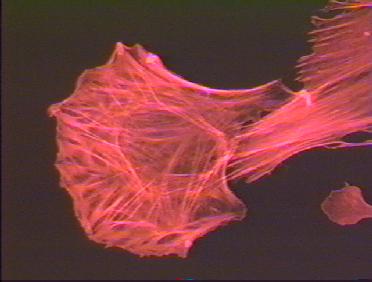
Smooth Muscle
Smooth muscles, muscle tissue that lacks cross striations, are located in many internal organs and in the walls of many blood vessels, including the digestive, reproductive, and respiratory systems. They are spindle shaped and have individual nuclei. They get their name from the fact that under a microscope they lack the stripe patterns that other muscles have, thus the name “smooth.” They are specifically found in the stomach, intestine, gallbladder, urinary bladder, the base of hairs, and duct glands under the skin. Except for the heart, which contains cardiac muscle, smooth muscle lines the walls of hollow organs. Smooth muscle often surrounds, or is integrated into, parts of the internal organs. Smooth muscle can contract or relax as a single unit without conscious thought. These functions are not induced by a nervous stimulation, but rather by a chemical signal that occurs, such as changing the size of a pupil to adjust to light. They also serve to move food down the digestional track by expanding and contracting. Because of this, it is sometimes referred to as involuntary muscle.
There are two forms, as multiunit or visceral. Most smooth muscle is in the visceral, or single unit, form. Multiunit smooth muscle cells are found in the iris and a small few other organs. In a multiunit smooth muscle cell, there exists as a discreet independent unit that is innervated by a single nerve ending. Multiunit cells rarely contract spontaneously. In visceral smooth muscle cells, a sheet or bundle of fibers that are intimately connected by junctions, allow ions to flow freely. Visceral cells, unlike multiunit cells, contract spontaneously if stretched beyond a certain limit. The organelles inside of a smooth muscle cell are generally a nucleus located within the widest part of the cytoplasm. The cell only has one centrally placed nucleus that contains two to five nucleoli. Smooth muscle is the simplest of all muscle cells and has relatively few mitochondria and other intracellular organelles. It does, however, have abundant amounts of caveolae, which maintains homeostasis in the cell. It has a complex and elongated protein structures. Smooth muscle cells also contain desmin, a filament only found in muscle cells, which create structures for the proteins found in the cells.
Bibliography:
http://www.uoguelph.ca/zoology/devobio/210labs/muscle1.html
http://www.e-muscles.net/#smooth
http://www.cell-biology.com/organ.html
http://www.sidwell.edu/sidwell.resources/bio/VirtualLB/tissue/muscle.html
http://attila.stevens-tech.edu/~vgrasso/Physio2k/MUSCLES.htm