| GaryD's Mucky Fingers | |
|
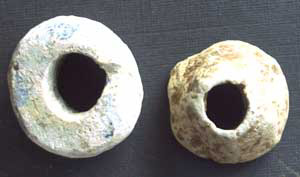
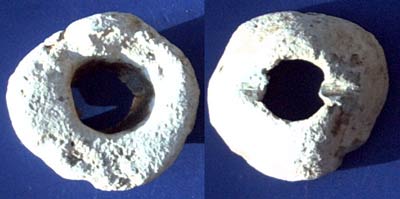
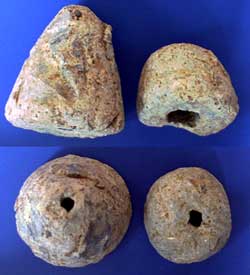
Drop-spindle The drop-spindle is thought to have been around for thousands of years. Many detectorists have found lead Whorls from a range of different land sites. Lead Wholes are difficult to date, as the shape hasn't changed much in thousands of years. Some are highly decorated, while others are just lumps of lead with a hole. The fleece from all sheep can be used. The wool is spun unwashed as the natural grease (lanolin) helps in the spinning process. Q.) How does a drop-spindle work? A.) You would have taken a handful of wool and tease some out until free from lumps or tangles. Then draw a few fibers out from the wool and twist in a clockwise direction to make a thread about 5" long. Then take the spindle and attach the yarn to the notch at the top of the spindle Stick. Holding the fleece in one hand and the spindle in the other, twist the spindle in a clockwise direction. As the spindle is spinning pull out more fiber's from the fleece. Allow the twist to run up the fibers to produce a yarn. All you had to do was continue spinning. Drawing out the fibers, until the spindle reaches the ground, then wind the yarn onto the base of the spindle allowing enough yarn to make a hitch in the notch at the top of the spindle stick and start all over again. Q.)Why do I find different size Lead Whorls A.)Heavy spindles spin thick yarns best while light spindles are meant for fine yarns.
| |