Lead token were given to all sorts of workers from farm labours to Dock handlers.
Churches also gave them to the poor so they could exchange for food.
There must be thousands of different lead design out there
using letters, pellets, numbers and some with only a simple mark.
Lead token
DFX 16.06.02
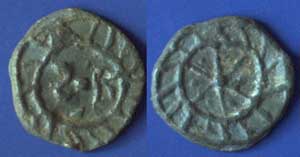
Linear 4-arm cross
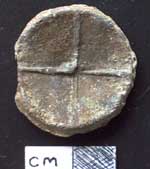
Lead token
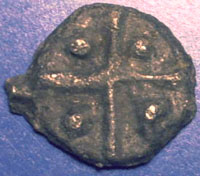
Linear 4-arm cross with pellets
dfx 4/01/03
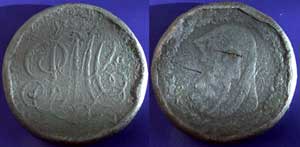
Druid Token
from the Parys Mining Company i think its the 2nd edition of 1787
A Penny token coin from the Anglesey Mines in North Wales.
Minted in Liverpool these coins were valid money for trade for Welsh Miners in the late 18th century.
This coin is from the year 1787 and has a Druid's
head in flowing robes on the front and letters PMC,
on the reverse, which I believe stands for the Parys Mining company
 11/11/03 dfx 11/11/03 dfx
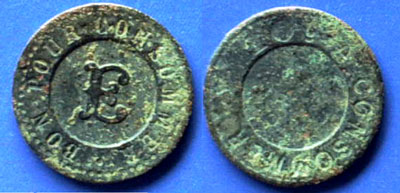
Need help with this one
Obvers, Bon Pour Sommer (E)
 10/11/02 xlt 10/11/02 xlt
Thanks go to Jelle, for his ID (Jelle's site, Fryske walden detector) it's on the link page!!
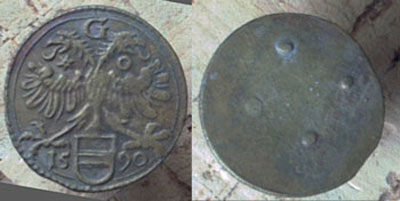
Groningen city council Token Netherlands (raadsteken)
These tokens were issued by the city council and were equivalent to three stivers.
(a Striver is a copper dump coin, from the Netherlands as far as i can make out)
It was minted in 1590 in the town of Groningen, Netherlands and would have been given to members of the city council to exchange for wine or beer at the local Rathskellar (city owned tavern).
Tell me more about The city of Groningen
Groningen, the largest city in the northern region of the country, has a number of canals and has always been an important port. Groningen is the site of an ancient Roman camp.
In 1040 Henry III, king of Germany, granted the settlement to the bishop of Utrecht. The town was fortified in 1255, and before 1284 it joined the Hanseatic League, a commercial federation of European cities. By the end of the 14th century, power was taken from the bishop by the rich burghers. .
In 1819, the Hoge Raad van Adel, the authority in the Netherlands which officially recognizes coat-of-arms. Confirmed the right of the city to its ancient coat-of-arms, which was described as follows: "A shield of gold with an double-headed black eagle with spread wings and legs. Having on its breast a small silver shield bearing a green crossbar. The shield surmounted by a gold crown and supported on both sides by a black eagle.
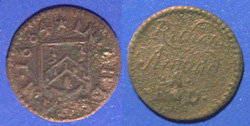
1664 Farthing token
Obverse 1664 * LN GH ** **
Reverse RICHARD AMOND then at the bottom R + D
Issued by RICHARD AMOND of CHESHAM in 1664
the arms shown are those of the clothworkers guild
.4/01/03 dfx
16th-century
farthing token
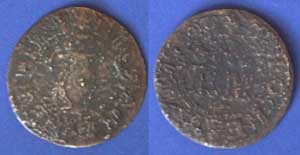
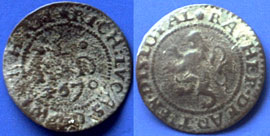
1670 copper halfpenny trade token
Issued by RICHARD LUCAS of WYCOMBE in 1670
 dfx 20/03/03 dfx 20/03/03
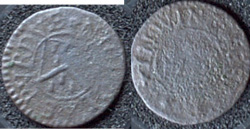
This is a farthing trade token of William Sayer,
a grocer of Ipswich,
dated around 1660.
Trade Tokens
At times in English history the official provision of small change, the money most useful in daily transactions, has been inadequate. In small periods unofficial Trade tokens have been provided to fill the gap. The first great age of such issues lasted from about 1649 until the early 1670s. During these years tokens, usually halfpennies and farthings, were widely produced for issue by traders, innkeepers and shopkeepers. There were also some important issues by local authorities. There may have been as many as 20,000 varieties issued for England, Ireland and Wales.
The tokens were normally copper or brass, and round, though octagonal, heart-shaped and square types are known from around 1668. Each side of the token bore an inscription. These could indicate the issuer, the locality, the face value, and sometimes the issuer's trade. Designs in the centre of the token could be initial letters, the arms of the relevant guild or merchants company, a symbol to indicate the issuer's trade (e.g. hat, tobacco pipes, roll of cloth), or an inn sign.
From Longships Mar-7-2002
Indian Temple Token! I found something similar a few years ago this looks modern. I understand that they are Purchased at Temple to leave as a token in temple or as grave goods ?Found in London
"Thanks Longships"
dfx 02/03/02
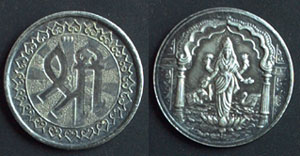
Indian Temple Token
thanks to Arne for the id
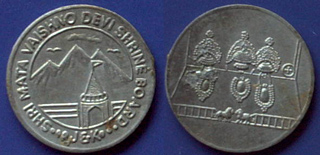
Obvers The Holy Shrine of Shri Mata Vaishno Devi
on the revers The Holy Pindies
 dfx 10/11/02 dfx 10/11/02
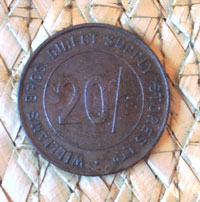
Henry F Shew
Munsley
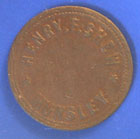
A trade token of oil merchant John Fowler
John Fowler,
Whale oil merchant and tinplate business man
who was trading from Long Acre,
in the west end of London around the 1780s.
The blubber from whales caught in the Arctic was chopped up small
and shipped back to the Greenland Yards in British ports.
Whale oil was used in soap making and to clean
wool before it was made into course cloth.
Many merchants and manufacturers issued their own currency
tokens during this period, partly because of
a chronic shortage of coinage.
Whale oil was widely used as fuel in lamps at this time.
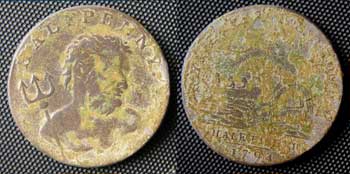
Hi I need help with this token
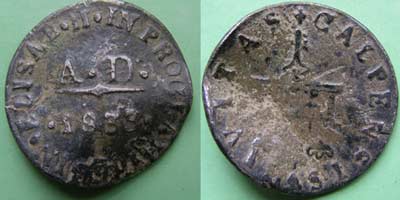
Back
| |
