Jettons, or reckoning counters, were probably first used in France around the early 13th century and were in use in England by the reign of Edward
I.
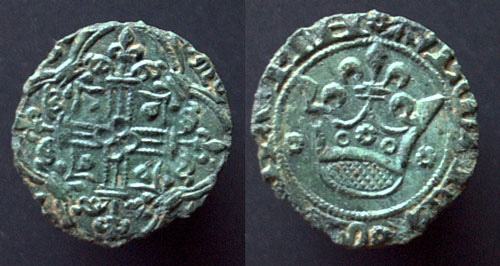
This was found on farmland
I think it could be a French jetton, Tournai 1415 1457
If anyone can give any more details please E-mail me.
Bronze jetton or trade token from c.1530, made in Nuremburg.
Obverse, 'Lion of St Mark', reverse is the standard orb and cross. Maker von Hans KRAUWINKEL
found near the river Thames.
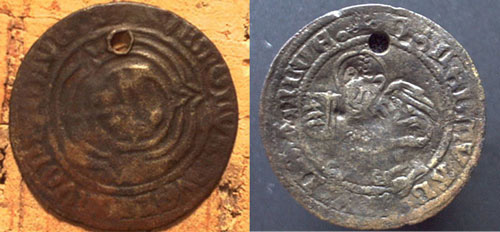
Found on farmland
This was Angie's first Jetton
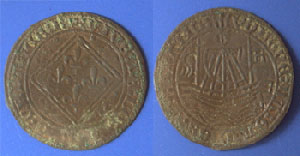
GERMAN STATES Nuremburg Circa 1490-1550 'Ship Penny' Brass 'Ship Penny' Jetton 2.42g. 27mm.
French Galley; G above, nonsense legends.
Four fleurs-de-lys within double diamond border.
xlt 19/05/02
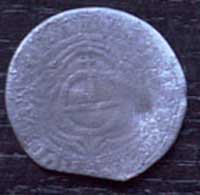
This one is not in such good condition found on farmland
It looks like a Nuremberg jetton.
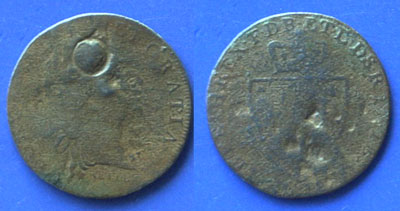
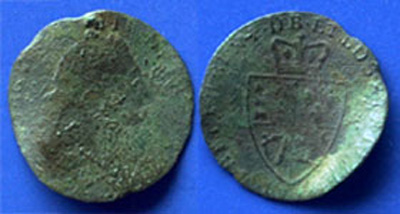
Advertisements Guinea and half Guinea Piece
Many similar jettons were made with the names and addresses
of businesses as novel advertising pieces,
the intention being that few people would throw away
something that looked like money, so the "coin" would be a long-lasting advert.
1788
The date 1788 would be entirely correct for this type of guinea
or half guinea, which were issued from 1787 to 1800,
although it is entirely possible that these jettons
were issued later than this. Obviously because
these are only "toy" imitations of coins, it is likely that there many
dates will appear on them which would not appear on actual coins.
This does not make them rare or valuable,
merely interesting.
Obverse
The obverse shows a crude portrait of George III.
GEORGIUS III DEI GRATIA
GEORGIVS III DEI GRATIA,
Reverse
The reverse shows a crowned spade-shaped shield in reasonable imitation
of a George III half guinea, with the inscription.
IN MEMORY OF THE GOOD OLD DAYS
1788
Advertisements half Guinea Piece
 dfx 16/02/03
Back dfx 16/02/03
Back
| |
