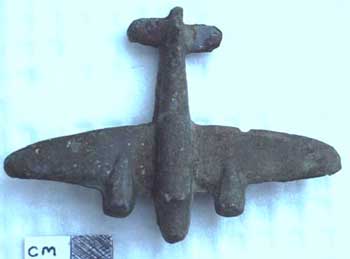
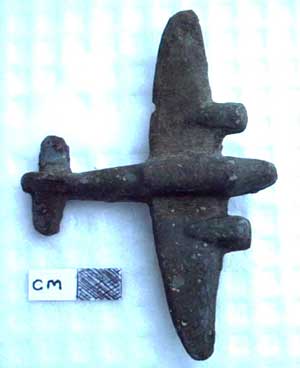
I think this lead Dakota aircraft was probably made in the 1940s or 1950s
It was recovered at a depth of 2in.
It announced itself with a very loud signal.
I would like to thank Pete for his id of this Douglas C47A Dakota (DC 3)
Perhaps one of the most historically significant British Dakota is the preserved Dakota C47B-20-DK (DC3)
with the markings "Larry Blackman", was originally presented to
General Bernard Montgomery by the American Supreme Commander, General Dwight Eisenhower in the war.
Bu27110 is perched on display outside the Air Niugini Head Office at Jackson's airport,
Port Moresby (Papua New Guinea). It was mounted there as a monument to all the airmen
who have given their lives flying in Papua New Guinea. P2-ANQ was built in 1943 as a 26 seat
VIP transport for the United States Army Air corps and sent to the United Kingdom
as a lend-lease aircraft. General Eisenhower presented the plane to General Montgomery “Monty”, and subsequently
Monty used the aircraft extensively throughout the European campaign during the last years of the
Second World War. After the war the aircraft was put into service as a personal VIP carrier
for Greek shipping magnate, Stavos Niachos. TAA - Trans Australian Airlines
(now merged with QANTAS) bought the aircraft in 1965 and registered
it as VH-SBW for service in Papua New Guinea.
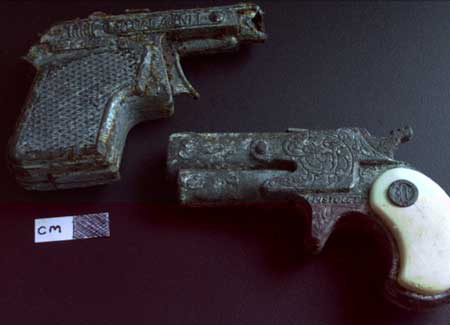
These toy Guns lay undisturbed in an old wood
for more then forty year till Angie unearthed them.
You can imagine the sadness of the small child who lost then.
I would say they were made around the 1950-60
The one on the right looks like a Toy Derringer
Derringers were invented, or at least popularized, by a man named "Deringer"
(note the single "r") in the 1800s. The original Deringer was a small, handy,
single barrel muzzle loading single shot pistol that could be easily concealed.
When other manufacturers wanted to capitalize on the burgeoning popularity of these small pistols,
they called their generic pistols "derringers," and that is where the extra "r" came from.
John Wilkes Booth used one of these to assassinate Abraham Lincoln.
Booth shot and killed President Abraham Lincoln. On 14 April 1865.
During a performance of Our American Cousin at Ford's Theatre in Washington, D.C.,
Booth snuck into the presidential box and shot Lincoln behind the left ear.
Booth leapt down to the stage (breaking the fibula bone in his left leg as he landed) and
shouted "Sic semper tyrannis!" (In Latin, "Thus ever to tyrants.") He escaped with an
accomplice and eluded pursuers for 12 days before being cornered in a tobacco shed in
Virginia. The shed was set on fire, and in the ensuing confusion Booth was shot by a
Union soldier, Sgt Boston Corbett, Booth was dragged from the shed alive, but died a few hours later.
Booth was a well-known actor and had appeared on the Ford's Theatre stage many times;
Lincoln had actually seen him there in an 1863 performance of The Marble Heart...
Booth's father, Junius Brutus Booth, Sr., was an even more famous actor... Booth shot
Lincoln five days after the Civil War ended, when confederate General Robert E. Lee
Surrendered to the Union's Ulysses Grant at Appomattox on 9 April 1865.
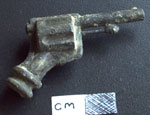
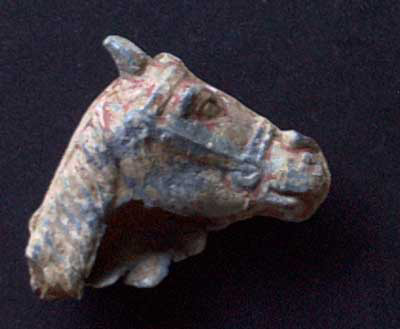
Seeking a more structured way to play with toy soldiers, H.G. Wells wrote Little Wars - recognized
today as the first recreational wargame. He is regarded by gamers
and hobbyists as "the Father of Miniature Wargaming.
One of the oldest lead toy makers is Britains Ltd.
It was founded around 1845, the year William Britain Sr. moved from Birmingham to Hornsey Rise, North London;
he made ingenious mechanical toys, but their complexity and high cost limited sales.
So to boost business, William Britain Jr. came up with the idea of hollow-casting lead toy soldiers,
a process whose origins have been attributed to Germany.
A hollow-cast figure was cheaper to make and ship to customers because it needed less lead
and was lighter than a solid soldier.
The first Britains model -- a mounted Life Guard -- was produced in 1893 and the process was patented.
Hollow-casting revolutionized the family business and the toy soldier industry
at a time when German-made flat, semi-round and solid toy soldiers dominated the market in Great Britain.
Britains' attractive and more affordable 3-D toy soldiers helped the firm supplant foreign competition.
In addition, Britains enhanced the collectible allure of its glossy troops
by continuously offering new lines in its standardized 54-mm scale.
Domestic and overseas sales mushroomed. The British company became recognized as
the global leader in metal soldiers. Plastics were added to its sales arsenal in the 1950s.
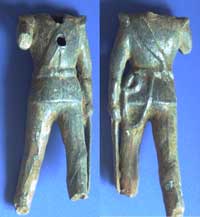
If you would like to add something or if I have made a clanger
on this page please feel free to correct me thanks
Back
