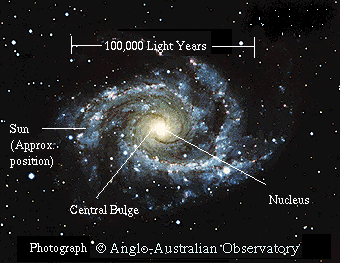
The Milky Way galaxy in which we now live is a very different place to the cold gas from which it formed over 16 billion
years ago. No longer is it a spherical mass of hydrogen; today astronomers with radio telescopes have charted the clouds of
gas and have found that the Milky Way is a Spiral Galaxy, one of countless others. Whilst we can't "stand back" and see our
galaxy as a whole, we can look out into space and see other galaxies which we think may be similar to our own.
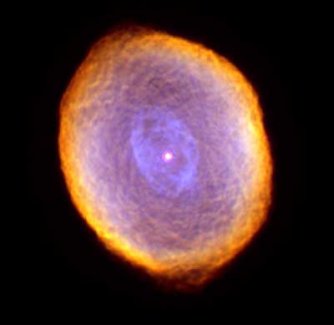
NEBULAS
Nebulas are clouds of gas and dust particles spread out through interstellar space. Before telescopes
advanced sufficiently to better resolve objects in space, all objects with a diffuse appearance were thought of as nebulas.
Many of these objects are now known to us as galaxies or star clusters.
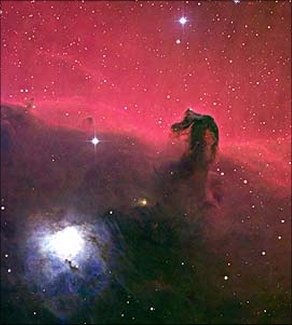
DARK NEBULA
Dark nebulae are huge clouds of dust that block the light from anything that is behind them. Some of these nebulas can be a
few hundred light years in width. The dark rifts seen in the midst of many pictures of our Milky Way galaxy are actually a
series of dark nebula.
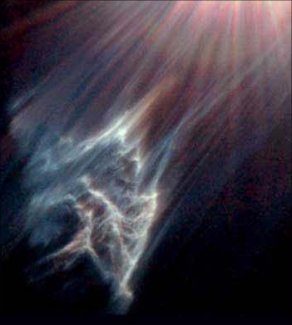
REFLECTION NEBULA
Reflection nebulas are huge clouds of dust which reflect the light of nearby stars. Like emission nebulas, reflection
nebulae are also usually sites of star formation. Reflection and emission nebulas are often seen together. Both are
sometimes also referred to as diffuse nebulae.
EMISSION NEBULA
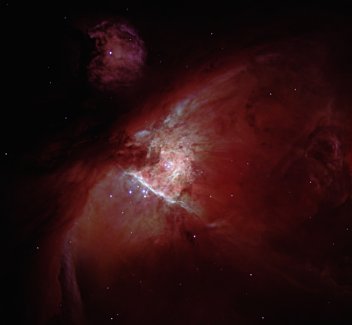
Emission nebulas are huge clouds of hot gasses sometimes many light years in width. Ultraviolet light from nearby stars
energize these gasses causing the nebula to shine. Emission nebulas are usually stellar nurseries where new stars are
forming.