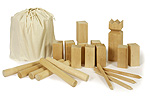
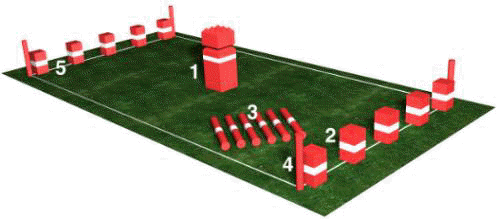
| An American interpretation of how to play Kubb. by Gary Gruber Overview: This is my interpretation of the rules of Kubb, which I have gathered from searching the web and playing the game both in Sweden and at home in the USA. I have tried to translate into American English and combine the rules from many different sites into this document. Kubb is a very old game. "Throwing logs" is quite a popular party game in Scandinavia & Europe. It is played outdoors with 2-20 participants. All ages can play and substitutes are allowed as long as the participants don't switch sides. The game is played on a field 5 x 8 meters(~ 16' 5" x 26' 3") or 8 x 10 meters(~ 26'3" x 32' 10"); the size can be more or less depending on the players� skillfulness. The field should be fairly smooth and flat, and can be grass, gravel, asphalt, etc. even snow. The players are divided in two teams and stand behind their respective baseline. The goal is to knock down all the other team's kubbs with the batons. When all the kubbs are knocked down, the king is then knocked down, the team that does this wins. Details: Five kubbs are placed along each baseline. The field is divided into two sides placing the king in the center. Team A divide all the batons among themselves. As many kubbs as possible should be knocked down on team B�s baseline thrown from behind team A�s baseline. Batons must be thrown underhanded from one end, not the middle. Intentional helicoptering should not be permitted. The king cannot be knocked down on the first turn by either side even if there is a baton remaining to be thrown after all kubbs have fallen. Then it's team B�s turn, starting by throwing the fallen kubbs over the halfway line from behind the baseline. When the kubbs have been thrown, team A stands them on end where they land. If any land outside team A�s side, team B has one more chance, if team B fails, team A may place the kubb wherever they like on their own side, suitably behind the king (no closer than a baton's length). Team B then throw their batons from behind their baseline. They must knock down all the kubbs on team A�s side before they can start knocking down the kubbs on team A�s baseline. (Note the difference between the terms "side" and "baseline") The game continues like this between the two teams. If a team doesn't knock down all the kubbs on one side during their turn, the opposite team can throw from an imagined line parallel to the baseline drawn through the kubb closest to the king on their side, and on subsequent turns until that kubb is knocked down by the opponents, then baton throwing is from the baseline again. An exception to this is that throwing at the king must always be done from the baseline. The game can be won by the team, having thrown all but one baton, knocking down all remaining kubbs, then throwing the remaining baton at the king knocking it down. If only one kubb is standing, the last baton may not be thrown at that kubb; instead it becomes the other team's turn. If the king is knocked down before all the kubbs, the opposing team wins. Materials: The game contains the following pieces made of hardwood: -1 King: approx 9 by 9 cm square and 30 cm�s in height. (~ 4" x 4" x 12") -10 Kubbs: approx 7 by 7 cm square and 15 cm�s in height. (~ 3" x 3" x 6") -6 Throwing Batons: Round 44 mm in diameter and 30 cm�s in length. (~ 2" x 12") -4 Corner Sticks: 2 by 2 by 30 cm are also useful to have. (~ 3/4" x 3/4" x 12") Guest # |

|
 |
 |
 |
 |
