SPI-74-2
FINAL TECHNICAL REPORT
FOR
DESIGN AND APPLICATIONS OF CLOSE- SPACED THERMIONIC
CONVERTERS
WITH NOVEL ISOTHERMAL ELECTRODES
Prepared Under Grant
DE-FG03-94ER81864/M008
Submitted to
U.S. Department of Energy
Oakland Operations Office
1301 Clay Street, Room 700N
Oakland, CA 946 12-5208
Submitted
January 2000
Submitted by
Space Power, Inc.
Gary O. Fitzpatrick
1253 Reawwood Ave.
Sunnyvale, CA 94089-2226
SBIR RIGHTS NOTICE
These SBIR data are furnished with SBIR rights under Grant No. DE-FG03-94ER81864. For a period of 4 years after acceptance of all items to be delivered under this grant, the Government agrees to use these data for Government purposes only, and they shall not be disclosed outside the Government (including disclosure for procurement purposes) during such period without permission of the grantee, except that, subject to the foregoing use and disclosure prohibitions, such data may be disclosed for use by support contractors. After the aforesaid 4-year period the Government has a royalty-free license to use, and to authorize others to use on its behalf these data for Government purposes, but is relieved of all disclosure prohibitions and assumes no liability for unauthorized use of these data by third parties. This Notice shall be affixed to any reproductions of these data in whole or in part.
Space Power, Incorporated
1253 Reamwood Avenue, Sunnyvale, California 94089-2226, (408) 541-1999, Fax (408) 541-9393
SPI-74-2
1.0 Background Perspective 1
1.1 Converter Performance Improvement 1
1.1.1 SAVTEC 1
1.1.2 EFFECT 3
1.1.3 NETCON 3
1.2 System Considerations 6
1.3 Thermal Distortion of Heated Electrodes 6
1.3.1 Expansion Calculations 6
2.0 Technical Approach to Close Spaced Converters 9
2.1.1 Heat Pipe Inserts 9
2.1.2 Laser Interferometer Testing 9
2.2 Active Gap Control 13
2.2.1 Piezoelectric Translators 13
2.2.2 Control Scheme 15
2.2.3 Compensation for the Expansion of Piezoelectric
Drive Rods 15
3.0 Experimental Effort of Phase II Project 15
3.1 Hot Shell for Thermionic Converters 15
3.2 Electrode Flatness Without Using Heat Pipes 16
3.3 Piezoelectric system 17
3.3.1 "Inchworm" Piezoelectric Motors 17
3.3.2 Cesium Conduction Effects on Capacitive Gap Sensors.. 17
3.3.3 Subcontract to Sensor Plus for Inchworm Control System 19
3.4 Experimental Apparatus 19
3.4.1 Design of Test Device for Active Gap Experiment 19
3.4.2 Partial Construction of Test Unit 21
3.4.3 Transfer of Test Fixture to University of New Mexico 21
4.0 Conclusions 22
4.1 Discussion of the Project Effort 22
4.2 Micro Fabrication of Close Spaced Thermionic Converters 22
References 24
i
SPI-74-2
1.0 Background Perspective
1.1 Converter Performance Improvement
Historically, many approaches have been tried to improve the performance of
It has long been recognized that near ideal performance of a thermionic converter could be achieved if the electrodes are placed very close to each other. With an interelectrode gap between the emitter and the collector of less than 10 m , the plasma voltage drop can be nearly eliminated. This yields two significant benefits. First, at any given operating temperature the efficiency of the thermionic converter would be greatly increased -- approximately doubled compared to the traditional ignited mode thermionic converters. Second, the elimination of the arc drop would allow us to have efficient operation of a thermionic converter at lower emitter operating temperatures than would be possible with the ignited mode. This combination of high efficiency and lower hot side temperature opens the way for the use of thermionic energy conversion in many new space and terrestrial applications. A Close Spaced Thermionic Converter (CSTC), with a very narrow gap between the emitter and the collector operates in the collisionless Knudsen mode for electron transport, instead of the collision dominated cesium plasma, which exists between the electrodes and the ignited mode. The increase in performance in a CSTC must be considered as a trade-off against the engineering difficulties to fabricate converters with narrow gaps, and to maintain the required parallelism and flatness of the electrodes at this very small spacing. The narrow gap must be maintained while the emitter electrode undergoes thermal cycles up to ~1700 K and up to ~1000 K on the collector electrode.
1.1.1 SAVTEC
The theoretical possibility of employing CSTCs has long been recognized. Experimental work on these converters has been much more limited. Several designs for CSTC’s have been built and tested in the past. One of the first of these was the SAVTEC concept, in which the interelectrode spacing was maintained by a thermal expansion difference between the structure supporting the emitter and the collector and the substrate. The name is an acronym for Self Adjusting Versatile Thermionic Converter. In the early 1980’s a series of experiments were performed [1,2.3] to demonstrate this type of CSTC. The SAVTEC converter concept was successful in achieving passively spaced electrodes with a gap of ~10 m , and with radiation coupling of the emitter to a source of heat. In the SAVTEC system, the electrodes are physically in contact with each other when the converter is cold; and they separate by thermal expansion, when heat is radiated onto the emitter. An "exploded view" drawing of a SAVTEC converter is shown in Figure 1. Feasibility of the SAVTEC concept was proven by experiments conducted in
1
SPI-74-2
Figure 1A. SAVTEC Thermionic Converter
Figure 1B. Diagram Showing Components Of SAVTEC Power Converters
2
SPI-74-2
1982 through 1984. A U.S. Patent [3] was granted to Mr. Gary O. Fitzpatrick; who is the principal investigator of the currently funded program, which is the subject of this report.
Certain features of the SAVTEC approach are not optimum, such as the characteristic that the interelectrode gap changes, depending upon the heat flux which flows through the converter. There are potential problems of warping caused by the temperature gradient due to the heat flux through the electrodes, and lateral expansion of the two electrodes scratching together. Avoidance of these problems practically limits the size of SAVTEC electrode pairs to ~1 cm in dimensions. Therefore, it is not practical to make SAVTEC thermionic diodes with large diameter emitters. In order to obtain a significant power level with a large active surface, it is necessary to group together a large number of interconnected SAVTEC diodes, similar to an array of "tiles". Nevertheless, one experiment in the 1980’s was performed with 19 converters connected together in such a "tiled" array, and the results showed that 14 out of 19 of this group operated more or less correctly.[2]
1.1.2 EFFECT
Another successful CSTC was built and demonstrated by SPI in conjunction with our Russian colleagues from ISTOK Lutch in Podulsk Russia. This CSTC System, named the "Effect" converter, had an emitter and collector which were separated by three small ceramic pads; and the electrodes were pushed together by a low pressure of inner gas through a compliant bellows. Three experimental "Effect" converters were built under subcontract from SPI to Lutch and shipped to the United States for testing. The tests were carried out by electrically heating at SPI’s facilities. These bell jar experiments successfully operated to produce a performance equivalent to 11% efficiency at an emitter temperature of 1300 K.[4] This performance is significant because a conventional ignited mode thermionic converter would produce no output power at all for this emitter temperature range. A similar test of an "Effect" Converter was carried out for 1,000 hours in Russia without performance degradation. Figure 2 shows a schematic of the "Effect" converter and Figure 3 shows some of the measured performance. The curves on Figure 3 also illustrate the additional performance improvement that is available with even closer spacings than were achieved by the "Effect" converter (gap equals 9.5 microns). Reduction of the interelectrode gap to 5 microns or less and minimizing the thermal emissivity of the electrode pairs significantly improves the performance.
1.1.3 NETCON
A third approach for CSTC design was developed by SPI with a concept known as NETCON. NETCON is an acronym for NEW Thermionic CONverter. In this NETCON approach, the interelectrode gap is maintained by three ceramic pads similar to the Effect design, except that NETCON uses mechanical springs instead of gas pressure to push the electrodes together.[5] Figure 4 shows schematic drawings of the NETCON with construction features. The approach for NETCON was to use metalized surfaces deposited on sapphire substrates in order to obtain the required flatness and parallelism.
Both the "Effect" converter from Lutch and the NETCON share a feature that may cause problems at higher emitter temperatures. The ceramic pads, which act as interelectrode spacers, are in contact with the emitter; and when its temperature is raised up to values approaching 1700 K, the ceramic may deteriorate or the surface of the emitter may become dented from the force of
3
SPI-74-2
Figure 2. A Schematic of the Effect Converter
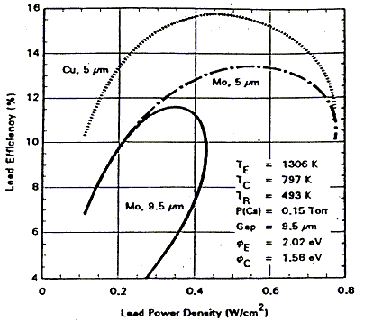
Figure 3. Lead Efficiency and Lead Power Density Increase as the Interelectrode Gap is Reduced. Molybdenum Collector: 9.5 m gap; Mo and Cu Collectors: 5 m gaps.
4
SPI-74-2
Figure 4. NETCON Thermionic Converter Module
5
SPI-74-2
the pads due to high temperature creep. Furthermore, heat transfer through these pads causes them to expand, which has a tendency to change the spacing or to upset the parallelism of the electrodes. NETCON experiments have indicated that it is difficult to maintain a stable parallel interelectrode gap less than 5 m with the high temperature emitters that are necessary for increased power densities.
1.2 System Considerations
In each developmental effort the principal technical obstacle has been the maintenance of a parallel flat electrodes with a small interelectrode gap at sufficiently high electrode temperatures needed for high power density. The output power of a thermionic system scales as the area of the active electrodes. Systems studies and economic considerations have shown that the power density should be ~10 W/cm2 for attractive applications in space and terrestrial systems. In order to increase the power density, the emitter temperatures and the heat flux through the electrodes must be increased. As this heat flux is increased, a larger temperature gradient is developed in the electrode leading to mechanical deformation due to expansion differential. This deformation is a critical problem which must be solved before the electrode size in a CSTC can be increased to a larger area.
1.3 Thermal Distortion of Heated Electrodes
The deformation of electrodes with high heat flux limits the size of a single thermionic converter cell in a CSTC system to a diameter less than 2 cm; and its does not permit bringing the electrodes closer than a gap of ~3 microns, which is necessary for high performance operation. A small temperature gradient in the electrodes is inconsistent with the high heat flux, unless the electrode is made in a special fashion such as an imbedded heat pipe to minimize the temperature gradient. In view of these limitations, the Phase I SBIR proposal of this project addressed novel electrodes for a CSTC with imbedded heat pipes in order to achieve the required flatness with high heat flux. Using this approach, it was felt that the electrode size could be increased up to ~4 cm in diameter. The heat flux problem is addressed by using the isothermal character of the heat pipe to avoid the "dome" shape, which develops when the heat flows through the faces of a disk-shaped electrode.
1.3.1 Expansion Calculations
A nominal size of 4 cm diameter was chosen for the experimental electrodes in the Phase I project. The first step was to perform an analytical modeling of expected thermal deformation. Both finite element calculations and simpler analytical methods were used to calculate the expansion deformation. Results of the calculations are shown in Figure 5 for a molybdenum 110 single crystal electrode. The graphs of Figure 5 show the deformation of an electrode composed of ordinary material compared to a heat pipe electrode. A finite element model predicted that nearly isothermal conditions would be achievable with heat pipe electrode could reduce the deformation to ~0.5 microns, which is the necessary goal for a 4 cm diameter emitter electrode. These calculations are illustrated in Figure 6 and Figure 7. Note that the deformation depends only on the temperature difference and not on the absolute value of the temperature. Therefore a similar amount of deformation will be expected in both the emitter and the collector, if the temperature gradients have the same characteristics. The "dome shape" results from a condition in which the temperature of one face of the disk is higher than the temperature of the opposite
6
SPI-74-2
Curvature of a Moly (110)
Single Crystal Collector vs
Current Density
Curvature of a Moly (110) Single Crystal Collector vs Heat Flux
Figure 5. Calculated Electrode Distortion
7
SPI-74-2
Figure 6. FEM Geometry Used for Heat Pipe Emitter 2-D Model
Figure 7. Exaggerated Distortion Plot of Heat Pipe Emitter
8
SPI-74-2
face of the disk. In this case differential expansion puts the disk into compression and it bulges upward, toward the source of heat flux. If there is any lateral heat flow in the electrode, the deformation will be affected. It can either be increased or reduced depending on the pattern of lateral heat flux in the disk.
2.0 Technical Approach to Close Spaced Converters
2.1 Isothermal Electrodes
2.1.1 Heat Pipe inserts
Based upon the Phase I calculational work, the initial approach was to use electrodes with near isothermal operation, in order to obtain adequate flatness for a CSTC electrode. Calculations indicated that electrodes with imbedded heat pipes would be necessary to maintain a sufficiently low temperature gradient. Some test electrodes, containing heat pipe inserts were constructed by ISTOK Lutch and delivered to SPI. Figure 8 shows a cross section of one of these disk electrodes with cylindrical cavities for heat pipes running through its cross section. The test electrodes obtained from Lutch were in the form of disks, 40 mm in diameter, and 10 mm thick. Each disk contains four cavities, which are closed internally to act as heat pipes. The drawing in Figure 8 illustrates a hole drilled at right angles to the four cavities, which connects their internal spaces. The test articles delivered from Lutch were not filled with a heat pipe working fluid, in order to allow them to be tested with and without the heat pipes to determine their effectiveness. A small tubulation was attached to the edge of the test disk, as shown in Figure 8, for filling the internal heat pipes with a alkali metal working vapor.
2.1.2 Laser Interferometer Testing
The first part of the work with the isothermal heat pipe electrodes was to measure their as-built flatness using a laser interferometer technique. The polished disks of single crystal moly were taken to a local test laboratory for laser interferometry measurement of their surface profiles. The results of these tests showed that the as-built flatness is approximately 0.65 m determined by the interferometric technique. The result of the measurement is shown in Figure 9. These measurements were taken at room temperature; and therefore, they do not illustrate the "dome" type of thermal expansion distortion. in order to see this effect, it would be necessary to heat up the test electrode, while it is mounted in the laser interferometry test device and compare the changes in the fringe pattern as the deformation occurs. It turns out that this is a difficult measurement to make, because the thermal effects on the interferometry measurement tend to be more severe than the changing shape of the electrode disk. Effects such as thermal convection of heated air and expansion of the test fixtures are potential sources of error in the measurement. A special test apparatus for measurement of the thermal distortion of the electrodes with the laser interferometer was designed, as shown in Figure 10. The special test apparatus included a vacuum chamber to hold the test electrode and a triangular bracket, which would permit free expansion. A non-contact, high intensity radiant heater was designed to heat the disk from the back side opposite the measurement laser beam. As shown in the sketch of Figure 10, a long evacuated pathway for the beam was provided to try to suppress any distortion from thermal convection effects. Although this device was designed in significant detail, it was never built
9
SPI-74-2
Figure 8. Cross Sectional Views of Lutch Heat Pipe Electrode.
10
SPI-74-2
Figure 9. Flatness Profiles of "As Built" Heat Pipe Electrode #1.
11
SPI-74-2
Figure 10. Design for Special Test Apparatus to Measure Thermal Distortion of Electrodes with Zygo Interferometer.
Figure 11. Cross-section View of the Close-Spaced Diode Hot Shell Converter with Active Gap Control.
12
SPI-74-2
and actually operated; and, as discussed later, the approach to use heat pipe electrodes was supplanted by another design approach later on in the course of the work.
2.2 Active Gap Control
2.2.1 Piezoelectric Translators
Many of the potential applications for closed spaced thermionic converter systems involve possible flame heated sources of energy. These would include
A design concept for flame heated CSTC with active gap control was developed. This is shown in the drawing of Figure 11. The active surfaces of the electrodes are planar disks; but the converter envelope is a cylindrical hot shell formed of silicon carbide, which acts as a flame barrier. Heat from a furnace raises the temperature of the silicon carbide hot shell, which in turn radiates to the cylindrical body of the emitter (designated as the emitter heat pipe base in Figure 11). The collector in the system is a cylindrical disk, which is cooled by forced air convection. This type of converter system potentially could be applicable to flame heated toping cycles, solar power systems, cogeneration systems, or vehicle power. The spacing is maintained by three piezoelectric translators, which penetrate through the collector and adjust the position of the emitter relative to the collector. Long actuator rods connect the piezoelectric translators to the emitter electrode base.
It was necessary to devise a method for determining a signal to be used in feedback control to indicate the spacing position of the electrodes in three different places for each of the piezoelectric translators. To provide a feedback signal, we have conceived a novel capacitive sensor, which can monitor the gap size in the presence of cesium vapor during the diode operation. Three of these capacitor sensors would be mounted in the electrode spaced 120º apart, as shown in Figure 12. The capacitor element is a portion of the collector electrode, which is dielectrically insulated from the rest of the collector surface. Individual electric leads from the capacitive sections permit the measurement of the capacitance between each
13
SPI-74-2
Figure 12. Collector Surface with a Potential Configuration of Three Wedge Elements for the Capacitance Gap Size Transducer.
Figure 13. Block Diagram for the Active Control Scheme of a Small Interelectrode Gap.
14
SPI-74-2
the emitter. The variation of capacitance with the gap spacing indicates the local spacing in each of the three places. These three capacitive sensors enable the measurement of the gap size and adjustment with a microprocessor feedback control to maintain the average gap at the specified value, as well as to also keep the surfaces parallel.
2.2.2 Control Scheme
The feedback control scheme for active adjustment of the small interelectrode gap is shown in a block diagram schematic in Figure 13. In this drawing, only one of three capacitive measuring sensors is schematically indicated. Note that a separate auxiliary power source must be used to operate the control system and to drive the piezoelectric translators. This additional power loss would not be a large fraction of the expected output for a CSTC with active gap control. The estimated magnitude of efficiency loss is ~1/2% of less. Furthermore, one controller could potentially timeshare its operation with a number of CSTCs in an overall system.
2.2.3 Compensation for the Expansion of Piezoelectric Drive Rods
Although a single piezoelectric translator can adjust very small motions to maintain the position of the emitter and the collector, usually the total range of motion for a piezoelectric drive unit is very small. This was a problem to be solved in the original concept of an active gap CSTC, because significant expansion of the piezoelectric positioning rods is expected to occur during the heat up from room temperature to the operating conditions of the converter. Calculations of the amount of this expansion showed that total motion was outside the range of conventional piezoelectric translators -- even with rods made of low expansion materials. Therefore, a method of expansion compensation in the drive rods was needed. One approach to this problem was the design of the drive rods with an adjustable length section for expansion compensation. The adjustable length section would be made of a highly expanding material, such as a plastic, and a heater control would be used to adjust the total length of the rod, by changing the temperature of the highly expanding section and compensating for the change in the length of the rest of the rod (which is made of low expansion material). Design calculations indicated that either some method such as this technique or a new type of piezoelectric translator with a large total range of motion would be necessary to make a successful system. As it turns out the latter approach was eventually adopted, and a new type of piezoelectric translator with adequate total motion range was used. This is described in an upcoming section.
3.0 Experimental Effort of Phase II Project
3.1 Hot Shell for Thermionic Converters
Inasmuch as the electrode materials of thermionic converters are typically refractory metals, which cannot stand exposure to air or to combustion products at high temperatures, it is necessary to have a flame barrier hot shell surrounding any converter, which works with a fossil fuel heat source. Work on the development of hot shells for thermionic converters began in the late 70’s and continued into the 80’s. This development effort identified silicon carbide as a material which can be formed into a suitable hot shell and provide lifetimes in excess of 10,000 hours with operating temperatures of the silicon carbide material exceeding 1700 K. Accordingly, Space
15
SPI-74-2
Power, Inc. procured several silicon carbide hot shells, which have a closed-end tubular configuration similar to the drawing in Figure 11. These hotshells were fabricated and delivered under subcontract during the program. A picture of three of these hotshells is shown in Figure 14 with a ruler to indicate their approximate dimensions. The active components of the CSTC would be mounted inside the thicker portion of these hotshells (at the top in Figure 14) with the closed end. The long extension tube would act as an enclosure for the actuator rods to the piezoelectric drive, which would be mounted outside the flame region. Before operation with the flame heat source, it was decided to carry out tests of the CSTC system with active gap control in the hot shell with an electric furnace. This would allow development of the active control system and preliminary testing of the thermionic performance in the convenient laboratory environment before dealing with the additional complication of a flame heated furnace.
Figure 14 Hotshells
3.2 Electrode Flatness Without Using Heat Pipes
Apart from the engineering difficulty of constructing the CSTC electrodes with heat pipes in them, another concern is possible distortion of the electrode, due to the vapor pressure of the working fluid in the heat pipe. Calculations showed that all alkali metals, except lithium, would cause sufficient "ballooning" of the heat pipe cavities to possibly affect the electrode flatness. Furthermore, additional analytical modeling showed that a radial temperature gradient, where the temperature is at the edge of the disks is higher than the temperature at the center, can be beneficial. This type of radial temperature gradient with heat flow from outside toward the
16
SPI-74-2
middle, keeps the electrode surfaces in tension, causing them to flatten rather than to bulge outward.
Because of these reasons, the heat pipe approach was replaced by a molybdenum (or graphite) heat collecting fin, as shown in Figure 15. In the electrode configuration shown for the emitter in Figure 15, the heat is radiated from the hot shell to the fin, which is made of molybdenum with a conical shaped hole in the center. Heat is conducted to the emitter, entering primarily at the outer section of the disk rather than at the center. It was planned to place a compliant pad between the heat collecting fin and the emitter base to further enhance the electrode flatness. An attractive form of this compliant pad would be a hexagonal grid, which contacts the emitter base in a honeycomb pattern and leaves hexagonal voids in between. This would produce a temperature distribution consisting of local regions with higher temperatures on the edges of the hexagons than the temperature in the center of the hexagons. This applies the local tension to each region, in addition to the global tension caused by the overall temperature distribution. On the collector electrode, the heat is removed by forced air convection. The cool inlet air is directed at center of the disk, and it flows outward to return heated air from the edge of the electrode. This creates a favorable radial temperature gradient, with highest temperature at the outer perimeter of the disk. With these approaches it was felt that heat pipe electrodes could be replaced and sufficient electrode flatness could be obtained. Therefore, the construction of experimental apparatus and further research was based upon electrode structure with a heat collecting fin instead of imbedded heat pipes.
3.3 Piezoelectric system
3.3.1 "Inchworm" Piezoelectric Motors
A new type of piezoelectric actuator was identified that overcomes the difficulties of the actuator rod expansion, as described in Section 2.2.3. The new actuators operate in a ratcheting fashion by alternately gripping and releasing the actuator rod and moving it with a piezoelectric drive. This ratcheting motion allows multiple steps of fine movement to achieve a large total range of motion. The name of these devices is "Inchworm" piezoelectric motors. Four commercial piezoelectric inchworm motors with built-in optical encoders were purchased from Burleigh Instruments Corporation. These units have a position resolution of 0.5 m , yet they have adequate total motion to allow the electrode to be maintained in proper position with the expansion during heat up. A computer system was setup to demonstrate the control of the inchworm motors, and the necessary software was developed for this purpose.
3.3.2 Cesium Conduction Effects on Capacitive Gap Sensors
The capacitive position sensors must operate with vapor of cesium in between the two plates, which are the active sections of the capacitor. Inasmuch as the cesium can form a plasma and conduct current, there was significant concern that this would degrade the accuracy of the capacitive position measurement. Therefore, an experiment was setup to determine the effects of operating the capacitive position sensors inside the environment of the thermionic converter. This demonstration was carried out by using the "Effect" converter, which was an earlier version of a CSTC tested during Phase I. The circuit model use for the sensor test setup is shown in Figure 16. The circuit model includes stray capacitance and inductance of the setup and the
17
SPI-74-2
Figure 15. Emitter Assembly Concept.
Figure 16. Validation of Capacitive Gap Measurement Technique Using an "Effect" Close-Spaced Converter.
18
SPI-74-2
connections to the converter electrodes. In this test, the entire electrodes of the "Effect" converter were used as the capacitor plates.
A number of capacitance measurements were made on the "Effect" converter while it was at room temperature and while it was hot. From this data we would infer a hot interelectrode gap of 9.8 ± 0.5 m and a room temperature gap of ~4 m . This is in excellent agreement with previous estimates for the "Effect" converter that were based upon its volt-ampere characteristics. The expected behavior of the circuit was also modeled on Electronic Workbench, which is a software package for electric circuit analysis. The results showed that the experiment matches the calculated expectations for AC signals above 4 MHz. The capacitive phase shift was in accordance with the expected value. Application of a DC voltage did not affect the measurements of the phase or the magnitude.
Later experiments were performed with both hot electrodes and cesium vapor in the interelectrode gap. In this case, the thermionic emission current creates a shunt path through the capacitive measurement circuit. We found that the current through the converter gap did severely interfere with the capacitive measurement when the potential difference was forward biased to allow a large electron current to flow from the emitter toward the collector. However, when the converter potential is reverse biased (collector made strongly negative relative to the emitter); the electron current is suppressed, and only very small amount of ion current can flow in between the electrodes. Under these conditions the capacitive measurements were not adversely affected. Therefore, it was concluded that the capacitive sensor approach can work in CSTC as long as the potential is reversed biased at the time the measurement is taken.
3.3.3 Subcontract to Sensor Plus for Inchworm Control System
SPI issued a subcontract to Dr. Darrold Wobshall, President of Sensor Plus to assist in the development of the control system for the capacitive. Sensor Plus developed a circuit, which could measure the distance between the capacitive plates as needed for the CSTC small gap and use this signal for feedback control of the "Inchworm" position adjustment. A computer control system was setup to test this circuit with the "Inchworm" drives. After some adjustment, a successful operation was achieved where the "Inchworms" could be moved into a desired position with a precision of less than 1m error. Based upon this development, SPI now began construction of a test apparatus for CSTC operational demonstration.
3.4 Experimental Apparatus
3.4.1 Design of Test Device for Active Gap Experiment
SPI designed a test apparatus for a CSTC experimental diode with active gap control, as shown in Figure 17. The drawings in Figure 17 show both the top view and the side view of the test apparatus. The close spaced thermionic converter is located inside a hot shell tube, which is in turn located inside of an electric furnace. The interior of the hot shell tube is connected to a vacuum system through a T-fitting at the top of the unit. This fitting also permits the introduction of cesium vapor for operation of the thermionic converter three piezoelectric actuators ("Inchworm") motors are connected to the actuator rods through spring-loaded pivot arms. These long actuator rods penetrate down into the active region and through the collector to
19
SPI-74-2
Figure 17. Adjustable-Gap Thermionic Converter Test Apparatus.
20
SPI-74-2
adjust the position of the emitter and maintain the gap at the desired value for close spaced converter operation. The outer operating chamber was expected to be filled with argon for the initial test operation. This type of apparatus simulates the kind of system design which might be used for a flame heated CSTS power system where the electric heater would be replaced by a flame heat source.
3.4.2 Partial Construction of Test Unit
The adjustable gap thermionic converter test apparatus was partially constructed at SPI’s facilities. The test chamber was fabricated and the long, evacuated, hot shell assembly was also fabricated. "Inchworm" piezoelectric actuators were mated with their pivot arm assemblies. Three of the "inchworm" actuators were used for the test apparatus, and an extra one was employed in checkout of the piezoelectric control system. The test apparatus was never completely assembled and operated. In the later stages of the work, it was partially constructed with three actuators and polished stainless-steel plates used in place of the electrodes. The capacitive spacing sensors were not included at this stage; however, the inchworm control system, with both electronic circuitry and software programming, was successfully developed and tested, along with the pivot arm approach.
Testing showed that, even when thin wires were used to support the "emitter" structure, the support wires lacked enough flexibility to enable the electrodes to be made parallel by independent adjustment of the three support rods. An effective system would have required a method of joining the support wires to the emitter which was highly flexible in angle, capable of supporting the weight of the emitter assembly without sagging, and able to operate at the expected emitter temperatures of up to 1430º C. A preliminary design effort was begun on the use of high temperature pantograph "spring washers", but this could not be completed within the scope of this contract.
3.4.3 Transfer of Test Fixture to University of New Mexico
A decision was made to transfer the adjustable gap test apparatus to the thermionic converter specialist group at the University of New Mexico in Albuquerque. This group was interested in pursuing the development of CSTC systems beyond the research work in the present contract. It was also decided that resources under this contract would not permit the test apparatus to be completed and/or to obtain useful data through its operation. The transfer of the test fixture to New Mexico was facilitated by the efforts of Mr. Dave Luchau of Team Specialties, who collaborates with UNM in this area of technology. In addition to the test fixture shown in Figure 17, a special laminar-flow, clean-air, glove box was also sent to UNM. The glove box is necessary to provide a clean environment for assembly of the CSTC electrodes. Cleanliness is required to prevent the possibility of particulates depositing on the electrode surfaces, which may short circuit the small gap in a CSTC. All of this equipment is now presently residing at UNM; and it could be used for further R&D efforts, if funded to go forward.
21
SPI-74-2
4.0 Conclusions
4.1 Discussion of the Project Effort
A synopsis of the findings in this R&D project indicates that close spaced thermionic converters are a feasible method for obtaining higher performance and lower operating temperatures in direct conversion systems. In particular, the following observations are noteworthy:
4.2 Micro Fabrication of Close Spaced Thermionic Converters
One conclusion of the all the CSTC development work is that the approach has technical promise, but would probably require a large-scale investment to develop a fabrication technique for economic production of the many CSTC diodes needed in order to obtain high power systems. One promising approach to this type of fabrication is the micro machining techniques that have been developed by the MEMS technology. MEMS devices have been constructed to act as machines with moving parts, pressure sensors, and biotech devices. The size and spacing of many of these MEMS machine components is smaller than 1 micron, and so it is likely that CSTC’s with micron-sized interelectrode gaps could be fabricated.
SPI contacted some people who are knowledgeable about the capability of micro fabrication techniques. Dr. Richard Goreman at the TRW Government Information Services and Dr. Mehren Mehregany at Case Western Reserve University were both consulted on this problem. Both Drs. Gorman and Mehregany were in agreement that, if the structure could be fabricated of silicon, it could be built with today’s techniques. Mehregany’s group has already fabricated similar geometries to an array of small-scale thermionic converters with a gap of 2 m and lateral
22
SPI-74-2
dimensions corresponding to the electrodes of up to 2 mm each. His process uses a sacrificial layer technique. The primary technical challenge would be to develop materials and fabrication techniques, which would be compatible with the high temperatures of thermionic converter and operation in cesium vapor. Note that silicon and silicon oxides are probably incompatible with this environment.
SPI discussed a possible cooperative program with other agencies involved in MEMS R&D. A possible program could proceed as follows:
1. Design an array of small CSTC thermionic diodes, which could be constructed by micro fabrication techniques.
2. Produce the necessary photolithography masks for fabrication of a prototype structure, which could be made from typical MEMS materials such as silicon.
3. The mechanical characteristics of the silicon prototype could be tested by exposing it to heat flux and temperature cycles to determine whether it maintains the appropriate spacing and flatness.
4. New materials and fabrication processes would be developed to produce cesium-compatible, high-temperature, versions of the micro fabricated CSTC.
5. Operational prototypes would be produced using the MEMS technique and they would be performance tested for thermionic output and stable operation over long life.
Based upon this assessment it appears promising that CSTC systems could be built using micro fabrication techniques. However, a large investment to set up such a fabrication facility would be necessary. Something on the order of investment in a wafer fab factory for integrated circuits would probably be required before large quantities of CSTC thermionic power systems could be manufactured by MEMS techniques. A group at New Mexico is interested in applying micro fabrication techniques to CSTC production. This is another reason why the test apparatus was transferred to the University of New Mexico in order to assist them in possible future development work.
23
SPI-74-2
References
1. Dick, R.S., McVey, J.B., Fitzpatrick, G.O. and Britt, E.J., "High Performance, Close-Spaced Thermionic Converters," Eighteenth Intersociety Energy Conversion Engineering Conference, Orlando, August 1983.
2. Nyren, T., Korringa, M., et al, "Design and Testing of a Combustion-Heated Nineteen Converter SAVTEC Array," Proc. Nineteenth Intersociety Energy Conversin Engineering Conference, San Diego, August 1984.
3. Fitzpatrick, G.O., U.S. Patent No. 4,667,126, "Thermionic Converter," 19 May 1987.
4. Fitzpatrick, G.O., Lawless, J.L., Nikolaev, Y., Yeremin, S., Klinkov, A., and McVey, J.B., "Demonstration of Close-Spaced Thermionic Converters", 28th Intersociety Energy Conversion Engineering Conference, Atlanta, Georgia, August 1993.
5. Fitzpatrick, G.O., Allen, D., Hatch, G.L., McVey, J.B., Bloomfield, H., "New Thermionic Converter for Out-of-Core Space Reactor Power Systems", 26th Intersociety Energy Conversion Engineering Conference, San Diego, CA, August 1991.
24