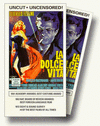
 |
| DIRECTED BY |
| Federico Fellini
|
| STARRING |
| Marcello Mastroianni |
| Anita Ekberg |
| Valeria Ciangottini |
| Walter Santesso |
 |
There is something that I like to refer to as �filmic excess� � many adore Fellini�s relentless sense of uncompromising nonconformity � and this is particularly evident in the 170+ minute �La Dolce Vita� that plays more like a cinema verit� documentation of one man�s peripatetic existence than a narrative film, and I have no problem with this. My problem lies within our protagonist�s unwavering state of confusion � even after going through so many potentially epiphanic experiences, Marcello remains the promiscuous/ambivalent/wayward individual who he was to begin with, carrying out the same old misguided and juvenile actions. This may still hold meaning in itself, but � either way � it�s just not worth dragging your viewers through roughly three hours of rather monotonous sequences in order to arrive at this conclusion.
To me, the basic message of the film is that � sometimes � there is no salvation. What you�re currently doing with your life may obviously be wrong, and the other option may seem more pure and proper but this may only be ostensible and superficial in actuality. It is essentially a despondent message but a resonant commentary on the state of contemporary humanity that could�ve turned out much better with a more focused, concise, and guided directorial vision.
Both Fellini and Mastroianni do a good job with conveying Marcello�s conflicting emotions and the fact that none of Marcello�s relationships deem to bind together in the end seems apt. The film also happens to be knee-deep in convoluted symbolism, however, which doesn�t particularly appeal to me. It�s made so painfully obvious that Fellini is demanding us to watch the film multiple times in order to grasp the full abstract nature of it, which isn�t really fair to the viewer. It�s my personal opinion that a film should only entail scrutiny if a viewer desires to do so rather than relentlessly attempt to provoke scrutiny.
The film admirably strikes a few chords concerning psychological/emotional ambivalence, societal superficiality, religious paradoxicalness, and the yearning for a completely new existence, but its unnecessary monotony, pretentious symbolism, lack of clear focus, and ultimate irresolution causes it to falter in the long run.