The objective here is to present the origin of the family name Garibay and does not in any way attempt to establish direct descendancy
The following excerpts were taken fromwww.buber.net/Basque explaining the Basque origins of the family name Garibay and supplemented by pictures from www.euskomedia.org. All photos and images were further edited using ArcSoft PhotoStudio 5.5
All information regarding the Basque Country were taken from www.geocities.com/Athens/9479


GARIBAY

A Basque surname, originally from the area of Garibai (near O�ate, Guipuzcoa) in 1323. This surname is also found in Arrasate-Mondrag�n in Guipuzcoa, Valle de Mena in Burgos, and Medina del Campo in Valladolid.


It comes from the Euskara words garo (meaning fern) and ibai (river). So in this case it would probably mean that the original house was probably near a stream or river flowing through a place where ferns grew. Other authors believe that it stems from garai (meaning a high place) or even gari (wheat) but river remains the same translation for ibai in all cases.


COAT OF ARMS

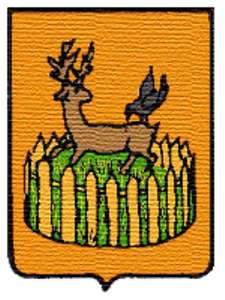
There seems to be different variations of the coat of arms for the Garibay family but three components are common in each design: a deer, a wheat field and an eagle


One version of the family's coat of arms has a red background. It has an eagle descending on a deer. The deer is standing on a wheat field with its head turned towards the eagle.

It has the following meaning:

The field of wheat stands for ABUNDANCE

The red background stands for BRAVERY

The eagle stands for VALOR

The deer stands for NOBILITY

This coat of arms was given to the family for the services rendered in battle at the time of the crusades.


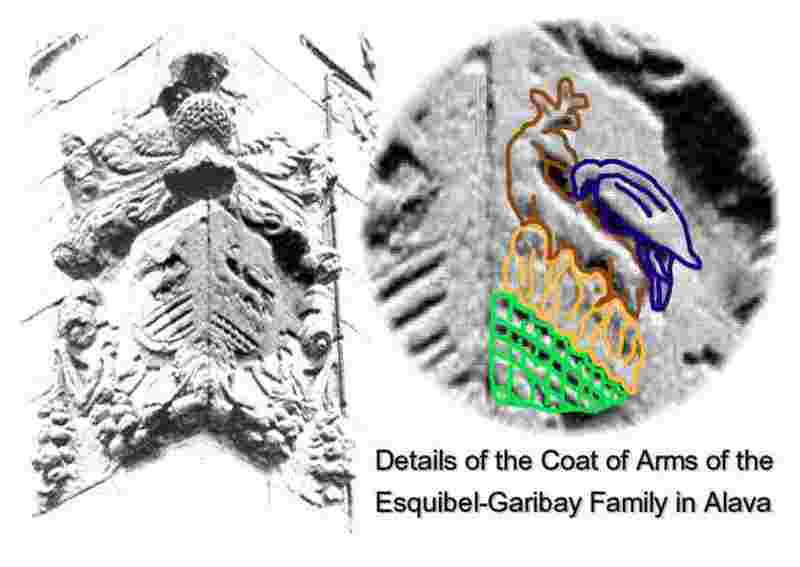
Another version of the family's coat of arms is composed of a deer of natural color on a background of gold. The deer is standing in a green area with golden wheat growing up from it. A black eagle has it's talons clasped to the deer's hindquarters and its beak is tearing at the back of the deer.


Here are the other versions:


THE BASQUE COUNTRY

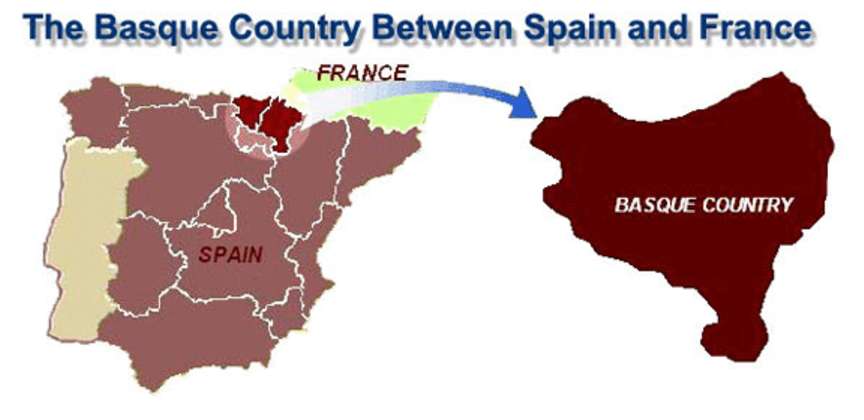
The Basque Country is a nation in southwestern Europe.

It is currently divided between two states: France and Spain (view map). Our country is located on the coast of the Bay of Biscay, on both slopes of the Western Pyrenees that separate Spain and France.

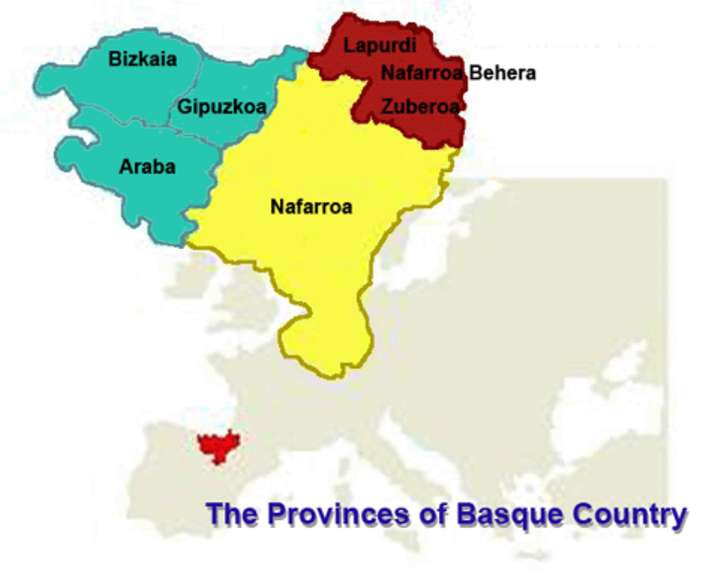
The Basque Country is the territory which is historically, ethnically and culturally Basque. Spanish and French may call Basque Country (Pays Basque, Pa�s Vasco) only to a portion of the country, not the whole nation. Nevertheless, Basques conceive their country as embracing the area of the traditional seven provinces: Bizkaia, Gipuzkoa, Araba and Nafarroa on the Spanish side, Lapurdi, Nafarroa Beherea and Zuberoa on the French side.(view map)

These provinces are divided among three politico-administrative structures. Two are within the Spanish State: the Basque Autonomous Community (formed by Araba, Bizkaia and Gipuzkoa, blue on the map above) and the Autonomous Community of Navarre (Nafarroa alone, yellow on the map). The three provinces within the French State (red on the map) are not autonomous. They form, along with Bearn, the french department of Pyrenees Atlantiques (capital Pau, in Bearn), which is part of the region of Aquitaine (capital Bordeaux).

The Basque Country is a little nation: just 20.864 sq. km and 2.9 million people. Only 650.000 of them speak basque, mostly in the Spanish side (only 70.000 in the French side). There is another minority language in the Basque Country: Occitan; several hundred people (or a few thousand) speak Gascon and Bearnais dialects of Occitan in the french side of the Basque Country. The Basque name of the Basque Country is Euskal Herria.

The Basque word for the language is Euskara.

Euskal Herria is formed from euskal, the combining form of Euskara, plus herri `country', with the article.

Euskadi is also used for the Basque Country. This is a political name, coined at the end of the 19th century. Sometimes spelled as Euzkadi, it has been translated as Basque Fatherland or Basque State. Lately, Euskadi is used just to name the territory under the Basque Autonomous Government (only three provinces out of seven).

That territory, the Basque Autonomous Commnunity is oficially called Euskal Autonomia Erkidegoa in Basque (initials: EAE), and Comunidad Autonoma Vasca in Spanish (initials: CAV). It is important to note that most of the Basque Country lies outside the borders of this autonomous administration.

What Spaniards and French call "Spanish" or "French Basque Country" is called Northern or Southern Basque Country by the Basques:

Ipar Euskal Herria or Iparralde for the northern part (under France).

Hego Euskal Herria or Hegoalde for the southern part (under Spain).

Back to top


MEET THE BASQUES

The Basques called themselves euskaldunak (singular, euskaldun). The word is formed from euskara `Basque language' and -dun `who has'; it literally means `one who has (i.e., speaks) Basque'. Euskaldun means properly only `Basque-speaker'. Ethnicity or being part of the Basque Nation is therefore a question of language. You can be japanese and euskaldun, but you can be born in the Basque Country and not be euskaldun. With no euskara, there is no Euskal Herria. Without our language, the Basque Country will not exist, from our point of view. Spanish, French or English do not have comparative terms to this basque word (euskaldun). You may read from a spanish source that "most basques do not know the basque language". Well, you should notice that basque or vasco are ambiguous from the native point of view, and we would more properly say that "we euskaldunak (native basques, basque-speaking people) are a minority in our own country".

At the same time, there are no proper words in basque for ethnic basque or person born in the Basque Country. Neologisms as euskotar or euskal herritar are used to define such terms.

Back to top


THE BASQUE LANGUAGE

Euskara, the language of the Basques, is an isolated language. It is not related to any other language at all, despite serious (and less serious) attempts to find similarities between Basque and other linguistic families or given languages.

It is a peculiar language, with distinctive lexical background and grammar. Being isolated and relatively strange (compared to other european languages), Basque is supposed to be extremely difficult. But this is not true. Larry Trask, an english linguist that commands Basque perfectly, writes: "In fact, Basque is a rather easy language to pick up, while mastering it is no more difficult than mastering any other language. The pronunciation is easy, the spelling is regular, there is no grammatical gender, there are no noun-classes or verb-classes, and there are no irregular nouns and hardly any irregular verbs". A curious fact about Basque is that even pidginized forms of it have evolved far from the Basque Country, for instance in Iceland.

Other features may shock you, for instance: pluri-personal verbs, the 3-number system (singular, plural and indefinite), allocutive speech, ergative construction, the 20-or-so declination cases (very easy to learn: they are just strictly regular postpositions), particular word order, positional nouns... Many of these features are strange to European language speakers, but are not that rare among the world's languages.

Back to top


LANGUAGE STATUS

The positions of the various existing governments in the Basque Country with regard to the promotion of Basque are very different. The language has official status in those territories which are within the Basque Autonomous Community, but only partially in Nafarroa, which is divided by the law in three distinct language areas (this law is strongly rejected by the Basque-speaking people of Nafarroa).

Nevertheless, co-officiality with Spanish does not mean equal status. Spanish rules and the Basque-speaking have great difficulties to deal with their administration in their own language, despite the law that grants that right.

Basque has no official standing in the Northern Basque Country, the part under France. French language laws and political culture are extremely hostile to regional languages. An absurd example of discrimination: If you have French nationality, you cannot use Basque to declare in a French court, but if you have Spanish nationality, you can do so, as Basque is officially recognised at the other side of the frontier.

Back to top


Hosted by www.Geocities.ws

1