 SOFIA...BULGARIA
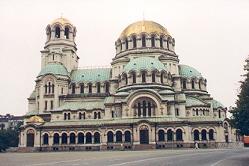
Alexander Nevski Memorial Church
Completed in 1912 in honour of the Russian casualties of the 1877-78 War of Liberation from Otterman rule. Gold domed, it is the finest piece of architecture in the Balkans. Craftsman and artists from 6 Countries worked on the five aisle church in the course of 30 years and created real masterpieces of icons, frescoes, murals and huge chandeliers. The interior decoration made of Italian marble, Egyptian alabaster, Brazilian onyx, gold and mosiacs embodies the spirit of the finest eastern Orthodox traditions.
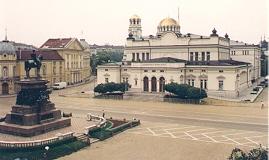
Parliament Square
SOFIA... The Capital of Bulgaria since 1879, its numbers over a million, which is nearly ten percent of Bulgaria's population. Settlements have existed here, below Mount Vitosha, for eight thousand years, but it is only within the last century that Sofia (borrowing its name from the Greek word for wisdom, and the original Bysantine church at its heart) has grown to its present eminence.
A constant procession of civilizations has left marks throughout Sofia, from the Serdi to the Greeks and Romans, the Slavs, Byzantines, Bulgarians immigrating from the East, and the Ottomans over 500 years.
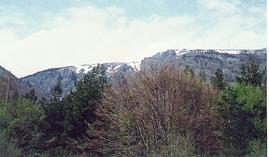
Mount Vitosha
Mount Vitosha..wherever you go in Sofia it seems you can always see the Mountains, and it has become very much part of Sofia, and is accessible by means of ski lifts and is a Winter ski resort..There are magnificent views of Sofia from the mountains and its highest point Cherni Vrah.
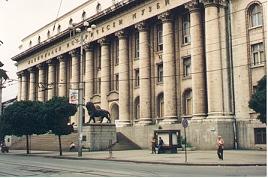
History Museum
Sofia has a history that goes back thousands of years. The Thracian Serdi tribe settled here in the 7th century BC and gave the first recorded name of Sofia-Serdica. The Byzantines called it Triaditsa and the Slavs, Sredets. The modern city of Sofia was named in the 14th century after the basilica St.Sofia. In the 3rd century AD, the Romans built strong walls around Serdica, their capital of Inner Dacia and an important stopping point on the Roman road from Naisus (preent Nish, Yugoslavia) to Constantinople.
After the Hun invasion of 441, the town was rebuilt by the Byzantines. The Slav's gave Serdets a key role in the First Byzantine empire, then in 1018 the Byzantines retook Traditsa. At the end of the 12th century, the Bulgarians returned and Sredets became a major trading centre of the Second Bulgarian Empire. The Turks captured Sofia in 1382 and made it the centre of the Rumelian beylerbeyship. The city declined during the feudal unrest of the 19th century, but with the establishment of the Third Bulgarian Empire in 1879, Sofia once again became the capital of Bulgaria
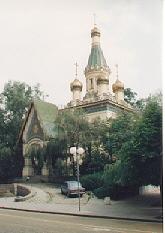
Russian Church
The so called Russian Church, St.Nicholas, on Tsar Osvoboditel Boulevard. This spectacular and beautiful church, with its bright yellow enterior, gilded domes and emerald green spire contrast with its dark interior. And below is the Byzantine 4th century Rotunda of St.George's church, with its fine medieval fresco's.
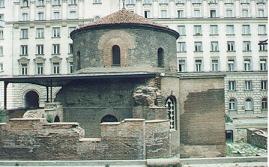
Rotunda of St.George
This is just a brief insight to the City of Sofia, a place I have always enjoyed visiting, and have some of my best friends there, but the 'Bulgarians' are a warm people, and its so interesting to see Sofia change, albeit slowly (particularly the roads!!)....
Easter is a special time there, and decorating the eggs is a labour of love, attending 'Mass' at the Alexander Nevsky Church, and walking around it 3 times for your sins to be forgiven !!
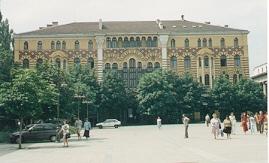
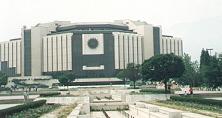
The University The National Palace of Culture