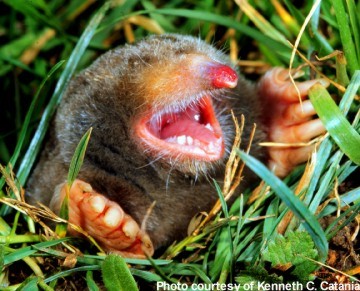
Gardeners mistakenly confuse the mole with a rodent, thereby attributing damage in their landscape to this animal. In fact, moles are a member of the zoological order Insectivora, meaning "insect eater." Their primary food sources are insects, grubs and other soil-borne larvae often the cause of serious damage to our gardens. Although some species will nibble on roots, for the most part they bypass these in favor of their primary prey.
Their chief damage, if any, is the underground excavation of soil, making runs and nests, which may cause a portion of a plant's root zone to dry. If the plant is healthy, however, it can easily survive this. This is particularly so with roses, which have deep-running root systems that radiate out from the plant and into all directions. All things considered, moles could actually be considered a beneficial "critter" to the landscape. That is, they consume enormous amounts of soil-dwelling pest larvae as well as aerate the soil.
In the landscape, the mole's shallow feeding tunnels provide habitat for in-ground rodents like white-footed mice, voles and gophers -- all members of the Rodentia Order of animals, and all plant destroying pests. However, they are often confused with gophers, a "critter" of similar size but much different in physical characteristics.
Apart from these characteristics, differentiating between moles and gophers in the landscape is easily done by finding their entrance holes, usually a mound of soil.
The mole's entrance is a soil mound similar in appearance to a mini-volcano. Soil is equally distributed around the entrance hole, which is clean and round. Conversely, the gopher's entrance mound is fan-shaped with the soil mostly on one side. The hole is usually plugged or capped with soil, and a depression in the mound can be found around this plug. |