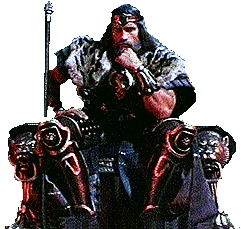
Black your horse, black your cloak,
Black your head and black yourself,
Black skull, are you the Frenzied One?
(P102)
As a Tolkien fan I had bought
a good number of his books and I read them all. I was thus left with a great yearning for
more fantasy books. I checked for any Tolkien books that I could find at the Public
Library, and right on the same shelf, I found the book named with the title
of this article. At more than 600 pages, this was a hefty hard-back publication.
The cover was interesting, and so was the title, after all, Mithrandir, or
Gandalf (meaning Wand-elf) as the hobbits called him was probably derived and
inspired from Merlin or Myrddin (in Celtic). Nothing fired my imagination
more than the prospect of reading this large book about Myrddin mab Morfryn
the Black Frenzied One. Well yes it was not an easy book to read. I looked up
the book reviews on amazon.
and I could see that most readers could not read further than page 65. There are
two reasons for this. This is not an easy book; it demands a lot of imagination
to understand the details and it is not for the faint-hearted either. It is to
be read slowly and patiently. For some of us a good dictionary would have to be
consulted very often to get to the bottom of the narrative. The second problem
is that the author filled a large number of pages with philosophical concepts
and conclusions that thread the fine edge between reality and fantasy. This
proved very tiring and sometimes I felt like throwing the book out of the
window. I was feeling that while the author was enjoying his ego by bombarding
us with his most intense metaphysical reflections, these killed a lot of the appeal
to the readers. Tolkien did sometimes fall in the same trap in the “Silmarillion”,
but definitely not to this extent.
Although not declared by the author, this book must have been inspired by Tolkien’s classics. There are at least five references to Prydein (Celtic for Britain, I assume) as ‘Middle Earth’ and for me this constitutes proof. Regrettably, as in Tolkien’s books, almost everything and everyone has two or three names. Other similarities are a map on the first page, and an (incomplete) list of names, places, seasons and gods found in the text.
The story revolves about the
British epic struggle between the Red and White Dragons. The Byrthon
(or British, nowadays called Welsh) Christian locals are in constant strife with the
Iwis (or Engl or Seasons) Anglo Saxon (nowadays called
English) invading barbarians. Myrddin, a one-eyed seer narrates the
deciding war between these factions and is himself a deciding factor in the
final bloody battle. Late in the book, it becomes more evident that both sides
are barbarians and the cruelty and obscenities described in this book, warrants
a warning that the book should only be read by adults (and young barbarians:-).
The last two chapters are particularly exciting and well paced, however the
story is concluded in an unorthodox way because it departs from the apparent
historical outcome in favour of an optimistic ending.
The author is Count
Nikolai Tolstoy a well-known aristocrat who was recently interviewed by
Pravda. This interview was also published by National
Vanguard. He is also the nephew of Leo Tolstoy, the writer of the classic
‘War and Peace’.
I found the book irresistible
and so I would give it a generous 4 stars out of 5. The book is out of print but
I think that it failed to make history because it was swamped by Tolkien’s
books. Nevertheless, as the LOTR films made such a huge success, I am sure that
if a good film is ever produced about this book it would resurface as one of the
greatest books ever written in the twentieth century. This book was supposed to
be the first volume from a trilogy. The other two volumes were never published.
Perhaps the Count had written them but they were never published . This book is
for the very few and readers should make some research about British, barbarian
and the Roman Empire’s history while reading the book, as the story is not
only about the Welsh and the English. The Internet might suffice as a suitable
source nowadays.
The following quote from this book very much reflects the feeling one gets after reading it:-
I had drunk too deep of the Well of the Wondrous Head, and learned for myself that excessive understanding without the binding of vision is, at the end of all things, the end of all things. (P146)Just one last comment: if you decide to fetch and borrow the Public Library’s copy, please do return it - others might want to read it too!