 |
|
|
|
|
|
|
|
|
|
|
|
|
|
|
|
|
|
|
|
|
|
|
|
|
|
|
|
|
|
|
|
|
|
|
Zeppelins |
|
|
|
 |
|
|
|
From our very creation on, man-kind has had some bizarre fettish with the idea of flying. In 250 BC, the Law of Archimedes was established stating; "When a gas less dense than air is enclosed in a container, the difference between the density of the gas and the air it replaces causes the container to rise." This being known, a search for some device lighter than air had begun.
In the late 1800's, Joseph Montgolfier and his brother Etienne developed the first hot air baloon. Though it was crewd and unstable, Joseph had managed to lift his invention from the ground by burning a marvellous collection of perfectly good trash. Though Montgolfier was certain that the rise had something to do with the gases realieased in the combustion, the exact cause was still unknown. |
|
|
|
The discovery of Hydrogen by Henry Cavendish in 1766 was a key help in the development of a floating aircraft. Along with the discovery of this element, he also found the density to be quite low. In fact, Hydrogen has the lowest density of any element, allowing it to float easily in air. Though Hydrogen is almost always bonded with another element, most commonly Oxygen, In 1800, a method of seperating them was found. When you add Carbon to water and heat it, carbon monoxide is formed and the hydrogen gas is realized seperately. Hydrogen was found to lift approximately 490,000lbs. with just 0.07lbs of Hydrogen.Wow, He must work out. |
|
|
|
 |
|
|
|
|
|
 |
|
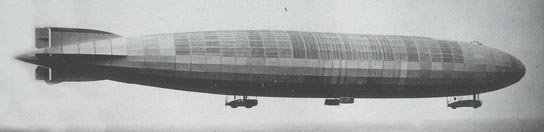
Driligibles a class of aircraft that includes zeppelins,blimps,hot-air balloons and some short lived combinations of the three. Though zeppelins and blimps may appear the same, they are different. Zeppelins, invented by Count F. Von Zeppelin of Germany in 1909 are gigantic structures of aluminum and steel wire covered in waterproof fabric. Inside were several small ballons filled with hydrogen gas. Blimps have no structured frame and are very fragile. they are simply an enormous balloon filled with hydorgen gas. Since a blimp has no frame, it is kept inflated simply through the pressure it's given, making it suseptible for popping. |
|
|
|
Don't you wish that all aircraft inventors were so attractive?
I know I can't have him, but I can get his hat? |
|
|
|
|
|
|
|
|
|
Though Hydrogen gas is so un-dense and affordable, there are important things overlooked by the inventors of these giant diligibles. With just 1 electron in it's valence shell, hydrogen is not only the least dense element, but it also the most reactive and extremely flammable. This is due to the enthalpy of hydrogen. Enthapy is defined as the measure of change in the energy of a system. If hydrogen in a zeppelin were to react with oxygen than there would be an exothermic reaction and a great amount of change on the system. the increase of energy lowers the stabilty of the hydrogen and makes it very flammable. When this information became appearent, zeppelins and blimps were designed for helium gas. Helium is slightly more dense, but completely unreactive due to it's full valence shell. However, helium is much more expensive and as World WarII grew darker, the United States refused to sell helium to the Germans in case they planned to once again use their zepplins as weapons.Being so berilliant and Eurasian, the Germans decided that zepplins were just way too nifty to abandon on the count of higher explosive gas adn once again flew hydrogen drigibles.Hmmmmm...ignoring all logic, what a novel idea. |
|
|
|
 |
|
|
|
|
Not the Hindenburg but pretty cool huh? |
|
|
|
|
|
|
|
|
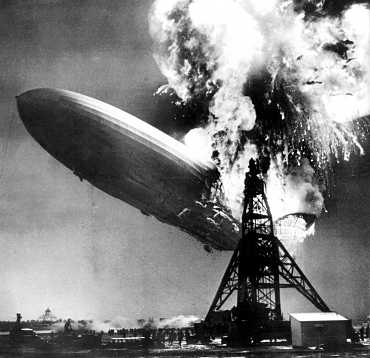
When the Hindenburg spontaneuosly burst into flames in 1937 killing 36, zeppelins dissappeared. Though the mistake of using hydrogen gas was obviously a major part of this catastrophe, what exactly happened remains unknown. Some theories say that static electricity caused the blaze, or lightening or a broken propellar rupturing a balloon or even sabotage. Whatever may have happened, the Hindenburg taught us a good lesson, Hydrogen is not the answer. |
|
|
|
|
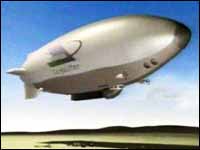
Zeppelins were the all-purpose aircraft. Faster than boats and more stable than winged flying machines(as well as more economically sound) zeppelins soon found responsibilities carrying cargo. As World War I broke out, zeppelins were armed with machine gun and bombs and sent out on attacks. This didn't last very long becasue the zeppelins were easily taken down with the advancement of airplanes. Soon, zeppelins were disigned just as luxury cruises to carry the rich wherever they wished and much faster than any boat. Thought the zeppelin phase ended with the crash of the Hindenburg in 1937, helium zeps may be brought back very shortly. these helium giants will be designed more ecinomically with lighter frames and engines and will be much less costly than a cargo plane or boat. When built properly, helium zeppelins are thought to be the safest mode of transportation around. |
|
|
|
|
|
|
 |
|
|
|
|
|
Our Future? |
|
|
|
|
Resources! |
|
|
|
|