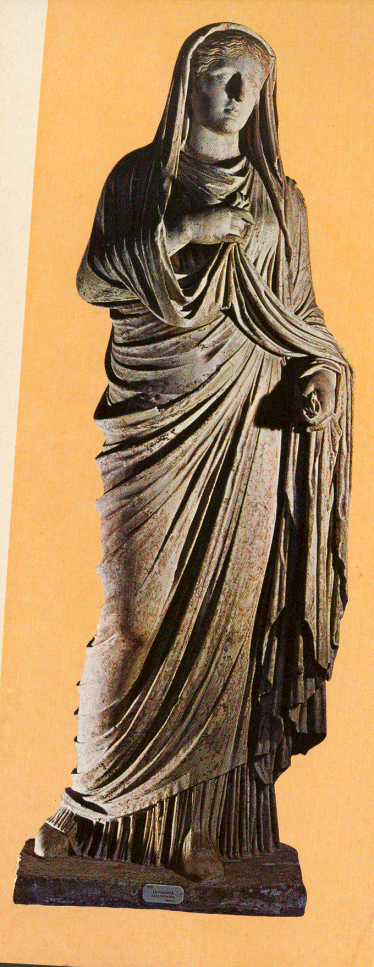
 Matrona in the National Museum of NapoliMatrona in the National Museum of Napoli
 The Copper healing snake of Moses in the Desert (Nu 21.9)
The Sages were the remaining representatives of the Jewish Community in Israel. They went to Rome to plead for their cases before Caesar. To whom did they turn in Rome? Where did they possibly dwell? Presumably they turned to people whom they were already acquainted with - for example to Matrona, who seems to have returned from Zippori to Rome. She was a person with very good relationships with the court, and also very well versed in its ways.
The voyage to Rome itself was no light matter. The sea voyage involved many hardships and was dependant on the weather and the time of year. No mention would be made of this were it not that Matrona herself worried about the Sages' welfare whenever they were at sea. She appears well versed in the ways of the sea too, its streams and winds. She knew the right season for seafaring, when ships weren't prone to shipwreck.
R' Joshua and R' Tanchuma Ben R' Hiyya of Kfar Hanun � wanted to sail. Said Matrona: "In these days to sail? I wonder!
The dangers of seafaring are well portrayed in The Life of Josephus Flavius, Sign 3 Leib No. 13. Josephus relates that he went to Rome on a certain mission, but the ship sank into the Adriatic and its passengers had to swim till a ship headed for Cyrene saved them.
Matrona, then, lives in the Land of Israel, but also in Rome. In the Land of Israel she advises them which is the best season to travel to Rome. In Rome Matrona is a part of the ruling classes and knows their ways. Accordingly, she advises the Sages what to do.
On the 28th of the month there came the good tidings to the Jews that they should not give evidence according to the Torah and learn the Torah and that they should no more circumcise their children and should profane the Sabbath. What did Jehouda Ben Shamoa and his friends do? They went and took counsel from a Matrona whose company all the great Romans frequented. She said to them: "Come and demonstrate tonight." They went and demonstrated in the night etc.
Hadrians' decree against circumcision brought about the Bar-Kochba (Bar Kuseiba) revolt.
Matrona's works in behalf of Israel
Matrona is present at fateful discussions between Caesar and the proselytes - e. g. in the case of Qeti'a Bar Shalom:
What about this Qetiah Bar Shalom? There was once a Caesar who hated the Jews. One day he said to the prominent members of the government, �If one has a wart on his foot, shall he cut it away and live [in comfort] or leave it and suffer discomfort?� To which they replied: �He should cut it away and live in comfort.� Then Qeti'ah Bar Shalom addressed them thus: �In the first place, you cannot do away with all of them, for it is written, For I have spread you abroad as the four winds of the heaven (Zacharia 2:10). Now, what does this verse indicate? Were it to mean that Israel was to be scattered to the four corners of the world, then instead of saying, as the four winds, the verse would have said, to the four winds. It can only mean that just as the world cannot exist without winds, so the world cannot exist without Israel. And what is more, your kingdom will be called a crippled kingdom.� To this the king replied: '�You have spoken very well; however, he who contradicts the king is to be cast into a circular furnace.� On his being held and led away, a Roman matron said of him: �Pity the ship that sails [towards the harbor] without paying the tax.� Then, throwing himself on his foreskin he cut it away exclaiming �Thou hast paid the tax; thou wilt pass and enter [paradise].� As he was being cast [into the furnace] he said: �All my possessions [are to go to] R. Akiba and his friends.� This, R. Akiba interpreted according to the verse, And it shall be unto Aaron and his sons [which is taken to mean that] one half is Aaron's and one half his sons.' A bath-kol then exclaimed: �Qeti'ah Bar Shalom is destined for [eternal] life in the world to come!� Rabbi [on hearing of it] wept saying: �One may acquire eternity in a single hour, another may acquire it after many years�.
This heroic story is about Matrona giving the final push to one of the God Fearers, the metuentes, (also called proselytes, sebomenoi [sebomenoi]]) to identify himself completely as a Jew. It is unlikely that a person wholly given to Christianity, Gnosticism or a true believer in any or all the pagan gods should behave as Matrona is depicted to have behaved in this case. She asks Bar Qetia to act according to the laws of complete intellectual integrity, to be steadfast in his beliefs and faith.
The fact that Bar Qetia wishes to bequeath his wealth to R' Aqiva shows that all this happened before the Bar Kuseiba revolt, while R' Aqiva was still alive: because the subject is the pressure the Caesar put on the Jews concerning bodily mutilations abhorred by the Romans who looked upon circumcision as equal to castration. To Hadrian's Greek culture this was anathema. As to Bar Qetia's thesis according to which even Caesar can not �liqtoa� (Hebrew: a pun on Qetia's own name, meaning �cut down�) the whole Jewish nation, since they live in a diaspora, everywhere on earth, this thesis of Qetia has been put to very severe test in the 20th Cent. Caesar's venomous words about the Jewish People being vermin, putrefaction and all kinds of strange animals were also heard again.
It is likely that the sources of R' Aqiva's wealth were not only the payments to him of his pupils for his tuition, or from the riches of Caesar's daughter given him by Matrona, or from all other sources enumerated in the Midrash elsewhere but also from what the proselytes left him in their wills. They could have been also his pupils. We see also Matrona paying her tithes. Naturally, R' Josi also knew her as a proselyte, and as such he praised her hinting at her faith in his answer to her query about the Ten Commandments.
The proselytes were the mediators between the precepts of the Jewish and the new Christian faith. The Sages also recognized them as such, and attributed to Matrona nothing less than the act of taking down Jesus from the Cross: �And [in the matter of the cross: concerning the one on the cross say I: Matrona went by and paid his ransom.� From the New Testament we know of Matronae taking down Jesus from the cross, and it is evident why the Sages thought Matrona to have done so. They knew of her vacillations between Judaism and Christianity: but it is also evident that Matrona of the 2nd Cent. could not take down Jesus in the 1st Cent. from the cross. She could only take down those Christians that the Romans continued later to crucify on their highways, as was their wont, e. g. on Via Apia.
Matrona knows the ways and usage of the court. She knows the life-style of Caesar. She counsels Jews (to demonstrate), and proselytes (to turn martyrs to subdue the Caesarian boast). She also counsels the Sages, for example as to the right time to plead for a reception at Caesar. It is true that her advice is included in a parable and not in a tale of historic characte, Presumably, the acts of Matrona and the Sages in Rome gave birth to the following story:
A parable of Matrona teaching when and how to approach the king with requests
[Thus R' Haggai in the name of R' Itzchak said: ' All the while Israel frequent the synagogues and the houses of learning God lets his Shechina [spirit] rest on them. Why so? 'I waited patiently for the Lord; he inclined to me and heard my cry' (Psalms 40.1). [It may be compared to] a king who had a day of joy. All the seven days of the feast Matrona hinted at the issue [clerks?] of the Palace household and to the Sages: 'All the while the king is in his hilaria ask for your needs , .
More matters of modesty (pertaining to the characters of Matrona in Rome).
In Aboth D'Rabbi Nathan we find Matrona helping captives in the Mamertine Caves (or in other jails, etc):
The Evil impulse: what is that? It is said: For thirteen years the evil impulse is greater than the good impulse. It grew with the person in his mother's womb and comes with him [into the world]. And he begins to profane the Sabbath. It does not prevent him; �thirteen years later the good impulse is born. �the good impulse is like a captive in prison, as it is said, 'For out of prison he came forth to be a king (Eccl. 4:14). And some say: The verse in Ecclesiastes refers to Joseph the righteous. When the wicked woman [=the wife of Potifera] came along �[he refused her seductive ways.] (Genesis 39:12).
And do not be astonished at Joseph the righteous, for lo, there was (the case of) Rabbi Zaddok, the leader of his generation. When he was taken captive to Rome, a certain matron acquired him and sent a beautiful maidservant to him. As soon as he saw her, he turned his eyes to the wall so as not to look upon her. And all night he sat studying. In the morning the maidservant went and complained to her mistress. "I would rather die,� she cried, "than be given to this man." The mistress sent for him and asked him: "Why didst thou not do with this woman as men generally do?" "Now what could I do?" he pleaded; "I am of a family of high priests. I come from a distinguished family. I thought: If I come to her I shall bring bastards into Israel.� When she heard what he said, she gave orders that he be sent off in great honor.
And do not be astonished at Rabbi Zaddok, for lo, there was (the case of) Rabbi Akiba, greater than he. When he went to Rome, he was slandered before a certain hegemon. He sent two beautiful women to him. They were bathed and anointed and outfitted like brides. And all night they kept thrusting themselves at him, this one saying "Turn to me," and that one saying, "Turn to me." But he sat there in disgust and would not turn to them. In the morning they went off and complained to the hegemon and said to him: "We would rather die than be given to this man!"
The hegemon sent for him and asked: "Now why didst thou not do with these women as men generally do with women? Are they not beautiful? Are they not human beings like you? Did not He who created thee create them?"
"What could I do?" Rabbi Akiba answered; "I was overcome by their breath because of the forbidden meats they ate."
Another tale of the same matter:
Rav Tuvi pointed to the following contradiction in the Mishna: In the Braitha there is the case of one who was confronted with an opportunity to sin, and by overcoming his desires he is saved from it, as illustrated by the following story about R' Hanina Bar Pappi. Matronita [A certain noblewoman] propositioned [him] to commit an immoral act. In order to discourage her he said something [either said the Holy name, or, alternately, protected himself by witchcraft, which, although generally forbidden, may be employed to avoid sin: Kiddushin, Talmud Bavli, Mesorah Heritage Foundation] and became covered with boils and scabs. She did an act of witchcraft and he was cured. He ran away and hid in a certain bathhouse in which the presence of demons was so prevalent that even if two people would enter it, even in the daytime, they would be harmed. The next day the Rabbis asked him: �Who protected you?� He said to them: �Two armor-bearers of the Caesar�. �Maybe you were confronted with an opportunity to commit an immoral act, and by subjugating you desires? For we learned in the Braitha: 'Whoever is confronted with an opportunity to perform an immoral act and by subjugating his desires is saved from it, a miracle is performed for him, as the Scripture states: �Strong warriors who do his bidding to obey the voice of His word� (Psalms 103:20).
The Talmud refers to the story of R' Zaddok:
Matrona (a certain noblewoman) propositioned R' Zaddok to commit an immoral act. He said to her: �My heart is weak and I cannot do it. Is there anything for me to eat?� She said to him: �There is some non-kosher meat.� He said to her: �What may we infer from this fact? [We may learn that] whoever performs this [=relations with a gentile woman] deserves to eat non-kosher food.� She lit the oven and put the meat inside it. R' Zaddok climbed up and sat inside the oven. She said to him: �What is the meaning of this?� He said to her: �Whoever performs this [immoral act] will fall into this [= the fire of Gey Hinnom= gehenna]. She said to him: �Had I known that you regard the matter so seriously I would not have bothered you.�
The Talmud goes on to relate a similar incident:
Rav Kahana was selling baskets when a Matrona [a certain noblewoman] propositioned him to commit an immoral acent. He said to her: �I will go and adorn myself.� He went up to the roof and jumped from the roof to the ground. Elijah the prophet came and caught him. Elija said to him: �You bothered me to travel four hundred high units of distance to save you.� Rav Kahana said him: �What caused me to [try to commit suicide]? Is it not my poverty?� Elija thereupon gave him a chest full of dinars.
TB brings three stories that concern the �vicious instincts:�
1) The story of R' Peppe, whom Matrona subpoenaed to commit with her adultery. He wished to escape her sexual demands of him by employing a spell, which made his body be covered by warts. Matrona answered him by activating a contra-charm cleaning his body from the warts. Matrona is a doctor and a witch, in accordance with her aforementioned profession and character. This is a magic story - a story of witchcraft.
In addition, and in character with the story we hear of demons who regularly frequent bathhouses (they seem to be born of the hidden and forbidden plays of the sexual instinct frequenting such places), the apt place for R' Kahana in this case to flee to.
2) The second is the story of R' Zaddok.
In this story, R' Zaddok and Matrona fulfil the roles of Joseph and the wife of Potiphera. Matrona is an honorable noblewoman, receiving Joseph as a guest in he home, enticing him to commit adultery. She is well versed in the Jewish dietary laws, but as a gentile has at her home only meat that is unsuitable for a Jew to eat. R' Zaddok instructs her according to the ways he is used to in discussing the Talmud, using the precepts of �Gzera Shava�, i. e. analogue, inference and syllogism..
3) The story of R' Kahana. This is a story full of folkloristic details. Matrona, a high-born noblewoman demands of R' Kahana - a simple person, a peddler of grocery baskets, to commit an immoral act with her. There is no need to point out in this case the involvement of the element of wishful thinking. A poor peddler dreams to share highborn ladies' beds. The chance fulfills his dreams; he meets the highborn lady who demands of him to cooperate in fulfilling his wishes. Of course, R' Kahana is aware of the social differences between him and the lady, bedecked in finery, and he declares of his wish to dress to the occasion. This he does of course only to escape her immoral demands on him; after all it is a grave, even three-fold sin to be with her; to think of sex outside of marriage is a sin, to transgress the social boundaries - even in a dream - is already a sin, and to sleep with a gentile is a sin too. Was he not admonished by the good advices in the Book of Proverbs, (7:1-23):�My son, keep my words � write them on the tablet of your heart. � to preserve you from the loose woman, from the adventuress with her smooth words: For � I have seen... young man without sense, passing along the street near the corner, taking the road to her house in the twilight, in the evening, at the time of night and darkness. And lo, a woman meets him, dressed as a harlot, wily of heart. She is loud and wayward, her feet do not stay at home; now in the street, now in the market, and at every corner she lies in wait. She seizes him and kisses him, and with impudent face she says to him: 'I had to offer sacrifices, and today I have paid my vows, so now I have come out to meet you to seek you eagerly, and I have found you. I have decked my couch with coverings, colored spreads of Egyptian linen, have perfumed my bed with myrrh, aloes, and cinnamon. Come, let us take our fill of love till morning; let us delight ourselves with love. For my husband is not at home; he has gone on a long journey; he took a bag of money with him; at full moon he will come home.' With much seductive speech she persuades him; with her smooth talk she compels him.� Of course, as implied by the Bible, she may be a married woman, like the wife of Potiphera: or she may be one sexually frustrated (v. Thomas Mann: Joseph and his Brothers), etc. Therefore, R' Kahana commits suicide. There is a hint in the story to an imperial demand to commit the immoral act with a woman highly placed in society - a kind of Messalina, whose approaches no man alive may disobey and refuse, and whose only outlet is suicide. So it happened to Joseph too: she caused him to be cast in jail. The concubines of Caesars could of course do more than that.
R' Kahana thus escapes from his moral dilemma to the arms of death. Better it is to die than to fall into the hands of Satan, the devil of the flesh; better than succumb to seduction and to revel in sin. Also, it is unlikely that a matrona in real life may come and all that may happen. The fulfillment of the dream is far from likely. It is better to choose death - even in a dream, and thus to push away the possibility of sexual release. The dream solves the problems of the impossibility of the fulfillment of the desire of sexual gratification
R� Kahana thus escapes, then, - even if only in a dream and in his imagination -from his moral dilemma into the arms of death. So he falls into the arms of Elija, the prophet. This is not the right opportunity to enlarge on Elija's place in the Jewish Aggadah. In various religions we find the righteous die in the arms of various saints - on the bosom of Abraham etc. Folklore depicts the way in which Elija reaches the place of action: he traveled 400 parsa, i. e. came from a far-away place especially to help this simple man, R' Kahana. On Elija's mild rebuke of R' Kahana having bothered him to come from so far, R' Kahana explains to him, somewhat inconsistently, out of character of the story, that he was coerced to that act because of his financial deficiencies. So Elija presents R' Kahana with a fortune of dinars, because, according to R' Kahana, his main problem was not at all sexual but financial.
Nevertheless, it seems worthwhile to mention that in stories and poems the sexual dreams come to integration in the image of death. There is always the possibility that R' Kahana dressed, went up to the roof, i. e. to the heights of sexual fantasy, and ultimately reaching the culmination in death fell, as it is necessary to descend after every ascent, leaving to R' Kahana the only solace in Elija's coming to fulfill his other, material, needs too.
So necessarily we find the character of matrona involved with matters of sex. She is a human being, of flesh and blood. She is interested in matters of circumcision, as any average healthy and normal woman would be: or in the act of abstinence demonstrated by a young man (Joseph). She is presented by the Aggada as a provider to the earthly needs of Jewish captives in Rome, thereby admitting the vicissitudes of human nature. She may, even further, act completely out of her character as a pious God-seeker, thereby stretching her image beyond the acceptable, into terrains mostly copied from women of historic presence like the Potiphera, or even Messalina, a very serious researcher probing into the boundaries and extremities into which the human body may go in experiencing sensual gratification, as against the masculine Romans searching into the possibilities of the human body to suffer pain. In short, she acts as a seducer and wanton sexual vampire. She is unlike Rachav, who is a whore waiting for financial remuneration; she is a free woman of means preying for sensual exhilaration. Of course, this part of her character may be an addenda woven by popular imagination, added only to enhance her flesh and blood character.
We see then Matrona busy even in Rome with the needs of the Sages, at any rate according to her understanding. She is down-to earth, human. Put generally, she is aware of the human needs of the body, either culinary or sexual. Inspite of all, we wish to maintain that the matrona we deal with here is a modest, human person: the more lecherous stories recounted of her belong to the tales invented by the popular imagination, tales based on envy and vicious dreams and not on what pertains to her historic reality.
Matrona's queries to the Sages
Matrona's questions to R' Elazar Ben Azarya
Matrona is busy with many worlds: she lends money: she heals the sick: she takes care of her wealth. She takes part in the life of the court in Rome and helps here her friends and co-religionists. She acts as their political advisor. She takes part in the cultural ideas of her time: and she has her spiritual face.
Most of those writing of her deal only with her discussing with the Sages in the Land of Israel. True, she is a wise woman frequenting the company of the Sages. She is intellectually interested in the Bible and in Jewish matters. She wishes to receive answers to her queries from the mouth of the Sages.
Her first step in Israel is to learn to read Hebrew. We see her well versed with the Hebrew letters, to the extent of feeling with them:
Matrona asked Rabbi Josi, saying to him: �What is unique in the Lamed, which makes it taller than all the other letters?� He said to her: �Because it is a herald, and it is the way of the herald to stand on a high place and announce.
She wants to approach the circles of the Sages, but she is rejected by R' Eliezer Ben Azarya:
Matrona asked R' Eliezer why did Israel die three times for the one sin of the calf? He said to her: �There is no wisdom in women except that they spin: as it stays written (Exodus 35:25): �And all women who had ability spun with their hands.� Hyrcanos said to him: � And just in order not to answer the Biblical query of a woman you lost us a tithe worth three hundred Kor a year?� He answered: �Let the words of the Torah burn and not be transmitted to women."
The Sage here is R' Eliezer Ben Azarya, the pupil of R' Eliezer Ben Hyrcanos: both lived at the end of the 1st Cent. and the start of the 2nd. It stands to reason that Matrona turned to R' Eliezer for tuition during his presidency. She did not approach him further, either because of the brevity of the period of his presidency, or because of his general attitude towards her.
What we learn from this story is that the proselytes paid tithes; and that Matrona was already a proselyte when she approached R' Eliezer with her queries. One can measure her wealth by the amount of the tithe lost to the common good by R' Eliezer's misogyny.
Of her wealth, domains and innumerable slaves of whose life she is the uncontested master as is usual in Rome we learn from stories in the Midrashim.
Matrona was rejected then from learning by R' Eliezer Ben Azarya: she turned to another Rabbi, who received better her questions: these we shall try to organize according to their subject matter.
Matrona's questions to Josi Ben Halafta
Some of Matrona's questions concern events in the Bible. Let us take these questions chronologically.
Three of her questions refer to the Creation of the World.
a) Matrona asked Rabbi Josi: �Why is it not written 'that it was good" for the second day?� He said to her: �Nevertheless, in the end he included them all, for it is said: 'And God saw everything that he had made, and behold, it was very good'� (Genesis 1:31). She said to him: �This can be compared to six people coming to you and you giving a maneh (a coin worth one hundred coins of an inferior value) to all of them and to one of them you do not give a maneh and then you gave one maneh to (share among) all of them. Would not each now have a maneh and a sixth, while one would have only a sixth? I wonder.� He then explained it to her a second time in the same way as Rabbi Samuel bar Nahman: �Because the creation of the water was not yet completed, it is written 'that it was good' twice in connection with the third day (Genesis 1:10, 12): once for the creation of the water and once for the creation on that day.�
Although the excerpt proves Matrona's mathematical expertise, it does not include much attentiveness to the Bible. The Sages appear to have used such Midrashim as a vehicle, putting questions they were diffident to raise into the mouth of foreigners. They were afraid to strengthen or awake a spirit of disbelief in the Scriptures.
The next query attests to Matrona's sharp eye to problems raised by the scriptures.
Her question is characterized by another difficulty. It also belongs to the questions the Creation awakens in her. This Aggadah won the appreciation of the Sages, so much so that they cited it everywhere. The tale underwent many redactions. The various redactors used parts of the original tale according to their needs.
The tale in its original form seems to have been best preserved in Genesis Rabba:
b) Matrona's query: �Within how many days did God create the world?�
R' Jehouda Bar Simon opened [the discussion with] (Psalms 68:7): �God setteth the lonely in families, he bringeth out those that are bound with chains.� Matrona asked R' Josi Bar Halafta. She said to him: �In how many days did God create the world?� He said to her: �In six days, as it stands written:'In six days the Lord made heaven and earth'�(Exodus 20:8). She said to him: �And what did he do since?� He said to her: �The Lord sits and arranges matches. The daughter of this man to that man, the wife of this to that, the wealth of this man to that.� She said to him: �And that is his art? Even I can do so. How many slaves, how many maidservants do I have? In a short while I can marry them all.� He said to her: �If it is easy in your eyes, it is as difficult before the Holy One Blessed Be He as dividing the Red Sea. That is what is written: "God sets the lonely in families, he leads out the prisoners to prosperity" (Psalms 68:7).
What did she do? She took a thousand slaves and a thousand slavegirls and made them stand in a row [the one against the other] and said: �Take each other.� And matched them together in one night.The next day they came to her: this one with a head-wound, this one with a blue eye, this one limping on his legs. She said to them: �What has happened?� Answered (one of the slave-girls): �I do not want this one�: and the other said: �I do not want this one.� She sent immediately for R' Josi. She said to him: �There is no God like your God: your Torah is true: it is fine and excellent. What you said was right.� He said to her: �Didn't I say so? If it is easy in your eyes, not so in the eyes of the Holy One Blessed is His Name. To him it is difficult like the sundering of the Red Sea.� What God does with them? He matches them against their will and not to their benefit. This is what is written: �God setteth the lonely in families, he bringeth out those that are bound with chains.� What does �chains� mean? (�Koshrot�) Wails and chants. There are those who sigh and wail and there are those who sing. Said R' Berechya: �Thus did R' Josi answer her: 'God sits and makes ladders: raises the one and lowers the other, He makes this one to ascend and the other one to descend. This means (Psalms 75:8): �it is God who executes judgment, putting down one and lifting up another.� May be that he will go to his match or she will come to him. Isaac's match came to him�[while] Jacob went to his match as it says: �Jacob left Beer-Sheba.�
Midrash Tanchuma brings a very abridged version of the story, in which the matter of making matches to a certain extent still prevails, but only one certain match dominates the scene, the one between Jochebed and Amram, the parents of Moses, who redeemed Israel from Egypt:
�Number the sons of Levi� (Numbers 3:15): This is what was said: �God setteth the lonely in families�: A story concerning Matrona who asked from R' Josi: �In how many days etc., (as it is written above�): �God setteth the lonely in families�. Who are they? They are Amram and Jochebed, his wife. Thanks to their merit, God delivered the captives from Egypt, where they were subjected to work in plaster and bricks. What did God do? Matched Jochebed to Amram, in order to give birth to a redeemer for Israel.�
Midrash Rabba Numbers 3:6 brings the story in reverse order: first comes the subject of the ascent and descent, and then the subject of the matching.
Midrash Tanchuma Ki Tissa Chapter 5 bases the story not on Psalms 68:7 but on Psalms 75: 8: and since we already know Matrona as a rich woman whose first care is not of a material character but rather of feminine interests of between him and her, we can only wonder at the metamorphosis of the story to one whose center stand material interests. The material cares now become dominant, with questions such as who will succeed in selling his merchandise. Most of the variants of the story turn towards this issue. The variant to be found in Midrash Shemuel Chapter 5 also extends the story in that direction.
�Said R' Berechya, in that language he [i. e. R' Josi] answered her: God is sitting and making ladders, raises the one and lowers the other, He makes this one ascend and the other to descend. He brings low and also exalts, that is Joseph. He raises up the poor from the dust - Pharaoh sent and called Joseph - �to make them sit with princes and inherit the seat of honor� (I Samuel 2: 8). Now Joseph was the governor of the land. Another possibility, raises the poor up from the dust, this is Daniel.
Midrash Tanchuma Matot Ch. 6 binds the tale directly to work and merchandise.
'A great multitude of cattle' (Numbers 32:1): This is what was said: �For promotion comes neither from the west nor from the south.� It is not from what man goes out and works with merchandise and goes from the east to the west that he becomes rich, but even if he sails in ships from the east to the west and visits deserts and climbs hills, he does not become rich. What does it mean �And not from the wilderness of hills� (Psalms 75:7)? Said R' Aba Sanegoria: �All the hills in the Scriptures are hills, except this one, which is exaltation: no man is raised above these matters. And what does the Almighty do? Takes goods from this one and gives them to the other, as it is said: �But God is the judge.� (Ibid.) This one he exalts and this one He brings low. �Matronita asked from R' Shimeon Bar Halafta [There is no Sage of that name, but the copyrighter quoted from memory and forgot the name: this shows that he wrote long after the event]: �In how many days did God create the world?� He said to her: �In six days, as it is written: 'In six days the Lord made heaven and earth' (Exodus 20:8). [The preacher remembers only the first sentence of the story]. She said to him: �And what does he do since then?� He said to her: �He sits and makes ladders, makes this one ascend and this, to descend.� This is what is written (Psalms 75:7): But God is the judge: he putteth down one, and setteth up another.�
Yalkut Shimeoni Genesis 1 Hint 5 takes a philosophical attitude:
R' Jehouda says: �In six days the world was created, as it is written: 'And it was so:' and R' Nechemia says: 'From the first day was everything created, as it is said: 'The earth has brought out a thing that was ready from the first day.' Matrona asked Rabbi Josi Ben Halafta: In how many days did the Holy One Blessed Be He create His world? He said to her: On the first day. She said to him: On the basis of what do you teach me this? He said to her: Have you ever prepared an ariston? (Ariston=breakfast;) She said: Yes. And how many dishes did you prepare? She said: So-and-so many. He said to her: And did you serve them all at once? She said: No, I prepared them all at once but served them one by one. Said he to her: �And all of them from one sentence of the Scripture (Jeremiah 10:15): �For He forms of all things.�
The compiler of this Midrash was concise, and the idea is clear. The main idea is the Creation of the World in one day and not by stages - as if God experienced difficulties in creating the Whole.
c) Matrona's queries concerning the Creation of the World: The Creation of Eve: Why had God stolen the rib of Adam?
Matrona asked Rabbi Josi: �Why [was woman created] by [means of] theft [of Adam's rib]?� He said to her: �This can be compared to a man depositing an ounce of silver with you in secret and your returning him a pound of silver openly, is that theft?� She said to him: �Why in secret?� He said to her: �First [God] created her for [Adam] and he saw her full of slime and blood; thereupon [Adam]) removed her from himself and [God] created her a second time.� She said to him: "I can add to your words. I was to be married to my mother's brother, but because I was brought up with him in (the same) house, I became plain in his eyes and he went and married another woman, who is not as beautiful as I.�
Matrona has further questions concerning the Scriptures:
Matrona asks about life after death (concerning Enoch):
�Enoch walked with God; and he was not, for God took him� (Genesis 5:24). Said R' Hamma Bar Hosaya: � He is not registered in the Book of the Righteous but in the Book of the Wicked.� Said R' Aibo: �Enoch was a flatterer. Sometimes he was a Zaddik, sometimes a wicked man. Said God: �All the while he is in his righteousness, let's take him away.� Said R' Aybo: In the day of Rosh Hashanah (New Year) he judged him, in the hour of the judgment of all the world.� Epicureans asked Rabbi Abahu: �We do not find death [stated] of Enoch.� He said to them: �Why? [=How come?] They said to him: �Here it is written �he took him� and further (II Kings 2:5) it is written �The Lord will take away your master from over you.� [Meaning to say that the prophet Elias did not die but ascended heaven, and he is said to be the Messiah, and therefore Enoch too is so: moreover, one can't object to the belief in Jesus' ascent to heaven after his death and his being the Messiah]. He said to them: �if you base your words on the [recurrence of the] word �take,� here it says �took,� and in Ezekiel 24:16 it says �took:� �I am about to take away from you the delight of your eyes at a stroke: yet you shall not mourn or weep nor shall your tears run down.�
Matrona has also put a similar question to R' Josi. She said:
�We do not find death [stated] of Enoch.� He said to her: �If it had stated "Enoch walked with God" and no more, I would have said as you say. But when it adds "And he was not, for God took him" (Genesis 5:24), "he was not" in this world, "for God took him".
We see Matrona standing at cultural crossroads. She is an aristocrat, presumably brought up on Greek philosophy: as a doctor, her heart is with the god of Medicine, Aesculapius; perhaps she had also connections with Epicurean philosophy. The Romans might have tried to escape the aridity of Hedonism, as they were basically a nation living for �higher� ideals (how high or of what kind is another question). They sought aims of a higher status and more sublime ideas worth living for. They were open to new ideas. In their approach to Judaism they also found themselves in touch with Christianity. Matrona sought her way between these religious trends. She was a proselyte, acknowledging the God of Israel, she paid tithes, helped the Sages in their political missions to Rome, but also saved Christians who were persecuted there. In her time there did not yet exist a clear division between the two: she could belong to both. In addition, she still belonged to the pagan world and faith. All those trends worked in her together: she did not have to leave one of them behind to belong to the other. Proselytes were the bridge between Jewry and the pagan, or the Christian world, respectively. Matrona stood at the crossroads of all these trends.
If Matrona's world consisted of Philosophy, (Epicureanism? Gnosticism?) Jewry, Christianity, etc., trying out in all these paths of knowledge, according to the ideas in vogue in her times, her education and the results of her spiritual research, so she found the Sages treatment of her. Some tried to bring her close to the Jewish faith: others held her in suspicion. Some needed her, and betrayed her good faith. There were these (R' Josi mostly) who saw her as one who saw the light, who was but one step from accepting the Jewish faith and belonging to the Congregation of Israel: and there were those who saw in her a pupil of Epicureus, i. e. one lacking any faith. There were those who brought her near and there were those who tried to block her way.
Why was Esau the first to be born?
Matrona asked Rabbi Josi Ben Halafta: Why did Esau come out first? He answered her: The first drop [of semen] was [the one that produced] Jacob. He said to her: This may be compared to your placing two pearls in a tube, does not the one put in first come out last? So too, the first drop was Jacob's.
Here Matrona also asks for answers concerning her doubts about religious preferences - wishing to find for them a �legal� basis in the Bible itself. The Scriptures, according to her opinion, point to the fact that Esau, (= Edom, which symbolizes Rome, or Christianity) is the firstborn, having the precedence over his brother, Jacob-Israel, who stole the firstborn's birthright by using devious means to buy it. The consequences for Israel are self-evident. True, not all Jacob's traits of character in the Bible point to his having been a naive tent-dweller, and at any rate there never was a lack of slanderers and accusers of the Jewish People anywhere or any time. This issue was raised by the early Christians too, after they decided to separate from the body of Jewry. Matrona is not necessarily one of them, but she must ask the question. To which R' Josi gives his ingenious answer.
Matrona finds other points of interest in the Bible: she attends to the cares of the righteous.
4) The lovingkindness of God and His promise to be with Jacob and keep him from evil (Genesis 27:15)
"For I fear him" (Genesis 32:11). Matronita asked: �Why is [Jacob] afraid of Esau. Had the Lord not made him a promise [that he will protect him from Esau]?� One of the sages answered her: �For he said, 'with only my staff I crossed this Jordan.' (ibid. 10). When the Holy One Blessed Be He gave [Jacob] his promise [he] was on [his] own, 'and now I have become two companies'. (ibid.) Thus, though I may not fear him, since the Holy One Blessed Be He He has given me a promise, I fear lest [Esau] come and beat 'the mothers with the children', (ibid. II) for [God] has not given his promise to mother and children.
We hear of no other Sage with whom Matrona held her instructional discussions except R' Josi. Perhaps the tradition has not kept his name in this case, for whatever reason. The real issue is to justify the ways of God in the eyes of the foreign woman. But there may be another Sage of a more legalistic frame of mind who put the words of God's promise to hold like to a contract, in preference to the precepts of lovingkindness.
5) There is no consolation for the dead (Jacob's sorrow).
"But he refused to be comforted" (Genesis 37:35). Matrona asked R. Josi. She said to him: �It is written: 'Judah became strong among his brothers' (I Chronicles 5:2), and it is written: 'Judah was comforted' (Genesis 38:12), and this [Jacob], the father of them all, �refused to be comforted?� He said to her: �One can be comforted over the dead but not over the living.� (Genesis 37:35)
6) Matrona is worried aboutthe fate of the righteous:
Matrona asked Rabbi Josi Ben Halafta: All this agony the righteous (Ezekiel) suffered. He had many male and female slaves and they all reject this food and drink (while he was made to eat horse dung). And he said to her: [This comes] to show you that when Israel are in sorrow the righteous suffer with them.
Margaliot (Vayikra Rabba) relates this passage concerning Ezekiel to problems issuing from the commandments of the Omer, but the mainstay of Matrona's words are the suffering of the righteous: there were several righteous who suffered. It is possible to say that man was born to suffer: and the matter of pain and suffering became the stone of foundation stone of Christianity.
The sorrow of men touched the heart of Matrona also in other cases. We already know of her interest in the physical suffering and joys of the human body by the part she plays in stories of sex and desire. Seen from this angle it is no wonder that she is also interested in self-negation and abstinence.
7) Matrona wonders how Joseph could keep his continence in the face of temptation.
Matrona asked Rabbi Josi: Is it possible that Joseph, seventeen years of age, standing in the passion of his youth, could do this thing[(i.e. resist the advances of Potiphar's wife]? Thereupon, he brought before her the Book of Genesis and began reading to her the stories of Reuben and Judah. He said to her: If Scripture did not cover up in the case of these, who were adults, and in their father's domain, how much more in the case of Joseph, who was young and on his own.
8) Matrona casts doubt on the omnipotence of God
"And Moses fled from it" (Exodus 4:3). Matrona said to Rabbi Josi: �My god is greater than yours.� He said to her: �Why?� She said to him: �When he saw the serpent, which is my god, immediately 'Moses fled from it.' (Exodus 4:3) But when your god revealed himself to Moses he (just) hid his face.� He said to her: �May (your) bones rot. When our God revealed himself to Moses in the bush, to where could he have fled? To the heavens? To the sea? To the earth? But what is stated of (our God)? 'Do I not fill heaven and earth?' (Jeremiah 23:24). But the serpent, your god, once a person flees from him two-three paces he is saved. Thus it is written 'And Moses fled from it.'"
The Serpent, the emblem of medicine, has, according to the Encyclopedia Britannica,
(�Medicine�) its source in the copper serpent of Moses
Doubtless, some of the tales presented in the Midrashim are the invention of the Darshanim, the preachers who regularly presented their weekly homily in the synagogues. These preachers were an integral part of the people. They were the answer and local equivalent of the Greek and Roman rethors.
It is far from likely that Matrona worshipped a zoological god, an atavistic, anachronistic residue of Egyptian totemism, the worship of various animals. The tale seems to refer to the copper serpent of Moses. (Numbers 21:9: �So Moses made a bronze serpent, and set it on a pole: and if a serpent bit any man, he would look at the bronze serpent and live�). This was an early form of homeopathy. King Hezekia broke it into pieces several hundred years later, (II Kings 18:4) because �until [his] days the people of Israel had burned incense to it: it was called Nechushtan (an amalgam-word made of �Nachash� and Nechoshet,� Serpent and copper, like �coppra�). It is beyond the powers of belief to imagine that Matrona, the proselyte, the almost-Jew, a person possibly brought up on the precepts of the Greek Epicurean-Skeptic philosophy, one near to Greek thought concerning the cares of the body would care for Egyptian animalistic fetishes like the Egyptians prostrating themselves before the images of Bess, Anubis, and Apis, Divine Dogs, Cats and Cows.
We found above Matrona as a doctor. As a doctor she could have been one of the believers in the (human-faced, at least) god Aesculapius, the doctor-god worshiped by the Greeks, whose cult spread with Alexander of Macedonia in the whole inhabited world: in 291 B.C. E. the cult reached Rome, and was accepted across the Roman Empire.. Aesculapius became one of the most beloved gods in the era of religious syncretism.
He earned the title of �The Redeemer.� He was considered to be a god loving humanity, full of loving-kindness and helping all Mankind. Some of these characteristics remind one of Jesus, and some remind us of Matrona. Aesculapius is portrayed by Phidias in his sculptures reclining on his staff, around which a serpent coils. Even today this is the symbol of the art of healing.
Matrona's questions touch not only upon Biblical events, but also concern wider issues. She asks about the choosing of Israel from all the nations:
9) Matrona and the dish of figs
Matrona asked Rabbi Josi, saying to him: �Your God, whom does He bring close to Him?� He brought her a basket of figs and she chose the fine ones and ate. He said to her: �You know how to choose, does the Holy One Blessed Be He not know how to choose? One whom He sees doing good he chooses and draws close to Him� meaning the choice of Israel from the nations, as it is stated: �For thou art a holy people unto the Lord thy God, and the Lord hath chosen thee to be a people for His own possessions, out of all the peoples that are on the face of the earth.� (Deuteronomy 14:2)
10) Matrona asks about a passage in the Book of Daniel
A certain Matrona asked Rabbi Josi bar Halafta, saying to him: �What is the meaning of 'He gives wisdom to the wise (and knowledge to those who have understanding)' (Daniel 2:21)? Should not Scripture have stated: He gives wisdom to those not wise and knowledge to those who have no understanding?� He said to her: �This can be compared to two persons coming to borrow money from you, one rich and one poor. To who will you loan, to the rich or the poor?� She said to him: �To the rich�. �And why?� She said to him: �For if the rich loses my money he has (other resources) to pay me back, but if the poor loses my money, from whence shall he pay me back?� He said to her: �Do your ears not hear what your mouth is saying? If the Holy One Blessed Be He were to give his wisdom to the fools, they would sit and discuss it in lavatories and theaters and bathhouses. But the Holy One Blessed be He gave wisdom to the wise and they sit and discuss it in the synagogues and houses of study. Thus: 'He gives wisdom to the wise and knowledge to those who have understanding.�' (Daniel 2:21)
It is evident that R' Josi's words consist of grave criticism against the extant pagan, Greek and Roman customs, hinting, perhaps, at Matrona's possible use of them: indeed, her nation, the Romans, introduced those theaters, bathhouses and lavatories in the Land of Israel, and these were of equivalent value in the eyes of the Sages. However they did not abstain from their use, as shown by the story attached to the name of R' Gamliel used to take his baths in the Bathhouse of Aphrodite in Acre, or by discussions between Sages and foreigners in the 2nd Cent.
Pericles, the Son of Philosophos asked R' Gamliel who used to take his baths in the Bathhouse of Aphrodite in Acre. He said him: �It is written in your Torah: 'and there shall cleave nothing of the forbidden things to your hands:':[he understands the word 'Herem' meaning 'forbidden' and not as 'booty of the battle' which is forbidden to acquire as it belongs to the community]: so why do you bathe in the bathhouse of Aphrodite?� He said to him: �One does not answer in the bathhouse.� [In Roman culture, the bathhouse also served as a place for socializing by means of discussion. The Sages resented this feature, because, in their eyes, these discussions stood also in the service of pagan faiths]. Emerging from the bath, he said: �Not I have come to her, she has come to me. One does not say: 'Lets build a bath to give honor to Aphrodite; but one says: lets put up a sculpture of Aphrodite to decorate the bathhouse. Another point: For no amount of money will you enter into the temple of your gods naked, having had a night pollution and urinate in her face.This one stands on the edge of the canal and everybody urinates in her face, and it is said only: 'Their gods:' (Deuteronomy 7:16: �Neither shalt thou serve their gods.�) What is treated as a god, is forbidden: and what is not treated as a god - it is permitted.�
We hear of a similar attack on Hellenist culture in the answer of R' Josi to a question put to him by Matrona. Her words consist of a syllogism, words of a riddle and of logic - but they serve R' Josi to launch an attack:
11) Matrona asks about the circumcision
Although the question belongs to Matrona's interest in the Bible, it also bears a universal character.
�'If circumcision is so important to God, why did he not give [include] it in the Ten Commandments?�' He said to her: �It was already given [included] [when it was said]: '�Nor the sojourner within thy gates.' This is the Ger, the sojourner who keeps the Sabbath according to the Covenant as the rest of Israel.� (Covenant=Brith, hinting here to the Brith Mila=Circumcision, the sign in the flesh of the covenant, the ancient contract between Abraham and God).
Matrona raises questions conceived by the Christians. Circumcision was a main issue with them (as in the second letter of Paul to the Romans: it was an obstacle to those who wished to become Jews). Hadrian was against circumcision, seeing in it an act of castration and mutilation of the human body. R' Josi advocates circumcision, according to the precepts laid down by Deuteronomy 29:9: "You stand this day all of you before the Lord your God; the heads of your tribes, your elders, and your officers, all the men of Israel, your little ones, your wives, and the sojourner who is in your camp, both he who hews your wood and he who draws your water, that you may enter into the sworn covenant of the Lord your God, which the Lord your God makes with you this day, that He may establish you this day as His people, and He promised you, and as He swore to your fathers, to Abraham, to Isaac, and to Jacob.�
R' Josi sees Matrona as belonging, or wishing to belong to the Congregation of Israel. If so, it should mean nothing to her whether or not circumcision was given in the form of one of the Ten Commandments. It is an express commandment of the Torah,, put straight and clear. (Genesis 17:9)
Matrona asks also some general questions that concern immortality:
Where does the soul (of the righteous, the wicked, or that of animals) go to.
Matrona asked Rabbi Josi Ben Halafta, saying to him: What is the meaning of the verse: "Who knows whether the spirit of man goes upward?" {Ecclesiastes 3:21). He said to her: These are the souls of the righteous, which are kept in store, for Abigail said to David in divine inspiration: "But the life of my lord shall be bound in the bond of the life" (I Samuel 25:29). Can this be true for the evil as well? But it says "And the lives of your enemies He shall sling out, as from the hollow of a sling" (ibid.). She said to him: And what is the meaning of the verse "and the spirit of the beast goes down to the earth?" (Ecclesiastes 3:21) He said to her: �These are the souls of the wicked, which descend down to Gehenna, as it is written: 'When it goes down to Sheol I caused mourning. I will make the deep mourn for it .'" (Ezekiel 31:15)
This seems to be the original version. It underwent changes by having been copied too often.
The compiler of the text in Koheleth Zuta takes from this text what he finds of general application:
"Who knows whether the spirit of man goes upward?" (Ecclesiastes 3:21). We learned: One is the soul of the righteous and one of the wicked: they all ascend to heaven: but the soul of the righteous are bound in one bond of life under the Holy Throne, as Abigail said to David: ��If men rise up to pursue you and to seek your life, the life of my lord shall be bound in the bond of life in the care of the Lord your God.� (I Samuel, 25:29) And of the wicked? Yes. As we have learnt: ��and the lives of your enemies he shall sling out as from a hollow of a sling.� (Ibid. ibid.).
The following passage gives a completely different turn to the general trend of the discussion between Matrona and R' Josi.
A matrona asked R' Josi Bar Halafta: "Who knows whether the spirit of man goes upward?" (Ecclesiastes 3:21). He said to her: �Those are the spirits of the wicked, who are troubled from east to west, as it is written: 'When it goes down to Sheol I will make the deep mourn for it.�'
It seems likely that the preacher of this passage sees Matrona as a Christian pestering R' Josi with her questions laden with precepts of Christian theology. He depicts R' Josi as one whose patience is used up by the questions of Matrona, whose soul is completely taken up by those who left Judaism. Her question concerning the soul ascending to heaven is also Christian at its foundations and tendency. She seems to speak of the ascent of Jesus from his tomb to heaven, to his father. But R' Josi of the late preacher does not see the saints of Christianity: he sees the wicked, and hence the extremity in his answer.
As we have noted, Matrona raises questions, which already belonged to the arsenal of queries of the Minim, the early Christians turning against their Jewish origins.
Matrona asks questions concerning Providence. (How God can observe everything).
Matrona asked Rabbi Josi bar Halafta, saying to him: �It is written: 'A land which the Lord your God cares for, the eyes of the Lord your God are always upon it.' (Deuteronomy 11:12) Is it possible that the Lord never turns his eyes away from it? If I were to watch closely over my maidservants they could not withstand the stench that I shall discover in them. How [then] does the Lord always watch the land, as is written: 'The eyes of the Lord your God are always upon it?'� He said to her: �For this reason you find the people of the Land of Israel suffering and inflicted, unlike those who live abroad. In all their doings they are inflicted and suffer. But in the future, when the Holy One Blessed Be He comes, all the lands shall tremble, but Israel will not be damaged, as it is written: 'He looks on the earth and it trembles."' (Psalms 104:32)
In this preacher's rendering of the aggada R' Josi seems to have turned Matrona's question upside down. The real question is not whether God can incessantly look at his people: the fact seems to be that his people suffer incessantly. Only in the future, in the far away and distant days to come will God once again resume his observance. Till then - there is no end of suffering. Although Matrona and R' Josi lived in the Land of Israel, the aggada seems to have been born in the Diaspora.
14) A late Matrona-story
We find a different kind of discussion between Matrona and R' Josi in Midrash Tannaim, Ki Tavo, 19, p. 502:
Once Rabbi Josi was sitting in the marketplace and a certain matrona came and sat at his right side and her husband came and sat at his left side. She said to him: �Rabbi, rejoice that I shall nurse you in the world to come, and my husband nurture you.� He said to her: �My daughter, what makes you say this?� She said to him: �Since it is written in your Torah: 'Kings shall be your foster fathers (and their queens your nursing mothers .'� (Isaiah 49:23) Rabbi Josi rebuked her and (tried to) remove her from these things [change the topics of the conversation]. She said to him: �Rabbi, why do you rebuke me? Is it not also written to you: 'Thus says the Lord, the redeemer of Israel, their Holy One to one deeply despised (abhorred by the nations...) Kings shall see and arise, princes and they shall prostrate themselves' (Isaiah 49:7). If this is fulfilled now rejoice; if in the future rejoice. Rejoice for what is written about you, for you and of you. Rabbi Josi (then) said: "When the cares of my heart are many, thy consolation cheer my soul" (Psalms 94:19). Although the nations of the world repress us and lord over us, we are reminded of the consolations You have written us and are comforted by them, as it is written: "thy consolation cheers my soul" (Ibid.). What is the meaning of 'deeply despised, abhorred by the nations?' (Isaiah 49:7) Even before the lowliest in Israel all the nations are destined to bow.�
Unlike the other stories of Matrona in which she appears without a consort, a widow presumably preoccupied with spiritual research, in this Midrash Matrona appears with a husband. In this story she does not ask questions, but teaches. Here she does not receive, but gives. In the times of the former Matrona, nations were seeking advice and tuition from Israel: this alone teaches us that this Midrash is a later one.
Now Israel is in need. Although in this period Israel is suppressed under the yoke of the nations, it is evident that this aggada reflects a political situation in which Israel has already lost all hope to regain its political independence. All hope, sustained all the while Israel still persisted in inhabiting the Land of Israel is lost. There is a difference in the sense of freedom and the feeling of security. A certain kind of yearning for compensation is felt, for the suppression, the debasement and scorn experienced, the ways of arrogance and conceit met with in the story.
That is a dream of realization and over-compensation. �He raiseth up the poor from the dust, lifteth the needy out of the dunghill.� (Psalms 113:7)
The preacher of this strange compensational Midrash did not know the stories about R' Josi and Matrona very well, and did not attend to the fact that one should not attach to her a living husband: it is out of character. It is intriguing to find out what made the preacher cast �historic� Matrona and her husband, strangers who serve as mediators between the nations and the Jewish people, in the roles of nurses and �pedagogues,� presenting complete submission to Israel. Rabbi Salomon Hirsch, the editor of the Midrash HaGadol, writes that he could not find this story elsewhere.
15) The Eternal life of Israel: Words of Poesy and Consolation, by way of conclusion
At the end of this work we return to its motto and bring this story in which Matrona, given to philosophical considerations, asks the ultimate question concerning the general worth of her endeavors in the field of research. After all, all is nothing but vanity: what profit has man of all his labor, which he undertakes under the sun?
A Matrona asked R' Josi Ben Halafta: �It is written in your Torah: 'That your days and the days of your children may be multiplied.' You will only survive as long as the heaven and the earth survive. And heaven and earth are destined to wear out, for so says Isaiah: 'Lift up your eyes to the heavens and look on the earth beneath. For the heavens will vanish like smoke, and the earth will wear out like a garment, and they who dwell in it will die like gnats.' (Isaiah 51:6) He said to her: �With the (words of the) same prophet you have rebuked me I (shall) answer you, as it is written: "For as the new heavens and new earth which I will make shall remain before me, says the Lord, so shall your descendants and your name remain." (Isaiah 66:22)
All Matrona's efforts to understand will die with her: but R' Josi offers her this consolation: �Since you [are to] belong to a community, you'll live on in this community and its future forever. You are never, nor ever will be, alone: because in your descendants your name will live on forever�.
Conclusion
In this article we portray Matrona as widely and consummately as possible: a Roman woman, a wealthy aristocrat, the carefree owner of large latifundiae and souls, whose lives she rules. She holds the ideas to her time, but seeks new answers to her philosophical and religious queries. The various trends of thought, behavior and beliefs of the age meet in her person. We unite her image as far as possible, and point to possible ways of uniting trends incompatible with her character. We concede to her image a character encompassing proselytism, a search for the ways of God, with a healthy Greek attitude to the vicissitudes of the human body and its earthly needs, making her somewhat fitting the character depicted of her by the OED, but reject the fantasies of the popular stories which exaggerate this trend by turning her to an object of a lower desire. These stories could, of course, be inspired by the Sages' general dislike of the Roman ways: they thought the Roman ways immoral, and would suspect any Roman woman of debauchery. However, we do not shun the task of presenting her in all the various forms in which she appears in the Midrash. We thereby avoid playing an unwarranted Victorian role. We show her acting in her economic, political, financial, religious, philosophical, professional interests and tasks, in addition to other traits of her character and life-story.
We will sum it all up with M. D. Herr:
�It is not within the scope of our study to determine whether R. Josi's "matron" was always the same person. Nor is it important to discover whether such a woman really existed. For, even, if she were but the result of creative fiction, she would still be an authentic reflection of what was occurring in actuality. Nurtured apparently on Hellenistic and Roman paganism, this matron manifested doubt in her faith and went about seeking a new faith. Her searching steered her towards both philosophy (mainly Epicurean) and the oriental religions, including Gnosticism and Christianity, and even Judaism.
At all events, in a certain period of her life, apparently, she was on the verge of converting to Judaism.
We cannot discover what fate finally overtook her. But in the light of the comparatively large number of these talks it might be possible to draw some lines of her spiritual image.� - which we tried to do.
Alphabethical Index of Sources
Abot D'Rabi Nathan Chapter 16
Batei Midrashot Part 1 - Midrash Yelamdenu Parashat Pekudey
Batei Midrashot Part 1 - Three Pesiktot Chapter 1
Daat Zekenim MiBaaley Hatosafot - about the Book of Genesis 32:12
Jellineck, Bet ha-Midrasch, vol. 5, 155.
Midrash Aba Gurion Parasha 1
Midrash Aggadath Bereshit Chapter 74
Midrash Aggadath Bereshit Chapter 26
Midrash Rabba Esther 2:12
Midrash Rabba Lamentations 1:1
Midrash Rabba Lamentations 1:3
Midrash Rabba Lamentations 1:36
Midrash Rabba Lamentations 1:56
Midrash Rabba Lamentations 3:1
Midrash Rabba Lamentations 3:7
Midrash Rabba Lamentations 5:19
Midrash Rabba Numbers 3:2
Midrash Rabba Song of Songs 5:1
Midrash Rabba Song of Songs 1:26
Midrash Rabba Song of Songs 1:30
Midrash Rabba Song of Songs 6:16
Midrash Rabba Song of Songs 6:6
Midrash Rabba Song of Songs 8:19
Midrash Rabba Deuteronomy 6:12
Midrash Rabba Deuteronomy 1:12
Midrash Rabba Deuteronomy 2:4
Midrash Rabba Deuteronomy 3:10
Midrash Rabba Deuteronomy 3:11
Midrash Rabba Deuteronomy 3:6
Midrash Rabba Deuteronomy 3:7
Midrash Rabba Deuteronomy 9:7
Midrash Rabba Ecclesiastes 1:17
Midrash Rabba Ecclesiastes 3:25
Midrash Rabba Ecclesiastes 3:3
Midrash Rabba Exodus 15:17
Midrash Rabba Exodus 29:9
Midrash Rabba Exodus 3:12
Midrash Rabba Exodus 3:4
Midrash Rabba Exodus 30:11
Midrash Rabba Exodus 30:3
Midrash Rabba Exodus 42:8
Midrash Rabba Exodus 44:4
Midrash Rabba Exodus 45:4
Midrash Rabba Genesis 1:4
Midrash Rabba Genesis 17:7
Midrash Rabba Genesis 25:1
Midrash Rabba Genesis 4:6
Midrash Rabba Genesis 45:10
Midrash Rabba Genesis 52:12
Midrash Rabba Genesis 56:11
Midrash Rabba Genesis 6:5
Midrash Rabba Genesis 83:8
Midrash Rabba Genesis 84:21
Midrash Rabba Genesis 87:6
Midrash Rabba Genesis 88:4
Midrash Rabba Leviticus 15:4
Midrash Rabba Leviticus 27:8
Midrash Rabba Leviticus 28:6
Midrash Rabba Leviticus 8:1
Midrash Rabba Numbers 13:2
Midrash Rabba Numbers 22:7
Midrash Rabba Numbers 12:7
Midrash Rabba Numbers 13:4
Midrash Rabba Numbers 3:6
Midrash Rabba Numbers 9:47
Midrash Rabba Numbers16:23
Midrash Shmuel Parasha 5
Midrash Shmuel Parasha 8
Midrash Tanhuma Emor Chapter 12
Midrash Tanhuma Kedoshim Chapter 12
Midrash Tanhuma Ki Tissa Chapter 5
Midrash Tanhuma Matot Chapter 6
Midrash Tanhuma Numbers Chapter 16
Midrash Tanhuma Shlach Chapter 13
Midrash Tanhuma VaYakhel Chapter 2
Midrash Tanhuma VaYishlach Chapter 10
Midrash Tannaim 26:19 (From the Midrash Haggadol)
Midrash Tehillim Mizmor 12
Midrash Zuta Song of Songs Parasha 1
Midrash Zuta Ecclesiastes Parasha 1
Midrash Zuta Ecclesiastes Parasha 3
Pesiqta De Rav Kahanah - Supplements Letter Gimel
Pesiqta De Rav Kahanah Paragraph 1 Letter Aleph
Pesiqta De Rav Kahanah Paragraph 12 Letter Het
Pesiqta De Rav Kahanah Paragraph 14 Letter Daleth
Pesiqta De Rav Kahanah Paragraph 15 Letter Waw
Pesiqta De Rav Kahanah Paragraph 19 Letter He
Pesiqta De Rav Kahanah Paragraph 2 Letter Daleth
Pesiqta De Rav Kahanah Paragraph 22 Letter Gimel
Pesiqta De Rav Kahanah Paragraph 28 Letter Aleph
Pesiqta De Rav Kahanah Paragraph 8 Letter Daleth
Pesiqta De Rav Kahanah Paragraph 9 Letter Yod
Pesiqta De Rav Kahanah Paragraph 9 Letter Zain
Pesiqta Rabbati Addenda 1 Parasha 4
Pesiqta Rabbati Parasha 18
Pesiqta Rabbati Parasha 23
Pesiqta Rabbati Parasha 5
Pesiqta Rabbati, Aseret Hadibberot 22
Rabbi Nissim Ben Reuben Girondi's Exegesis to TB Nedarim 50.1
T. Yerushalmi Yebamot 83.1
T. Yerushalmi Pesachim 68.1
T. Yerushalmi Sabbath 19.2
T. Yerushalmi Sabbath 54.2
T. Yerushalmi Shekalim 13.1
T. Yerushalmi Sotah � 16.1
Tana D'Beth Elijahu Zuta Chapter 16
TB Avoda Zara 28/1
TB Avoda Zara 10/2
TB Baba Mazia 84.1
TB Brachot 55:1
TB Hulin 105.2
TB Kiddushin 39.2
TB Kiddushin 40.1
TB Nedarim 49.2
TB Nedarim 50.1-2
TB Rosh Hashana 19.1
TB Sanhedrin 14/1
TB Sabbath 81.2
TB Sabbath 127.2
TB Yoma 84.1
Tosaphot Sota 21:2
Yalqut Shimeoni Esaias Chapter 43 Hint 455
Yalqut Shimeoni Exodus Chapter 29 After Hint 384
Yalqut Shimeoni Exodus Chapter 33 Hint 394
Yalqut Shimeoni Ezekiel Chapter 32 Hint 373
Yalqut Shimeoni Genesis Chapter 15 Hint 78
Yalqut Shimeoni Genesis Chapter 1 Hint 5
Yalqut Shimeoni Genesis Chapter 16 Hint 80
Yalqut Shimeoni Genesis Chapter 5 Hint 42
Yalqut Shimeoni Leviticus Chapter 11 Hint 554
Yalqut Shimeoni Leviticus Chapter 19 Hint 615
Yalqut Shimeoni Leviticus Chapter 21 Hint 643
Yalqut Shimeoni Leviticus Chapter 24 Hint 656
Yalqut Shimeoni Numbers Chapter 10 Hint 729
Yalqut Shimeoni Numbers Chapter 3 Hint 690
Yalqut Shimeoni Numbers Chapter 32 After Hint 786
Yalqut Shimeoni Proverbs Chapter 26 - After Hint 966
Yalqut Shimeoni I Samuel, Chapter 2 Hint 485
Bibliography
Auerbach, Ephraim, Our Sages, Beliefs and Opinions, (Hebrew), Magnes Press, 1998
Bamberger, Proselytism in the Talmudic Period, Ktav Publishing House, New York, 1968
Boyarin, Daniel, Carnal Israel, University of California Press, 1993
DBS, �������� ������
Ganan, Moshe, �Matrona in Parables, Shana Beshana, The Heichal Shlomo Yearbook, (Hebrew), �2002
Gershenzon, Rosalie and Elieser Slomovic, �A Second-century Jewish Debate: Rabbi Josi Ben Halafta and the Matrona,� Journal for the Study of Judaism in the Persian, Hellenistic and Roman Period, Vol. XVI, June 1985, No 1.
Graetz, H., History of the Jews, Vol. II, Philadelphia, 1893
Grimal, Pierre, Love in Ancient Rome, Oklahoma University Press, 1980
Herr, Moshe David, �The Historical Significance of the Dialogues Between Jewish Sages and Roman Dignitaries,� Scripta Hierosolymitana, Volume XXII, 1971
Hirschman, Marc, The Bible and its Exegesis, Between our Sages and the Fathers of the Church, (Hebrew), Hakkibutz Hameuchad, 1992
Jastrow, Marcus, A Dictionary of the Targumim, the Tal
Your comments? Please write to mganan@zahav.net.il
This is a work in progress - if there may some interest be found it will forward the work.
Previous Page>
