Assignment #1
Game Review: Empire Earth II
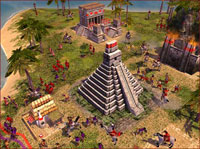
Game Concept The game is divided in 15 different epochs, where each epoch is a period of time in history that can date back to the prehistoric Stonehenge , where armies fight with sticks and stones, to the modern times of tanks and aircraft, to the futuristic era, where robots and machines dominate our war tasks. Users use the technology and military forces of the epoch they are in to try and cripple their opponents by destroying valuable infrastructure, kill their units and eventually wipe out their forces. |
 |
Gameplay
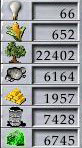
Players start on a terrain map on opposite sides with a basic civilian structure, the town center, 5 workers and the following resources:
 |
|
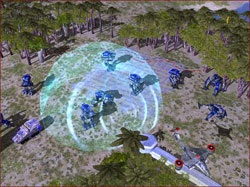
The map is divided into “territories”, with resources scattered all over these “territories”.
 |
Players are expected to gather more of these resources by building more workers. Doing so will allow the player more options to build other units, such as offensive or defensive units, which will result in a strong army that will repel invaders or even crush the enemy completely. Tech points must also be accumulated in form of building universities or temples so as to generate. The more of such structures built, the faster the rate of tech points earn. This is to simulate the amount of “research” your civilization has done. However, the catch is that only one of each of these buildings can be built on each territory. This means that to increase the amount of tech points earn, one must control enough territories to build such tech buildings. |
Also, when you gather enough tech points, you may also choose to upgrade your epoch to the next epoch, in which technological advantages will follow to help you improve all your units.
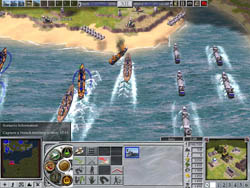
Storyline There is no general storyline in this game of epoch, because the gameplay actually allows the user to have a feel of “recreating history” itself. Also, each civilization chosen, be it English, French, German or even Chinese, has their own unique units: The British, their longbow-men, the Chinese their Dragon Archers, and the German Panzer, for example. However, the game actually has a few maps that seek to reconstruct actual battlescenes for players to have a feel of what was it like to fight such epic battle. One of such scenes is the battle of D-day, which turned the tide of the German invasion of WWII. Users can choose to defend the shore by playing the Germans, or brave the gunfire by choosing Allied forces. |
 |
Multiplayer support
Multiplayer is also possible in this game, and like all RTS game, is highly encouraged. There are 2 ways to connect multiplayer: online through the Internet, or local through a LAN. Multiplayer in Empire Earth 2 is generally smooth with hardly any jerks or interruption during game play.
Other Additional Characteristics of Empire Earth II
Tutorials to guide newbies
The tutorial is explains the concept of playing the RTS game slowly but surely. Each step from simple ones like moving a unit, assigning task to workers, to complex moves like resource gathering, unit combat, is carefully and thoroughly explained in the tutorial through an English-speaking narrator.
However the addition of subtitles in conjunction with the narrator might be better in helping many people to understand the lessons better as well as to remember them better.
Management of Resources is simpler and not too repetitive
In the past, RTS games have been criticized for been too much of a resource management game rather than a war game. This is because before the actually battles in RTS games, users need to build up a strong resource collection economy to support financially the huge cost of the war machines. This double role as a war planner as well as a resource manager can often cause users to divert unnecessary attention to either one side, leaving the other neglected. But because resources and war have such a strong interdependency, it is the user who can balance both that can untimately win the game.
To work around this problem, EE2 strives to automate the resource management, choosing instead to focus on the war:
Self automated production of workers
With the self-automated production button turned on, users can enable workers to be produced automatically as long as the resources permit. This will keep users minds off the production nitty-gritties and frees them to concentrate on the war zone while the number of workers increases and their economy continues to build up by itself.
Automatic redistribution of workers to resources that the user needs
No more looking for that lone worker to harvest that scarce resource. Now, the user would just have to click on the number of workers to work on harvesting that particular resource and the computer will automatically assign the desired number of workers to the resource.
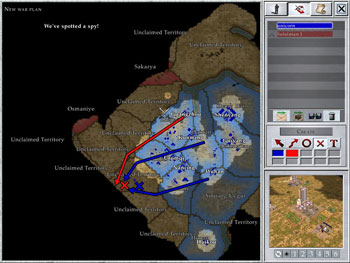
Game of Wit, not just skill In some of the early RTS games, speed of the mouse clicks, rather than wit, is often the winning factor to the game. Players with the fastest fingers first can enjoy the advantage of gathering resources better, building units faster and then, churn out a sizable force so quickly that the other party might not even know when defeat is imminent. In Empire Earth 2, because most of the unit creation can be automatically queued, or made to repeat production in continuous loops, this will mean that even the slowest user can create a huge army automatically and quickly, send them out to fight, and still return to see another equal size reinforcements waiting to be deployed. In this case, users' game play is quickly changed: users must use new tactics and strategy in order to reduce the enemies' force without sustaining too much damage themselves. |
 |
Varied Units, Varied Game Play
With 300 units that span from the most ancient war elephants to the modern Abram Tanks, war can be conducted with many different fashions with different strategies comprising of different types of units. Also, each unit can be given an option to upgrade itself up to three times, making it thrice as strong in firepower and armor. With such distinction in composition and strength within an army, users can employ a diverse range of tactics. Also, all units have their respective counter-units, following the rock-paper-scissors formula, so there is almost no single “winning strategy” existing in this game.
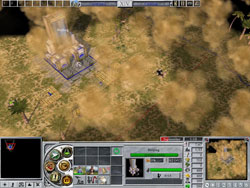 |
Game Environment/Texture Mappings/Lightings/Ambience True volumetric fog-of-war is employed for most of the weather effects, making it one of the most impressive climate-stimulated RTS games. Users can actually see the four seasons change during the course of the game, as well as weather effects, like rain, lightning, or even sandstorms. . |
| Also, this climate realism is not just for eye-candy, it will actually affect the game play as well: troops will travel slower in rainy or snowy conditions, but will fight better in sunny and dry days. This effect will force the user to consider the weather before launching any sort of campaign. | 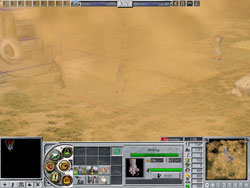 |
In-Game Music
The music is dependent on the civilization that the user chooses and strives to reflect the culture of the chosen civilization. For instance, for the Chinese, heavy Chinese Drum beats will be heard while for the Europeans, a soothing Classical Music will be played. The music is also composed in a way that will excite the user when as he/she progresses through the game, so that a feeling of tension can still be felt to keep the user in anticipation of any impending attack.
General Conclusion
Overall, the good game concept and design, coupled with the stunning artwork and game detail, making playing Empire Earth II a pleasurable and enjoyable experience. Users can actually imagine themselves as real generals conducting a battle on the field. In regards to resource management, though it is necessary to control and regulate logistics on the battlefield, it should not take up too much time and effort, which is the clear message that Mad Doc Software (The Makers of EE2) wants to convey to its audience. This direction is an easter egg to RTS players who welcome such changes as this will challenge players more in terms of tactics and strategy, rather than the "fastest fingers first" mentality.
On the other hand, though the climate and weather changes are welcomed and appreciated for its realistic appeal, its actual impact on the game itself is still a drop on the surface of the pond. Mad Doc can actually take this one step further by introducing some harsher penalties should players choose to fight in adverse climate conditions, for example, certain infantry can suffer damage from the cold if force to travel long distances, or planes can refuse to take off if the wind is too strong.
Still, most can agree that the main game play has not really changed since Empire Earth I, with unit upgrades, battle concepts and unit characteristic similar in feel. Replayablity of the game is now increased with the number of epoch increase to 14 - this will create more possiblities for gameplay as the technological advances and war units are more in variety and characteristics: doubling the fun.
Hardware Specifications
Recommended CPU/Processor |
2.2 GHz Intel® Pentium® 4 or AMD® Athlon™ or faster processor; |
Graphics Card |
NVIDIA® GeForce™ 4 or DirectX® 9.0c-compliant 128 MB 3D video card with hardware T&L and pixel shader support; |
RAM |
512 MB RAM or more |
Hard Disk Drive |
1.5 GB of uncompressed hard disk space |
O/S |
Microsoft® Windows® XP operating system |
CDROM |
24X or faster CD-ROM drive |
Sound Accesories |
DirectX®-compatible sound card and speakers or headphones; |
Internet Connection |
Broadband/LAN, DSL or faster Internet connection for online play |
