 |
| Japanese Aircraft |
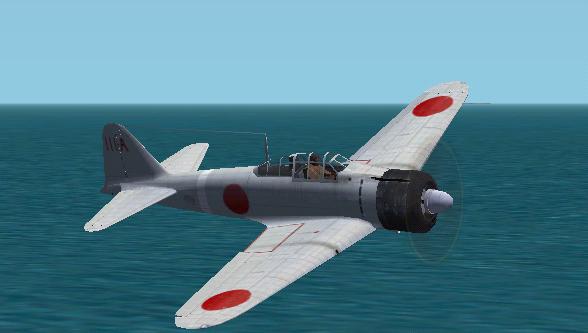
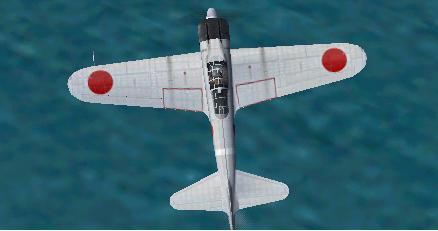
| Mitsubishi A6M2 (Model 21) Reisen (Type Zero Fighter) "Zeke" |
| Specs: Weight- 3,704 lb(Empty)/5,313 lb(fully loaded) Length- 29 feet 8.75 inches (9.0 meters) Wing Span- 39 feet 5 inches (12m) Engine- Nakajima NK1C Sakae 12 14-Cyl. Aircooler Radial (950 hp) Armament- two 7.7 mm (.303 cal) Type 97 machine guns with 500 r.p.g. on nose, and two 20mm Type 99 (Oerlikon) cannon with 60 r.p.g. in wings, plus two 66 lb (30 kg) or two 132 lb (60kg) bombs Max Speed @ Altitude- 288kts/331.5 mph (533.4 km/h) @ 14,930 ft (4,550 m) Ceiling- 32,810 ft (10,000 m) Initial Climb Rate- 4,517 ft (1,376m)/min Range- 1,160 mi (1.866km) at 132kts/152 mph; with drop tanks, 1,930mi (3,105km) |
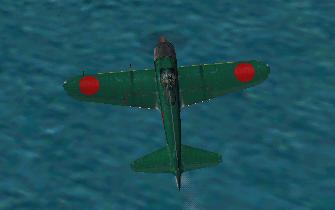
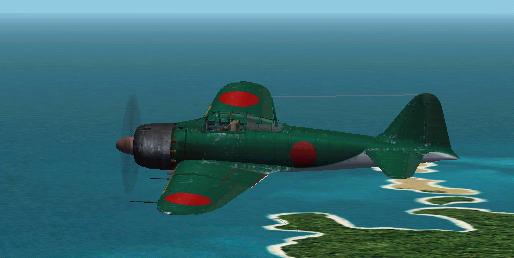
| Mitsubishi A6M5 (Model 52) Reisen (Type Zero Fighter) "Zeke" |
| Specs: Weight-4,136 (Empty)/ 6,025 (Fully Loaded) Length-29 feet 11 inch (9.1 meters) Wing Span- 36 feet 1 inch (11m) Engine-Nakajima NK1F Sakae 21 14-Cyl. Air Cooled Radial (1,130 hp) Armament- same as A6M2 Max Speed @ Altitude- 305 kts/351 mph (565 km/h) @ 19,685ft (6,000 m) Ceiling 38,520 ft (11,740 m) Initial climb rate- 3,159 ft (1,372m)/min Range- with drop tanks 1,194mi (1,921 km) |
| When the war began, the Zero gave enemy pilots a rude shock. No allied fighter could match the Zero's phenomenal maneuverability and climb, or its range. Some thought the Zero was invencible, but the Zero got its performance through light constructio-and a lack of armor and self sealing tanks. The Zero pilot learned to use the planes outstanding maneuverability to out turn and -in some cases- out-climb Allied aircraft. Even when the US introduced faster and more powerfull fighters, pilots could never underestimate the Zero- in the hands of a skilled pilot, it was always a dangerous adversary against any American fighter The Zero's lightly loaded, high-lift wing and low weight made it a dream to fly at sppeds below 250 mph, with a jaw dropping ability to execute the wildest gyrations and zoom climbs at the whim of its pilot. However, the Zero became hard to handle as its speed approached 300 mph. Although it could reach an altitude of more than 32,000 ft, its clinb rate and maneuverability fell off between 15,000 to 20,000 ft. Light weight, relatively low horsepower, and that high lift wing made the Zero a reluctant diver. Designed by the brilliant Jiro Horikoshi, the Zero got ite name from the Japanese Navy Air Force numbering system, based on the final digit of the year which the aircraft entered production. For the A6M, the year was 1940 (the year 2600 in the Japanese calender), so it was called the "Type 0 (Zero) fighter" |
| The Japanese Navy had started flying this improved version of the Zero in late 1943. Its added horsepower, speed and armament made it even more dangerous than the A6M2. Its slightly smaller, thicker skinned wing gave it better diveing qualities, but it still suffered from some of the A6M2's old problems. While slightly more maneuverable than a Hellcat at low speed, it was still lightly built and more vulnerable to battle damage than the Grumman. Despite these problems, the Zero could be very dangerous, especially if its pilot could draw his enemy into a turning fight below 15,000 ft. The zero remained in production and continued to evolve. Anyone who thinks a Zero was an easy kill had better think twice. |
| On to page 2 |
|
| Strengths -Excellent maneuverability up to 261 kts - Superior climb rate up to 15,000 ft - Very long range at low speeds |
| Weaknesses - Light construction, low survivability - No armor or self-sealing tanks - Poor dive characteristics |
 |
 |
 |
 |
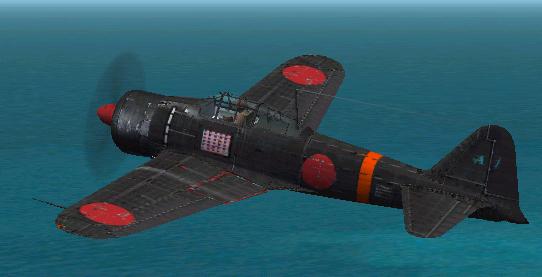 |
| A6M2 in black paint |
| For more info on Japanese planes please check out this site ---> |
 |