| Disappearances |
 |
| The novel Disappearances, written by Howard Frank Mosher is a story of a family living in Vermont just before the Prohibition. It is narrated by Wild Bill, the thirteen year old son of Quebec Bill. When spring doesn't come soon enough and the family runs short of hay to feed their animals, Quebec Bill decides that a whiskey smuggling adventure into Canada is the only way to make money. After convincing the mother, both father and son get into their canoe, one constructed by Wild Bill's grandfather, Rene Bonhomme. Not long into their trip, they decide to break. While having a rest, the two happen to see two monks also rowing their canoe downstream. Not long after, the two voyagers are hijacked by some outlaws headed by Carcajou. After meeting Wild Bill's Uncle Henry and another man named Rat Kinneson, the four of them cross over the border. A while later, the four of them stop at a place to rest and create a plan to steal whiskey from Carcajou. They then resort to a barn where Carcajou is staying and wait until the outlaws fall asleep. They then break in, steal 200 cases of whiskey, and set the place on fire. Using White Lightning, Uncle Henry's new car, they try their hardest to make it back to the lake with some cases of whiskey. This trip was difficult because Carcajou and his outlaws were chasing them but Wild Bill and his family made it back successfully. White Lightning was destroyed but Quebec Bill promised his brother in law that with the profit they would make, he would purchase him a new car. At the lake is where fighting started to break out. Wild Bill and his crew were in their canoe when they began to get fired at. Carcajou had his cannons and guns and was firing at them. Wild Bill shot back and ended up hitting Carcajou but did not kill him. Trying to escape, the crew encountered difficulties with frozen water. The canoe ended up tipping over, spilling all of the whiskey into the water. But Quebec Bill saves some, going down and retrieving about 12 cases. Wild Bill and the crew continue on. A little while later, they encounter an old milk train. After asking the conductor to let them ride and receiving 'no' for an answer, they decide to hijack the train. They disguise their whiskey to be milk cartons, give whiskey to the conductor, and take over. Carcajou reappears, trying to get back at them once again, but once the train crashes, it falls off the tracks, into the water and onto Carcajou. The crew takes an old handcar to an old county monastery. There they are sheltered, fed, and bathed. They plan their next escape of Carcajou. As they are leaving, Wild Bill flags down a United States Border Patrol plane and it swerves down to pick up Wild Bill and his injured father. Quebec and Wild Bill take off in the plane. They fly until they run out of gas and end up crashing out in the middle of nowehere. The two begin their next adventure and that is to get home safely. They make it a few miles before they once again encounter Carcajou. Wild Bill gets into another bout with him and ends up finally killing him by taking his axe to Carcajou's head. They battle the last blizzard of the winter and eventually make it home. Throughout this novel, the reader is reminded of the family's past and the disappearances in the family. |
| SUMMARY |
| BIOGRAPHY OF: Howard Frank Mosher |
| Review of the text: |

|
   |
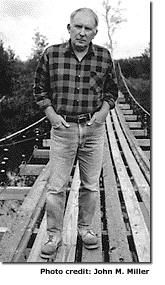
| Howard Frank Mosher is an author of seven novels including The Fall of The Year and Northern Borders. He writes most of his books based on his experiences, the life of where he lives, and about where he lives. Howard still lives in the area. He resides in Irasburg, Vermont with his wife and two children. |
| (Howard Frank Mosher) |
| The novel, Disappearances, is a very well written novel. The author, Howard Frank Mosher, uses good elements in writing the text but there are also some weaknesses in it. Mosher has many strengths in this piece. His use of vocabulary adequately describes the characters, setting, and actions that are taking place. The vocabulary gives the reader amazing insight as to what is going on and makes it feel like you are a character in the novel yourself. He uses actual places in the novel that allows readers such as myself to feel like they know where they are. That also attracts the reader into the novel. The actions that take place are so intriguing and suspenseful and they make for a very exciting novel. Despite the strengths of the novel, there are some weaknesses. Mosher bounces the time of the setting all around in the novel and confuses the reader. He has the person telling the story explaining about the trip and then refers to thirty years after that and then the novel is back before the trip. The skipping around makes the reader stressed trying to figure out what is actually happening. There is also a lot of useless information in this novel. Some of the stories that Quebec Bill tells Wild Bill are not necessary and could easily be omitted from the text. Some are significant in the mystery of the disappearances in his heritage but some could be left out. Besides those two things, the novel was all around very exciting to read. The strengths of the novel outweigh the weaknesses. This novel received many good reviews but isn't very popular. I would reccommend this novel to people who enjoy excitement with a balance of nature and setting. This is extremely interesting to people who live near the Vermont border with Canada because all of the locations have been heard of and the reader is able to think in their minds where it is actually taking place. The rating I would give would be an eight out of ten. Minus the extra information on the past and that would be a nine. Disappearances is a well written novel and is full of suspence. |
| BACKGROUND INFORMATION ON: The Prohibition Era |
| This novel is set along the Vermont and Canadien border in the early 1930's, just before the Prohibition was repealed. The Prohibition was a law that made the production, sale, and transportation of alcoholic beverages forbidden. People were aroused by this law and began smuggling whiskey more than ever. This law was repealed in December of 1933. Smuggling whiskey was not uncommon in this time period. This was something that many people did to make money for their family. It was very easy because the border was so close and it wasn't a difficult or rigorous task to bring it across. There was also a demand for the alcohol. Another factor in this smuggling was the low security at the border. This made it easier for the people who smuggled because it wasn't hard to hide the whiskey or get across the border. People began drinking in bars just because this law upsetted them. Gangs and fighting broke out everywhere as every person was against the act. This Prohibition Era helped in giving the nickname The Roaring Twenties to the decade. |
| By: Howard Frank Mosher |
| To purchase your copy of the novel: |
| Sources: 1)Huthmacher, J. Joseph. "Prohibition." World Book Encyclopedia 1979 ed. 2)Book Discussion Guide. Viewed 28 Dec. 2002. http://www.uua.org/re/reach/fall00/adult/stranger_in_the_kingdom.html 3)A Disappearing Eden. Viewed 28 Dec. 2002. http://www.theatlantic.com/unbound/ bookauth/hfmint.htm |