| Symbols |
 |
| The similarities of Feng Shui to Belandu Powercentering" are also very strong in this respect: the philosophy of creating an environment that is positive and productive and finding balances through Geomancy and symbols and interconnecting the symbols with the inhabitants of a dwelling and their outside environment - but that's where it ends. Belandu teaches that symbols interconnect through sounds of nature and all its inhabitants. It continues to teach that there is a synchronicity of living matter and because, there is one, one finds what is called "peaceful acceptance." There is no becoming one with earth but "one" with "one" --- one universal being within the being of reality we have created. It may sound to some very existentialist. Powercentering in a dwelling is synchronicity - finding the power source of what one creates within an environment be it positive or negative and once discovering, changing it or increasing it, or better still, acknowledging it. A powercenterer will help the person find his source and then ask what he wants to create within that source. The Powercenterer would never tell someone, they should move from their house, change bedrooms, energy cannot be changed or that there is no solution. It is entirely up to the interpretation and perception of what one is seeking. It is all within one's environment and within one's reach. |
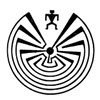
| Within North America symbols played an important role in defining a culture of spiritual beliefs for the indigenous people . It foretold the future, defined a community, marked the period to plant/harvest, increased fertility, improved prosperity and provided blessings from the Gods. Symbols changed after the colonization and tribal nations that adhered to a particular ideology and ritual - incorporated their beliefs and redefined them with other Tribal Nations. The Tohono O'odham Nation of Southern Arizona has the symbol of the 'man in the maze' This symbol represents life's journies but it also represents the symbol of the circle which represents completion and the search of finding that completion. |
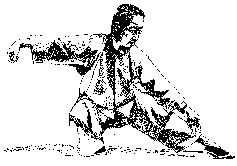
Belandu is an all-encompassing lifestyle that acknowledges that reality is created by oneself and the only weakness or strength is governed by one's humaness. Being human encompasses strengths and fraigilty and through human emotions lifes path is etched into a cycle of self awareness - and the definition of what is reality and what isn't. I have discovered that the philosophy of Belandu is similar to Daoism. I hadn't realised how close Belandu was to Daoism until I met a Daoist monk. We sat talking for hours - during our discussion he kept comparing Belandu to Daoism shouting "that's Daoism!" and I would shout back "that's Belandu!" It became quite comical actually as we both eyed each other and then bowed in mutual respect. There are theories that many of the Native American Indian beliefs were the direct influence of the Chinese but it's yet to be confirmed. I understand that recent discoveries show that the Chinese influence dates as far back as the 12th and 15th century and this may substantiate their claim that the Chinese might have been in the Americas before the Europeans. This naturally has lead to a great deal of controversy. Tai-Chi There are also other similarities of Belandu to Tai-chi. There is an exercise that I do everyday called the 'tree.' The movement is circular and concentrates on the waist along with sweeping movements of the arms. |
| SHAMANISM: There is a part of shamanistic ritual in Belandu "powercentering" similar to those in Feng Shui, eg; both use incense or smoke, chanting and drumming. But the similarities end again - Belandu suggests all possibilities and does not specify that "only"statues, coins, chimes or specific colours promote prosperity. |
 |
 |
| Power Centering |
 |
|
| Daoism - Belandu |
| Feng Shui |
| / |
| The majority of the tribal nations believed in the symbol of the circle and had utlized various other symbols to represent a similar meaning. |